
Many English learners confuse are and our because they can sound similar when people speak quickly. However, these two words have completely different meanings and jobs in a sentence.
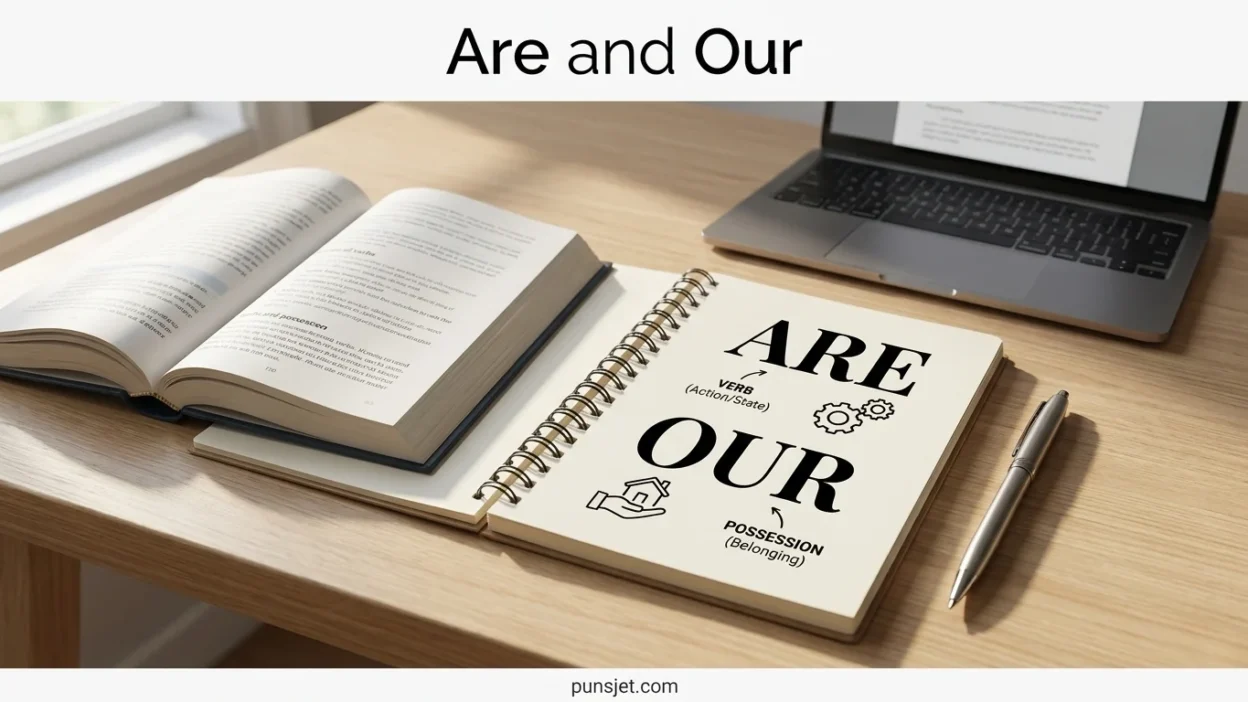
Are is a form of the verb be. It is used to talk about people or things, especially with you, we, they, and plural nouns.
Our is a possessive word. It shows that something belongs to us or is connected with us.
Once you understand what each word means, the difference becomes much easier to remember.
Quick Answer: Are vs. Our
Here is the simple answer:
- Are is a verb.
- Are is a form of the verb be.
- We use are with you, we, they, and plural nouns.
- Our shows that something belongs to or is connected with us.
- Our usually comes before a noun.
- Are can be followed by an adjective, noun, place, or other information.
- Our cannot normally be used as a verb.
Simple examples
- We are happy.
- They are students.
- You are my friend.
- This is our house.
- Our teacher is kind.
- We love our family.
A useful trick is:
What Does “Are” Mean?
Are is a form of the verb be.
We use it to describe people or things, tell where someone or something is, or talk about a condition or situation.
For example:
- You are tired.
- We are ready.
- They are at school.
- The books are on the table.
- My friends are happy.
In these sentences, are connects the subject with information about it.
“Are” with different subjects
We commonly use are with:
- You
- We
- They
- Plural nouns
Examples:
- You are very helpful.
- We are students.
- They are outside.
- The children are playing.
- My parents are at home.
Remember that are is related to the verb be.
The verb be can appear in different forms:
- I am
- You are
- He is
- She is
- It is
- We are
- They are
So, when you see are, think about the verb be.
What Does “Our” Mean?
Our is a possessive word. It tells us that something belongs to us or is connected to us.
It is usually used before a noun.
Examples:
- This is our car.
- That is our school.
- We cleaned our room.
- They visited our house.
- Our teacher gave us homework.
In the sentence “This is our car,” the word our tells us who the car belongs to.
The car belongs to us.
More examples with “our”
- Our family lives here.
- Our team won the game.
- Our dog is very friendly.
- Our English class starts at nine.
- We finished our work.
- Please bring our books.
A simple way to remember our is:
Are and Our: The Main Difference
The biggest difference is their job in a sentence.
Are tells us something about a person or thing. It works as a verb.
Our tells us who something belongs to. It works as a possessive word.
Compare these sentences:
- We are happy.
- We love our home.
In the first sentence, are tells us about our condition.
In the second sentence, our tells us that the home belongs to us.
Another comparison
- They are students.
- They brought our books.
Here, are connects “they” with “students.”
But our tells us that the books belong to us.
Are vs. Our Comparison Table
| Word | Meaning | Job | Usually Used With | Example |
|---|---|---|---|---|
| are | A form of “be” | Verb | You, we, they, plural nouns | They are ready. |
| our | Belonging to us | Possessive word | A noun | This is our house. |
Another easy way to see the difference:
| If you mean… | Use |
|---|---|
| “be” | are |
| “belonging to us” | our |
| “We are…” | are |
| “belonging to us” before a noun | our |
When Should You Use “Are”?
Use are when you need a form of the verb be.
1. With “you”
- You are kind.
- You are late.
- You are ready.
2. With “we”
- We are friends.
- We are busy.
- We are at home.
3. With “they”
- They are happy.
- They are outside.
- They are teachers.
4. With plural nouns
- The students are ready.
- The flowers are beautiful.
- My friends are here.
You can often test the sentence by replacing are with another form of be, such as am or is. If the sentence needs a verb, are may be the correct choice.
When Should You Use “Our”?
Use our when you want to show that something belongs to or is connected with us.
It normally comes before a noun.
Examples:
- Our house is large.
- Our teacher is friendly.
- Our school is nearby.
- Our parents are proud of us.
- We finished our project.
Notice that our usually has a noun after it:
- our car
- our home
- our teacher
- our friends
- our school
- our idea
This makes our easier to recognize.
Common Mistakes With Are and Our
Because the words can sound similar, people sometimes choose the wrong spelling.
Mistake 1: Using “our” instead of “are”
Incorrect:
- We our happy.
Correct:
- We are happy.
Why? Because the sentence needs a verb. Are is the correct form of be.
Mistake 2: Using “are” instead of “our”
Incorrect:
- This is are house.
Correct:
- This is our house.
Why? The sentence needs a word showing possession. The house belongs to us, so we use our.
Mistake 3: Forgetting that “our” comes before a noun
Incorrect:
- This house is our.
Usually, this should be:
- This is our house.
Or:
- This house is ours.
This is an important difference between our and ours. Our normally comes before a noun, while ours can stand alone.
Are and Our in Everyday English
You can find both words everywhere in everyday communication.
In emails
- We are happy to help.
- Thank you for contacting our team.
- We are checking our records.
- Our office will contact you soon.
In school
- We are ready for the test.
- Our teacher explained the lesson.
- They are in our classroom.
- Our books are on the desk.
In social media
People may write:
- We are excited!
- Check out our new video.
- These are our favorite photos.
- We love our followers.
In daily conversation
- Where are you?
- We are almost there.
- Where is our car?
- Our food is ready.
- They are waiting for us.
These examples show how different the two words are even though their sounds may sometimes be confusing.
A Simple Trick to Remember Are and Our
Try this easy memory trick:
ARE = BE
When you can think of be, choose are.
- We are tired.
- They are ready.
- You are correct.
OUR = US
When you mean something belongs to us, choose our.
- Our house
- Our family
- Our school
- Our friends
So remember:
ARE → BE
OUR → US
This simple connection can help you choose the correct word quickly.
A Short Learning Exercise
Try choosing are or our in each sentence.
- We ___ ready to leave.
- This is ___ classroom.
- They ___ my friends.
- ___ parents are at home.
- You ___ very kind.
- We love ___ new teacher.
- The children ___ outside.
- Where ___ your books?
Answers
- We are ready to leave.
- This is our classroom.
- They are my friends.
- Our parents are at home.
- You are very kind.
- We love our new teacher.
- The children are outside.
- Where are your books?
When practicing, ask yourself two questions:
Does the sentence need a verb?
→ Use are.
Does the sentence show something belongs to us?
→ Use our.
Are and Our Pronunciation
Another reason learners confuse these words is pronunciation.
In many accents, are and our can sound similar, especially when people speak quickly. However, their pronunciation can vary depending on the speaker’s accent and the sentence.
This is why it is better to learn their meaning and grammar, rather than depending only on sound.
When writing, always think about the meaning:
- are = a form of be
- our = belonging to us
This will help you avoid spelling mistakes even when the words sound alike.
FAQs:
1. What is the difference between are and our?
Are is a form of the verb be. Our shows that something belongs to or is connected with us.
- We are happy.
- This is our home.
2. Is “are” a verb?
Yes. Are is a form of the verb be.
For example:
- They are tired.
- We are students.
3. Is “our” a verb?
No. Our is a possessive word. It shows that something belongs to us.
- Our house is blue.
- Our teacher is helpful.
4. Can “our” be used without a noun?
Usually, our comes before a noun.
- Our car
- Our school
- Our family
If you want the possessive word to stand alone, use ours.
- This car is ours.
5. Why do are and our sound similar?
They can sound similar in some accents, especially during fast speech. This can make them difficult for English learners. Their meanings and grammar, however, are completely different.
6. Which is correct: “We are family” or “We our family”?
The correct sentence is “We are family.”
Here, are is needed as the verb.
7. Which is correct: “Our friends are here” or “Are friends are here”?
The correct sentence is “Our friends are here.”
Our shows that the friends are connected with us, while are is the verb.
8. What is the easiest way to remember them?
Remember:
Are = be
Our = belonging to us
If you can replace the word with a form of be, you probably need are. If you are showing that something belongs to us, you probably need our.
Conclusion
The difference between are and our is simple once you focus on their jobs.
Are is a verb and a form of be. We use it with you, we, they, and plural nouns.
- You are ready.
- We are friends.
- They are happy.
Our shows possession or connection with us. It usually comes before a noun.
- Our house
- Our school
- Our family
- Our teacher
The easiest rule to remember is:
Even though are and our may sound similar in some forms of spoken English, they should never be confused when writing. Look at what the sentence needs, think about the meaning, and choosing the correct word will become much easier with practice.