Have you ever wondered whether to write cocoon or cacoon? These two words look similar, so it is easy to feel unsure about which spelling is correct. If you are writing about butterflies, insects, or their life cycles, choosing the right word is important.
The correct spelling is cocoon. It refers to a protective covering made by certain insects around themselves during a stage of development. The word is commonly used when discussing moths, silkworms, and insect life cycles. On the other hand, cacoon is a misspelling of cocoon in standard English. Although people may type it by mistake because of the way the word sounds, it is not the accepted spelling for the protective covering.
In this guide, you will learn the meaning of cocoon, understand why cacoon is incorrect, and see how to use the correct word in everyday writing. Simple examples and helpful memory tips will make it easier to remember the right spelling.
Quick Answer
Cocoon is the correct spelling in standard English. It means a protective covering made by certain insects, such as moths, during development. Cacoon is a spelling mistake when used with this meaning. Remember the spelling with the letter o after the first c: c-o-c-o-o-n.
Why Do People Confuse Cocoon and Cacoon?
People often confuse these spellings because they sound similar when spoken. When someone hears the word without seeing it written, the vowel sounds may not make the correct spelling obvious.
Another reason is that English spelling does not always match pronunciation perfectly. People sometimes replace an unfamiliar letter with one that seems more natural to them. This can lead to the incorrect spelling cacoon.
The word cocoon is also less common in everyday conversation than words such as house, tree, or animal. Someone who has not read it often may find it difficult to remember.
Here is the main difference:
- Cocoon: The correct spelling of the word.
- Cacoon: An incorrect spelling when referring to an insect’s protective covering.
What Does Cocoon Mean?
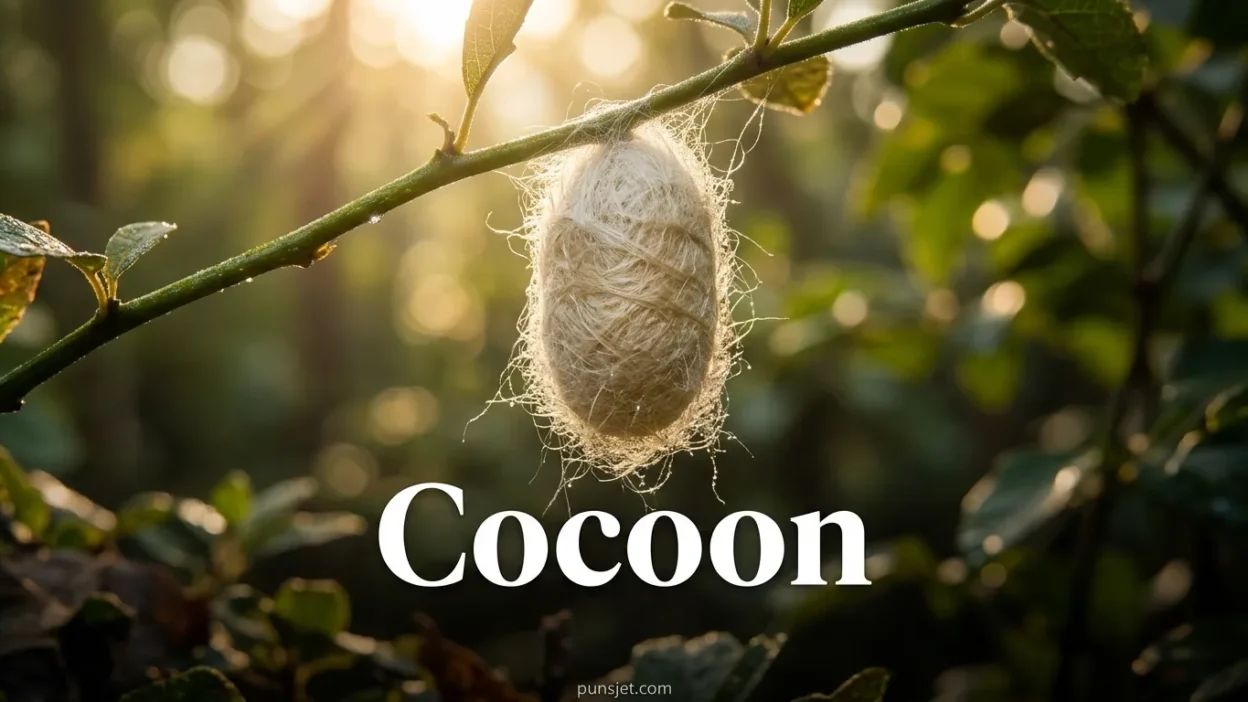
A cocoon is a protective covering that certain insects create around themselves during a stage of their life cycle. It may be made from silk or other materials produced by the insect.
Cocoons are often associated with moths and silkworms. They help protect the developing insect while it changes into its adult form.
For example:
- The silkworm spun a cocoon around itself.
- The child watched a moth emerge from its cocoon.
- The cocoon was attached to a small branch.
The word can also be used figuratively. A person might describe a quiet room as a cocoon because it provides comfort, warmth, or protection from the outside world.
For example: She wrapped herself in a blanket and created a cozy cocoon on the sofa.
In this sentence, cocoon does not refer to an insect. It describes a comfortable and protected feeling.
What Does Cacoon Mean?
Cacoon is not the standard spelling of the word used for an insect’s protective covering. In ordinary English writing, it should be corrected to cocoon.
For example:
Incorrect: The caterpillar formed a cacoon.
Correct: The caterpillar formed a cocoon.
Incorrect: We watched the butterfly emerge from its cacoon.
Correct: We watched the moth emerge from its cocoon.
If you see cacoon in a school assignment, article, email, or other piece of writing, check whether the writer intended to use cocoon.
Cocoon vs Cacoon: Comparison Table
| Feature | Cocoon | Cacoon |
|---|---|---|
| Spelling status | Correct | Incorrect for the intended meaning |
| Part of speech | Noun; sometimes a verb | Not the standard spelling |
| Meaning | A protective covering made by certain insects | No standard meaning as a variant of cocoon |
| Common use | Science, nature, everyday writing | Usually a spelling error |
| Example | The moth rested inside its cocoon. | The moth rested inside its cacoon. |
| Suitable for formal writing | Yes | No, when cocoon is intended |
When Should You Use Cocoon or Cacoon?
Use cocoon whenever you are talking about the protective covering associated with certain insects or using the word to describe a feeling of comfort and protection.
Use the following examples as a guide:
- In science writing: The insect developed inside a cocoon.
- In schoolwork: The students learned how silkworms make cocoons.
- In nature descriptions: A small cocoon hung from a branch.
- In creative writing: The warm room felt like a cocoon.
- In everyday conversation: He stayed in his cozy cocoon all weekend.
Do not use cacoon as an alternative spelling. If your spelling checker highlights it, replace it with cocoon when that is the word you mean.
12 Examples of Cocoon in Sentences
These sentences show how to use cocoon correctly in different situations.
- The silkworm began spinning a cocoon around itself.
- A small cocoon hung from the tree branch.
- The student drew a picture of a cocoon for science class.
- We learned how a moth develops inside its cocoon.
- The cocoon was difficult to see among the leaves.
- The teacher explained the purpose of a cocoon.
- A researcher carefully examined the insect’s cocoon.
- The children watched a video about how a moth emerges from its cocoon.
- She wrapped herself in a blanket and made a cozy cocoon.
- The quiet bedroom felt like a peaceful cocoon away from the busy world.
- He created a small cocoon of warmth with pillows and blankets.
- The writer used the word cocoon to describe a place of safety and comfort.
Notice that cocoon can describe both a real insect covering and, in a figurative sense, a protected or comfortable environment.
Common Mistakes When Using Cocoon and Cacoon
Here are some mistakes to avoid.
1. Writing cacoon instead of cocoon
Incorrect: The insect built a cacoon.
Correct: The insect built a cocoon.
2. Thinking both spellings are acceptable
Cacoon is not a standard alternative spelling of cocoon. Use cocoon in formal and informal writing.
3. Forgetting the double o near the end
The correct spelling is c-o-c-o-o-n. Pay attention to the two consecutive o’s before the final n.
4. Confusing a cocoon with a chrysalis
These terms are related but not identical. A cocoon is a protective covering made by certain insects, often moths. A chrysalis is the pupal stage of a butterfly. Butterfly pupae are generally not enclosed in a silk cocoon.
5. Assuming every caterpillar makes a cocoon
Different insects have different life cycles. Some caterpillars make cocoons, while butterflies generally form chrysalises.
Memory Trick: How to Remember Cocoon
Use this simple trick to remember the correct spelling:
Cocoon has two c’s and three o’s.
Break it into letters:
C – O – C – O – O – N
Think of the two o’s together near the end as a little enclosed space. This can remind you of the protective covering that a cocoon provides.
You can also remember this short sentence:
“A moth rests in a cocoon, not a cacoon.”
Repeat it a few times, and the correct spelling will become easier to recognize.
American vs British English: Cocoon or Cacoon
There is no spelling difference between American and British English for this word.
| English variety | Correct spelling | Incorrect spelling |
|---|---|---|
| American English | Cocoon | Cacoon |
| British English | Cocoon | Cacoon |
| Canadian English | Cocoon | Cacoon |
| Australian English | Cocoon | Cacoon |
Whether you are writing for an American, British, Canadian, or Australian audience, use cocoon.
Some English words have different spellings across countries, such as color and colour. Cocoon is not one of them.
Similar Words You Should Know
Learning a few related words can help you understand cocoon more clearly.
1. Chrysalis
A chrysalis is the pupal stage of a butterfly. It is the stage during which the caterpillar transforms into an adult butterfly.
Example: The butterfly developed inside its chrysalis.
2. Pupa
A pupa is a developmental stage between the larva and adult in insects that undergo complete metamorphosis.
Example: The insect remained in the pupa stage before becoming an adult.
3. Caterpillar
A caterpillar is the larval stage of a butterfly or moth.
Example: The caterpillar ate leaves before entering the next stage of development.
4. Silk
Silk is a fine fiber produced by certain insects and other organisms. Some insects use silk to create cocoons.
Example: The silkworm produced silk to build its cocoon.
5. Cocooning
Cocooning describes the act of staying in a comfortable, protected space, often away from outside activities. It can also refer to the process of making or being enclosed in a cocoon.
Example: She spent the rainy afternoon cocooning at home.
6. Metamorphosis
Metamorphosis is a major change in an animal’s body as it develops from one life stage to another.
Example: A butterfly undergoes metamorphosis during its life cycle.
FAQs:
1. Is cocoon or cacoon correct?
Cocoon is correct. Cacoon is a misspelling when referring to the protective covering made by certain insects.
2. What is the meaning of cocoon?
A cocoon is a protective covering made by certain insects during development. It is commonly associated with moths and silkworms.
3. Is cacoon a real English word?
Cacoon is not the standard spelling of the word for an insect’s protective covering. In ordinary writing, use cocoon instead.
4. How do you spell cocoon correctly?
Spell it C-O-C-O-O-N. The word begins with c-o, has another c-o, and ends with o-n.
5. Is cocoon spelled differently in American and British English?
No. Cocoon is the accepted spelling in both American and British English.
6. What is the difference between a cocoon and a chrysalis?
A cocoon is a protective covering produced by certain insects, often moths. A chrysalis is the pupal stage of a butterfly. A chrysalis is not simply another spelling or name for every type of cocoon.
7. Can cocoon be used in a sentence about comfort?
Yes. Cocoon can be used figuratively to describe a safe, warm, or comfortable place.
Example: The soft blankets made a cozy cocoon on the couch.
Remember This
- Cocoon is the correct spelling.
- Cacoon is incorrect when you mean an insect’s protective covering.
- A cocoon is often associated with moths and silkworms.
- Cocoon can also describe a comfortable, protected environment.
- American and British English use the same spelling.
Conclusion
Choosing between cocoon and cacoon is simple once you know the correct spelling. Cocoon is the standard English word for a protective covering made by certain insects. The spelling cacoon is a mistake when used to express this meaning. Learning the correct letter pattern will help you write more clearly and confidently.
Whenever you write about moths, silkworms, insect development, or a cozy place that feels safe and protected, remember to use cocoon. Practice the spelling with the examples in this guide, and you will be less likely to make the same mistake again.