Can and may are two common English words that often confuse students and English learners. Both can be used when talking about whether something is possible or when asking for permission. Because of this, people sometimes use them in the wrong situations.
For example, you may hear:
- Can I leave early?
- May I leave early?
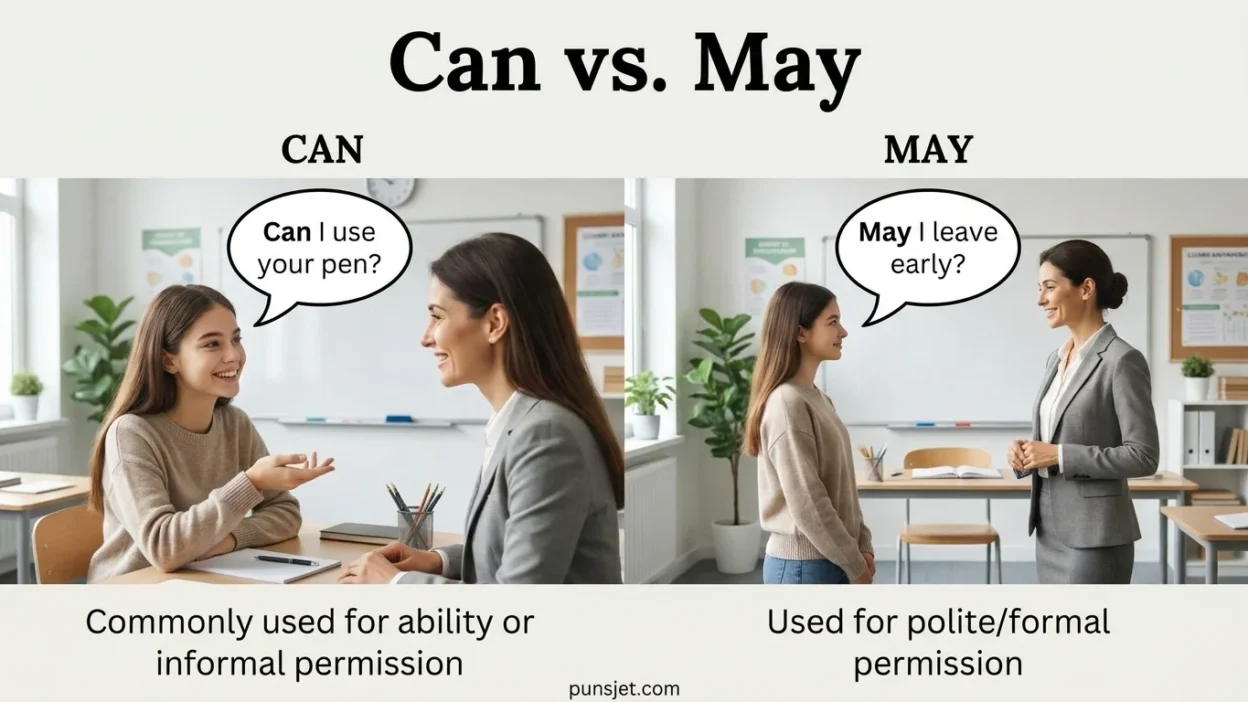
Both sentences ask for permission, but they have a slightly different feeling. Can is more common in everyday conversation, while may is often more formal or polite.
There is another important difference. Can can talk about ability, while may usually talks about possibility or permission.
Once you understand these main uses, choosing between can and may becomes much easier.
Quick Answer: Can vs. May
Here is the easiest way to remember the difference:
- Can usually means be able to do something.
- Can is also commonly used to ask for or give permission.
- May can mean that something is possible.
- May is also used to ask for or give permission, especially in formal situations.
- Can I…? sounds natural and common in everyday speech.
- May I…? sounds more formal and polite.
- Use can for physical or learned ability: I can swim.
- Use may for possibility: It may rain tonight.
Simple memory trick
Can = ability or common permission
May = possibility or formal permission
What Do “Can” and “May” Mean?
The Meaning of Can
Can is a modal verb. It is mainly used to talk about:
- Ability
- Permission
- General possibility
Can for ability
Use can when someone has the ability to do something.
Examples:
- I can swim.
- She can speak three languages.
- He can drive.
- We can solve this problem.
- My brother can play the guitar.
In these examples, can means is able to.
For example:
I can cook.
This means:
I am able to cook.
The Meaning of May
May is also a modal verb. It is commonly used for:
- Possibility
- Permission
May for possibility
Use may when something is possible but you are not sure it will happen.
Examples:
- It may rain tonight.
- Sarah may come later.
- The team may win the match.
- He may be at home.
- We may travel next month.
In these sentences, may means something is possible.
For example:
It may rain tomorrow.
You are not saying that rain will definitely happen. You are saying that rain is possible.
A Simple Background of Can and May
Both can and may have been used in English for a very long time.
The word can developed from an old English word connected with knowing or being able to do something. Over time, its use became strongly connected with ability.
The word may also comes from Old English. It was connected with having the power, opportunity, or permission to do something.
As English developed, both words gained several uses. This is one reason they can sometimes overlap.
Today, can is extremely common in everyday English. May is still widely used, especially when talking about possibility or when asking for permission in a more formal way.
Can vs. May: The Main Difference
The biggest difference is easy to understand if you look at their most common uses.
1. Can = Ability
When you want to say that someone is able to do something, use can.
- I can run fast.
- She can solve the puzzle.
- They can speak English.
- He can lift the box.
You normally would not use may to express this kind of ability.
Incorrect for ability:
I may swim.
This usually means swimming is possible or perhaps you will swim. It does not normally mean that you know how to swim.
Correct:
I can swim.
2. May = Possibility
Use may when something is possible.
- We may go to the park.
- She may be busy.
- It may snow tonight.
- The bus may arrive late.
Here, may shows uncertainty.
Compare:
She can come tomorrow.
This can mean she is able or available to come.
She may come tomorrow.
This means there is a possibility that she will come.
Can and May for Permission
This is where the two words can be confusing.
Both can be used to ask for permission.
Can I…?
Can I…? is very common in everyday English.
Examples:
- Can I use your phone?
- Can I sit here?
- Can I open the window?
- Can I leave now?
- Can I borrow your pen?
These sentences are natural and normal in modern conversation.
May I…?
May I…? is also correct, but it sounds more formal or polite.
Examples:
- May I come in?
- May I ask a question?
- May I use your computer?
- May I leave early?
- May I speak with you?
You may hear may I in classrooms, formal conversations, customer service, or polite requests.
Comparison Table: Can vs. May
| Point | Can | May |
|---|---|---|
| Main meaning | Ability | Possibility |
| Permission | Very common | Formal or polite |
| Ability example | I can swim. | Usually not used |
| Possibility example | It can happen. | It may happen. |
| Everyday requests | Very common | Less common |
| Formal requests | Possible | Very common |
| Certainty | Depends on context | Shows possibility |
| Example | Can I come in? | May I come in? |
Which One Should You Use and When?
Choosing between can and may becomes simple when you ask yourself what you want to say.
Use “Can” for Ability
If you mean “am/is/are able to,” use can.
- I can read.
- He can drive.
- We can help you.
- They can play football.
Easy test
Replace can with be able to.
She can dance.
→ She is able to dance.
If the meaning still works, can is probably the right choice.
Use “May” for Possibility
If you mean “perhaps” or “it is possible,” use may.
- He may call tonight.
- They may arrive late.
- I may visit my friend.
- It may be difficult.
Easy test
Replace may with perhaps.
She may come later.
→ Perhaps she will come later.
If that meaning works, may is a good choice.
Use “Can” for Everyday Permission
When talking with friends, family, classmates, or coworkers, can is natural.
- Can I borrow your book?
- Can I sit beside you?
- Can we watch this movie?
- Can I use your charger?
There is nothing wrong with these sentences.
Use “May” for Formal Permission
Use may when you want your request to sound more formal or respectful.
- May I enter the room?
- May I ask something?
- May I take a seat?
- May I leave the meeting early?
However, this does not mean can is always rude. In modern English, Can I…? is perfectly normal when asking permission.
Common Mistakes With Can and May
Mistake 1: Using “May” for Ability
Incorrect:
I may speak English.
If you mean you have the ability to speak English, say:
I can speak English.
Mistake 2: Thinking “Can I?” Is Always Wrong
Some learners are taught that “Can I?” is incorrect for permission.
That is an old-fashioned rule that does not match normal modern English usage.
Can I…? is widely used to ask for permission.
For example:
Can I borrow your pen?
is perfectly natural.
Mistake 3: Using “Can” When You Mean Possibility
Consider:
It can rain tonight.
This sentence can be correct in some contexts, but if you are simply predicting that rain is possible tonight, may is often clearer:
It may rain tonight.
Mistake 4: Confusing Ability With Permission
Look at these two sentences:
I can drive.
This means I have the ability to drive.
I can drive your car.
Depending on the context, this may mean I am allowed to drive it or that I am capable of doing so.
The surrounding situation tells us the exact meaning.
Everyday Examples of Can and May
In Daily Conversation
Friend: Can I use your phone?
You: Sure, you can.
Here, can is used for permission.
Another example:
I may go shopping later.
Here, may shows possibility.
In School
A student might say:
Can I go outside?
This is normal everyday English.
A more formal version is:
May I go outside?
A teacher might also say:
You may begin the test.
Here, may gives permission.
In Emails
In a casual email:
Can I send the document tomorrow?
In a formal email:
May I request an extension until Friday?
The second sentence has a more formal tone.
In News
News reports often use may to describe uncertain events.
For example:
The company may announce changes next week.
This tells readers that the changes are possible, but not certain.
On Social Media
People usually use can in casual posts and messages:
Can I ask you something?
Can we meet tomorrow?
They may use may when talking about possibilities:
This may be the best decision.
Can Also Talk About General Possibility
There is one more useful point.
Can can sometimes describe something that is generally possible.
Examples:
- Winters can be very cold here.
- Mistakes can happen.
- Too much sun can damage your skin.
- Learning a language can take time.
Here, can does not mean that something will definitely happen. It means it is possible in general.
Compare:
It can be dangerous.
This means it is sometimes dangerous or has the potential to be dangerous.
It may be dangerous.
This means it is possibly dangerous in this particular situation.
A Simple Learning Trick for Students
Remember these three questions:
1. Am I talking about ability?
Use CAN.
I can swim.
2. Am I talking about possibility?
Use MAY.
It may rain.
3. Am I asking for permission?
Usually use CAN in everyday conversation and MAY for a more formal or polite request.
Can I leave?
May I leave?
Both can be correct.
Easy formula
CAN → ability + everyday permission
MAY → possibility + formal permission
This simple formula will help you choose the right word in most situations.
FAQs:
1. Is “Can I?” correct for asking permission?
Yes. Can I…? is very common and correct in modern everyday English.
Example:
Can I use your laptop?
2. Is “May I?” more polite than “Can I?”
Usually, may I sounds more formal and polite.
For example:
May I speak with the manager?
sounds more formal than:
Can I speak with the manager?
Both can be correct.
3. Does “Can” mean ability?
Yes. This is one of its most important uses.
I can swim.
means:
I am able to swim.
4. Does “May” mean possibility?
Yes. May often shows that something is possible.
She may arrive late.
This means there is a possibility that she will arrive late.
5. Can “Can” show possibility?
Yes. Can can describe general possibility.
Accidents can happen.
This means accidents are possible in general.
6. Which is better: “Can I leave?” or “May I leave?”
Both are correct.
Can I leave? is natural in everyday conversation.
May I leave? sounds more formal or respectful.
7. Can I use “may” for ability?
Usually no, if you mean that someone knows how or is able to do something.
Say:
I can drive.
not:
I may drive.
The second sentence normally suggests possibility or permission, not ability.
8. How can I remember the difference?
Use this simple rule:
Can = ability
May = possibility
For permission, remember:
Can I…? = common and natural
May I…? = more formal and polite
Conclusion
Can and may have some similar uses, but their main meanings are different.
Use can when talking about ability:
I can swim.
Use may when talking about possibility:
It may rain.
Both words can also be used for permission. Can I…? is very common in everyday English, while May I…? sounds more formal and polite.
The easiest way to remember everything is:
- Can = ability
- May = possibility
- Can I…? = everyday permission
- May I…? = formal permission
Once you focus on whether you are talking about ability, possibility, or permission, the difference becomes much easier to understand.

Donald Andrew is the creative mind behind PunsJet.com, where he shares clever wordplay and humorous puns for readers around the world. With a passion for language and comedy, Donald enjoys crafting witty jokes that bring smiles to everyday conversations. His goal is to make humor simple, fun, and easy to share.