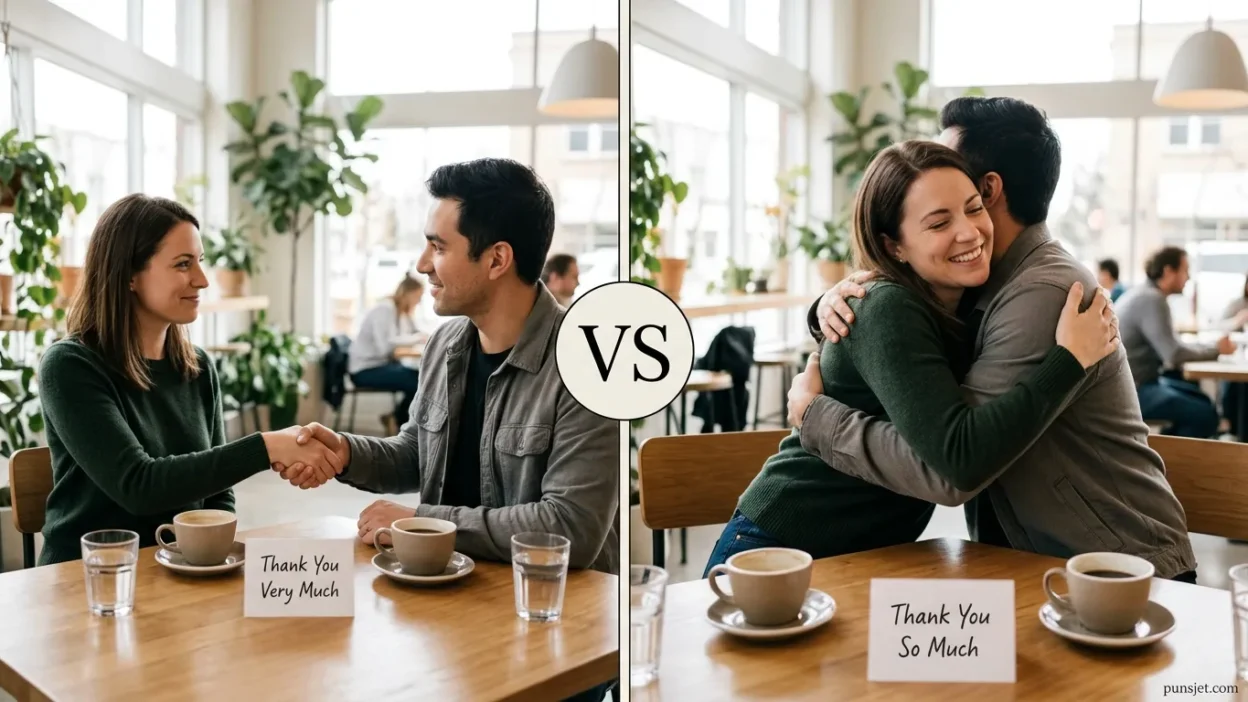
Have you ever wondered if to say “thank you very much” or “thank you so much” when someone does something kind for you? Both expressions are common ways to show gratitude in English. They tell someone that you appreciate their help, kindness, support, or generosity. However, there are small differences in their tone and how people use them.
The good news is that both phrases are grammatically correct, natural, and polite. “Thank you very much” often sounds a little more formal, traditional, or professional. On the other hand, “thank you so much” usually sounds warmer, friendlier, and more personal. You can use either phrase in everyday conversations, emails, messages, and professional situations. The best choice depends on the person you are speaking to, the situation, and the feeling you want to express. Let’s explore both expressions with simple explanations and practical examples.
Quick Answer
“Thank you very much” and “thank you so much” both express strong gratitude. The first often sounds slightly more formal and traditional, while the second feels warmer and more personal. Both are correct and can be used in casual conversations, professional emails, and everyday situations.
Why Do People Confuse Thank You Very Much and Thank You So Much?
People often confuse these expressions because they have almost the same meaning. Both communicate appreciation and tell someone that you are grateful for something they have done.
The confusion mainly comes from the words “very” and “so.” Both words add emphasis to the expression “thank you.”
For example:
- Thank you very much for your help.
- Thank you so much for your help.
Both sentences are correct. They express gratitude for someone’s assistance.
The difference is mostly about tone and personal preference, not grammar or meaning.
1. What Does Thank You Very Much Mean?
“Thank you very much” is a polite expression used to show that you are grateful for someone’s help, kindness, gift, or support.
The word “very” adds emphasis to your thanks. It makes your appreciation sound stronger than simply saying “thank you.”
It is commonly used in formal, professional, and everyday situations.
Examples:
- Thank you very much for your time.
- Thank you very much for helping me.
- Thank you very much for your kind words.
- Thank you very much for the invitation.
- Thank you very much for your support.
When Does Thank You Very Much Sound Natural?
This expression works especially well when you want to sound polite, respectful, and professional.
You can use it when:
- Thanking your teacher for explaining a lesson.
- Appreciating your manager’s help.
- Responding to a professional email.
- Thanking someone for an important favor.
- Showing appreciation to someone you do not know well.
Example:
“Thank you very much for considering my application. I appreciate your time.”
This sounds polite and professional.
2. What Does Thank You So Much Mean?
“Thank you so much” is an expression of gratitude that sounds warm, friendly, and heartfelt.
The word “so” adds strong emphasis and can make your appreciation feel more emotional or personal.
People commonly use it when someone gives them a gift, offers help, provides support, or does something thoughtful.
Examples:
- Thank you so much for the beautiful gift.
- Thank you so much for helping me today.
- Thank you so much for being there for me.
- Thank you so much for your kindness.
- Thank you so much for everything.
When Does Thank You So Much Sound Natural?
This phrase is especially useful when you want to express warmth and genuine appreciation.
You can use it when:
- A friend helps you with something.
- Someone gives you a thoughtful present.
- A family member supports you.
- A colleague does you a favor.
- Someone makes your day better.
Example:
“Thank you so much for helping me prepare for my exam. I really appreciate it!”
This sounds friendly, personal, and sincere.
Thank You Very Much vs Thank You So Much: Comparison Table
| Feature | Thank You Very Much | Thank You So Much |
|---|---|---|
| Meaning | Strong gratitude | Strong gratitude |
| Tone | Polite and respectful | Warm and friendly |
| Formality | Often slightly more formal | Often slightly more casual |
| Emotion | Appreciative | Often more heartfelt |
| Professional use | Very common | Also very common |
| Casual use | Yes | Yes |
| Grammar | Correct | Correct |
| Main purpose | Express thanks | Express thanks |
Important: These differences are general tendencies, not strict rules. Both expressions can sound formal, casual, sincere, or professional depending on your voice and the situation.
When Should You Use Each Expression?
Choosing between these phrases is easy when you understand the situation.
Use Thank You Very Much When:
Choose this expression when you want to sound polite, respectful, or slightly formal.
For example:
- In professional emails.
- When thanking a teacher.
- When speaking with customers.
- When receiving professional assistance.
- When thanking someone for their valuable time.
Example:
“Thank you very much for your quick response. I look forward to hearing from you.”
Use Thank You So Much When:
Choose this expression when you want to sound friendly, warm, or emotionally appreciative.
For example:
- When thanking friends.
- When receiving a thoughtful gift.
- When someone helps you personally.
- When expressing appreciation to family.
- When someone does something special for you.
Example:
“Thank you so much for remembering my birthday. That means a lot to me.”
Can You Use Both in Professional Communication?
Yes! Both phrases are acceptable in professional communication.
For example:
- Thank you very much for sharing the report.
- Thank you so much for your continued support.
Neither sentence is incorrect. Choose the one that matches the tone of your message.
12 Examples of Thank You Very Much vs Thank You So Much
Here are practical examples to help you understand how both expressions work in everyday English.
1. When Someone Helps You
- Thank you very much for helping me with my homework.
- Thank you so much for helping me with my homework.
2. When Receiving a Gift
- Thank you very much for this lovely gift.
- Thank you so much for this lovely gift.
3. In a Professional Email
- Thank you very much for your quick reply.
- Thank you so much for your quick reply.
4. When Someone Gives You Advice
- Thank you very much for your useful advice.
- Thank you so much for your useful advice.
5. When Someone Invites You
- Thank you very much for inviting me to your party.
- Thank you so much for inviting me to your party.
6. When Someone Supports You
- Thank you very much for your support during this difficult time.
- Thank you so much for supporting me during this difficult time.
7. When a Teacher Helps You
- Thank you very much for explaining this lesson.
- Thank you so much for explaining this lesson.
8. When Someone Gives You a Compliment
- Thank you very much for your kind words.
- Thank you so much for your kind words.
9. When Someone Offers You a Favor
- Thank you very much for offering to help.
- Thank you so much for offering to help.
10. When Someone Makes You Happy
- Thank you very much for making my day special.
- Thank you so much for making my day special.
11. When Someone Shares Information
- Thank you very much for sharing this information.
- Thank you so much for sharing this information.
12. When Someone Shows Kindness
- Thank you very much for your kindness.
- Thank you so much for your kindness.
In all these examples, both expressions are grammatically correct. The main difference is the feeling and tone they communicate.
Common Mistakes to Avoid
Although both expressions are easy to use, English learners sometimes make a few mistakes.
1. Saying Thank You Very So Much
Incorrect: Thank you very so much.
Correct: Thank you very much.
Correct: Thank you so much.
Do not combine “very” and “so” in this expression.
2. Saying Thank You Much
Incorrect: Thank you much.
Better: Thank you very much.
Better: Thank you so much.
In standard everyday English, use one of the complete expressions.
3. Thinking One Expression Is Always More Polite
Some learners believe that “thank you very much” is always more polite.
This is not true. Both expressions are polite. Your tone, words, and situation also affect how polite you sound.
4. Using the Wrong Word Order
Incorrect: Very thank you much.
Correct: Thank you very much.
Correct: Thank you so much.
Remember the correct word order.
5. Forgetting the Context
Both expressions are suitable in many situations, but your choice should match the feeling you want to communicate.
For example, “Thank you so much!” may sound more natural when a close friend gives you a thoughtful gift.
Memory Trick: How to Remember the Difference
Here is a simple trick to remember both expressions:
- Very = Polite: Think of professional emails, teachers, and formal conversations.
- So = Warm: Think of friends, family, gifts, and personal support.
Remember:
Thank you very much = Polite and respectful.
Thank you so much = Warm and heartfelt.
This is a helpful general guide, not a strict grammar rule. You can use both phrases in almost the same situations.
American vs British English: Is There a Difference?
There is no important grammatical difference between American and British English when using these expressions.
Both Americans and British English speakers commonly use “thank you very much” and “thank you so much.”
| Expression | American English | British English |
|---|---|---|
| Thank you very much | Common | Common |
| Thank you so much | Common | Common |
| Thanks a lot | Common | Common |
| Many thanks | Common | Common |
The main difference is personal speaking style and context, not regional grammar.
For example:
- American English: Thank you so much for your help!
- British English: Thank you very much for your help!
Both sound natural in either variety of English.
Similar Words and Expressions
English has several other expressions that you can use to show gratitude.
Here are some common alternatives:
| Expression | Meaning or Tone |
|---|---|
| Thank you | Simple and polite |
| Thanks a lot | Friendly and appreciative |
| Many thanks | Polite and slightly formal |
| Thanks so much | Warm and friendly |
| I really appreciate it | Sincere and personal |
| I am grateful | Heartfelt and sometimes formal |
| Much appreciated | Brief and professional |
| I cannot thank you enough | Very strong gratitude |
Examples:
- Thanks a lot for your help.
- I really appreciate your kindness.
- Many thanks for your assistance.
- I cannot thank you enough for everything.
These expressions help you communicate gratitude naturally without repeating the same phrase every time.
Final Verdict: Thank You Very Much or Thank You So Much?
Both “thank you very much” and “thank you so much” are correct English expressions.
The main difference is their usual tone:
- Use thank you very much when you want to sound polite, respectful, or slightly formal.
- Use thank you so much when you want to sound warm, friendly, and heartfelt.
However, these are preferences rather than fixed rules. You can use either expression in professional emails, casual conversations, and everyday communication.
If you are unsure which one to choose, do not worry. Both are natural ways to express gratitude.
FAQs:
1. Is Thank You Very Much or Thank You So Much More Correct?
Both expressions are equally correct. They follow standard English grammar and communicate gratitude. Your choice depends on your preferred tone and the situation.
2. Is Thank You So Much More Emotional Than Thank You Very Much?
It often sounds warmer and more personal. However, both phrases can express strong feelings of gratitude depending on your voice and the context.
3. Can I Use Thank You So Much in a Professional Email?
Yes. It is perfectly acceptable in professional emails, especially when thanking colleagues, clients, or coworkers for their help and support.
4. Is Thank You Very Much Too Formal?
No. It is polite and suitable for both formal and everyday situations. You can use it when speaking with teachers, coworkers, friends, or strangers.
5. Can I Say Thank You Very Much So Much?
No. This combination is grammatically incorrect. Use either “thank you very much” or “thank you so much.”
6. Is Thanks So Much the Same as Thank You So Much?
Yes. Both expressions communicate gratitude. “Thanks so much” is slightly shorter and often sounds more conversational.
7. What Is Another Way to Say Thank You Very Much?
You can say “I really appreciate it,” “many thanks,” “thanks a lot,” or “I am very grateful.” The best alternative depends on the situation.
Remember This
- Thank you very much is polite, respectful, and often slightly more formal.
- Thank you so much is warm, friendly, and often more personal.
- Both expressions are grammatically correct.
- Both work in professional and casual situations.
- Your tone and context matter more than the choice between “very” and “so.”
Conclusion
Understanding the difference between “thank you very much” and “thank you so much” is simple. Both expressions show appreciation and help you communicate politely in English. The first often sounds a little more formal, while the second usually feels warmer and more personal. Neither is wrong, and both are useful in everyday communication.
The next time someone helps you, gives you a gift, or does something kind, feel free to use either expression. Choose the one that feels natural for the moment. Most importantly, express your gratitude sincerely because a genuine thank-you can make someone feel valued and appreciated.

Emily Margaret is a writer and humor enthusiast at PunsJet.com. She enjoys creating clever puns and lighthearted content that entertains readers and adds a spark of humor to everyday life. With a love for wordplay and creativity, Emily aims to share fun, relatable jokes that make people smile and laugh.