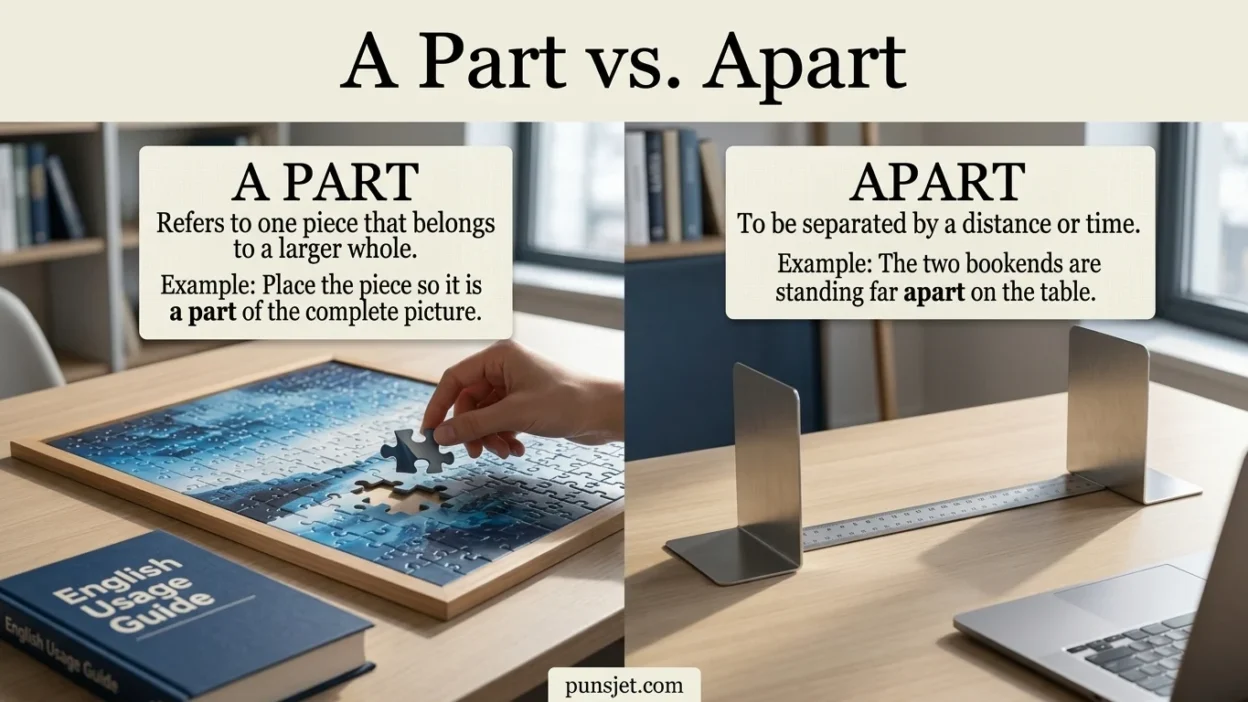
English has many words that sound similar but have completely different meanings. A part and apart are a good example. They look almost the same, but the small space between a and part changes the meaning.
This can be confusing for students, ESL learners, and even people who use English every day. The good news is that the difference is simple once you understand what each form means.
In this guide, we will explain a part vs. apart with simple definitions, examples, common mistakes, and easy ways to remember which one to use.
Quick Answer: A Part vs. Apart
Here is the easiest way to understand the difference:
- A part = one piece of something or one member of a group.
- Apart = separated, away from each other, or not together.
- A part has a space between a and part.
- Apart is written as one word.
- Use a part when you mean a piece, section, or member.
- Use apart when you mean separated or away from something or someone.
Simple examples
- I am a part of the school team.
→ I am one member of the team. - The two friends live far apart.
→ They live far away from each other. - This small piece is a part of the machine.
→ It is one piece of the machine. - Keep the two wires apart.
→ Keep them separated.
A simple trick is:
What Does “A Part” Mean?
A part is made of two words: a + part.
The word part means a piece, section, member, or portion of something. When you put a before it, a part means one piece or one section of something.
Examples
- This handle is a part of the door.
- She is a part of our team.
- I want to be a part of the project.
- He ate a part of the cake.
- This chapter is a part of the book.
In each sentence, a part refers to something that belongs to a larger whole.
“A part” can also mean a member
You can use a part when talking about being included in a group, activity, or situation.
For example:
I am proud to be a part of this community.
This means the speaker belongs to or is included in the community.
Another example:
She played a part in the success of the event.
Here, a part means she had some involvement in the event.
What Does “Apart” Mean?
Apart is one word.
It usually means separated, away from each other, or not together.
Examples
- The two houses are far apart.
- Please keep the children apart.
- They decided to live apart.
- The two pieces came apart.
- My shoes are still apart from the rest of my clothes.
When you see apart, think about distance or separation.
For example:
The twins sat apart.
This means the twins were not sitting together.
Apart can describe physical separation
You can use apart when two or more things are physically separated.
- The chairs were placed apart.
- The buildings are several meters apart.
- The two buttons are too far apart.
Apart can also describe relationships
Apart is not always about physical distance. It can also describe people who are no longer together.
For example:
The couple has been living apart for several months.
This means they are living separately.
You can also say:
Distance kept the two friends apart.
This means distance prevented them from being together.
A Part vs. Apart: The Main Difference
The biggest difference is their meaning.
A part means one piece, section, or member of something larger.
Apart means separate, away, or not together.
Compare these sentences:
She is a part of the team.
She is a member of the team.
She and her teammates stood apart.
They stood separately.
The two expressions may look similar, but they describe completely different ideas.
Comparison Table
| Expression | Meaning | Word Type | Example |
|---|---|---|---|
| a part | one piece or member of something | phrase | He is a part of our group. |
| apart | separated or away | adverb/adjective in some uses | The houses are far apart. |
| a part | a section of a whole | phrase | This is a part of the machine. |
| apart | not together | adverb | They decided to stay apart. |
A quick memory rule:
A part → belongs to something.
Apart → separated from something.
When Should You Use “A Part”?
Use a part when you can replace it with words such as:
- one piece
- one section
- one member
- one portion
- one element
Example 1
The engine is a part of the car.
You could say:
The engine is one piece of the car.
So a part is correct.
Example 2
Maria is a part of the team.
You could say:
Maria is one member of the team.
Again, a part is correct.
Example 3
This paragraph is a part of the article.
The paragraph is one section of the larger article.
When Should You Use “Apart”?
Use apart when you are talking about things or people being:
- separated
- distant
- away from each other
- not together
- divided
Example 1
The two schools are ten miles apart.
They are separated by ten miles.
Example 2
Please keep the dogs apart.
The dogs should not be together.
Example 3
The old chair fell apart.
Here, apart means the chair broke into separate pieces.
Example 4
We have been apart for a long time.
This means we have been separated or not together.
Common Mistakes With A Part and Apart
Because the expressions look almost identical, people often use the wrong form.
Mistake 1: Using “apart” for membership
Incorrect:
I am apart of the team.
Correct:
I am a part of the team.
Why? You mean that you are a member of the team.
Easy reminder
If you mean member of, use a part of.
Mistake 2: Writing “a part” when you mean separated
Incorrect:
The two houses are a part.
Correct:
The two houses are apart.
You are describing the distance or separation between the houses.
Mistake 3: Confusing “a part of” with “apart from”
These expressions can look especially confusing.
A part of
A part of means something belongs to or is included in something.
She is a part of the group.
Apart from
Apart from can mean except for or in addition to, depending on the sentence.
Apart from John, everyone came to the meeting.
Here, it means except for John.
So remember:
- a part of = included in something
- apart from = separate from, or except for
A Part vs. Apart in Everyday Life
These words appear in normal conversations, schoolwork, emails, news reports, and social media.
In school
I am a part of the school debate club.
This means you belong to the club.
The students sat apart during the test.
This means they sat separately.
At work
She played a part in completing the project.
She contributed to the project.
The two offices are located far apart.
The offices are separated by distance.
In emails
You might write:
I am happy to be a part of this project.
Or:
Please keep the files apart until we finish checking them.
In relationships
They wanted to remain a part of each other’s lives.
This means they wanted to continue having a place in each other’s lives.
But:
They decided to live apart.
This means they chose to live separately.
Easy Examples to Remember
Here are some short examples that make the difference clear:
A part
- This is a part of my plan.
- He is a part of our team.
- The wheel is a part of the bicycle.
- I want to be a part of the celebration.
- She played a part in the movie.
Apart
- The chairs are far apart.
- The children stood apart.
- The two buildings are miles apart.
- The box broke apart.
- They have been living apart.
A Simple Learning Trick
If you are unsure whether to use a part or apart, ask yourself one question:
Am I talking about a piece or member?
If yes, use a part.
He is a part of the team.
He is a member.
Am I talking about separation?
If yes, use apart.
The players stood apart.
They were separated.
This simple question can help you choose the correct form quickly.
For Students and Beginners
The easiest way to learn these words is to connect each one with a key idea.
A part = PIECE
Think:
a part = one piece of a bigger thing
Examples:
- a part of a car
- a part of a book
- a part of a team
- a part of a plan
Apart = SEPARATE
Think:
apart = not together
Examples:
- two people standing apart
- two houses far apart
- friends living apart
- pieces falling apart
Remember the space
There is also a useful visual clue:
A PART → has a space → think about one part of something.
APART → no space → think about things being separated.
FAQs:
1. Is “a part” two words?
Yes. A part is written as two words.
Example:
I am a part of the team.
2. Is “apart” one word?
Yes. Apart is written as one word.
Example:
The two friends live apart.
3. Is “apart of” correct?
Usually, no. If you mean that someone or something belongs to a group or whole, use a part of.
Correct:
She is a part of the team.
Not:
She is apart of the team.
4. Does “a part” mean a piece?
Yes. A part can mean one piece or section of something larger.
This wheel is a part of the machine.
5. Does “apart” mean separated?
Yes. Apart commonly means separated or away from each other.
The two houses are far apart.
6. Can “apart” be used for people?
Yes. It can describe people who are physically separated or who are no longer living together.
The friends sat apart.
7. Can “a part” describe a person?
Yes. It can mean that someone is a member of a group or involved in something.
Daniel is a part of our team.
8. What is the easiest way to remember the difference?
Remember:
A part = a piece or member.
Apart = separated or not together.
Final Conclusion
The difference between a part and apart is small in spelling but important in meaning.
A part is two words and means one piece, section, member, or portion of something larger.
I am a part of the team.
Apart is one word and means separated, distant, or not together.
The two teams stood apart.
When you are unsure, remember the two key words:
A part = PIECE
Apart = SEPARATE
Once you connect these two words with their meanings, choosing the correct form becomes much easier.

Donald Andrew is the creative mind behind PunsJet.com, where he shares clever wordplay and humorous puns for readers around the world. With a passion for language and comedy, Donald enjoys crafting witty jokes that bring smiles to everyday conversations. His goal is to make humor simple, fun, and easy to share.