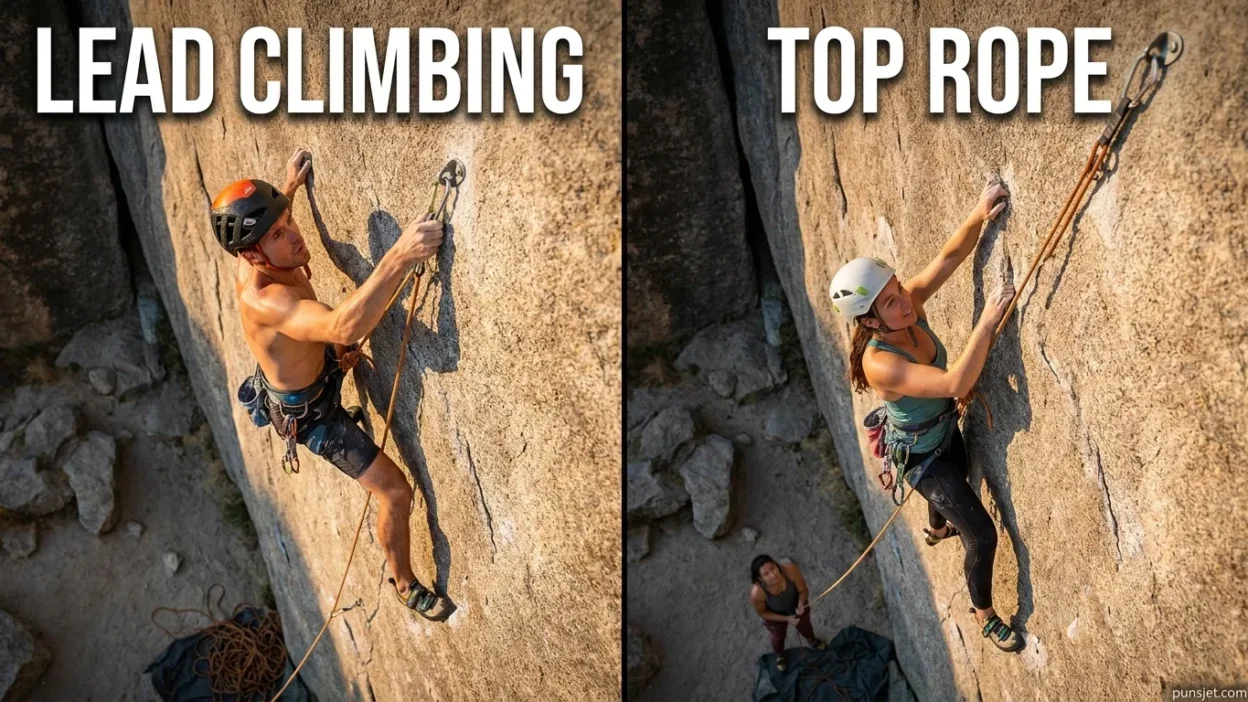
If you are new to rock climbing, you may wonder whether to learn lead climbing or top rope first. Both are popular climbing methods, but they work differently and require different skills. Choosing the right one can help you build confidence, learn proper techniques, and stay safer as you improve.
Top rope climbing is generally the best choice for beginners. It allows you to focus on footwork, balance, movement, and grip without managing a rope while climbing. Lead climbing is usually the next step because it requires additional skills, including clipping the rope into protection points, managing slack, and understanding fall risks. However, your best starting point also depends on your climbing goals, experience, and access to qualified instruction.
In this guide, you will learn the differences between lead climbing and top rope climbing, the benefits of each method, and how to decide which one to learn first. You will also discover common mistakes, practical examples, and answers to frequently asked questions so you can begin your climbing journey with a clear plan.
Quick Answer: Lead Climbing vs Top Rope
Learn top rope climbing first if you are a beginner. It provides a simpler way to practice climbing movements while a rope runs from your harness through an anchor above you. Lead climbing comes later, when you have developed solid movement skills and learned how to clip protection, manage rope slack, and handle falls with proper instruction.
Why Do People Confuse Lead Climbing and Top Rope?
People often confuse these two methods because both involve climbing a wall or rock face while connected to a rope. Both can be practiced indoors or outdoors, and both require suitable equipment, a climbing partner, and proper safety procedures.
The main difference is where the rope goes as the climber moves.
In top rope climbing, the rope passes through an anchor above the climber. In lead climbing, the climber takes the rope upward and clips it into protection points along the route.
These differences affect how you manage the rope, what skills you need, and how you prepare for a fall.
What Is Top Rope Climbing?
Top rope climbing is a method in which the rope runs from the belayer, through an anchor at the top of the route, and down to the climber. The belayer manages the rope as the climber moves upward.
When the climber falls or needs a rest, the belayer can take in the rope and help limit how far the climber descends, assuming the system is correctly set up and operated.
Why Is Top Rope Good for Beginners?
Top rope climbing lets beginners concentrate on basic climbing skills without needing to clip protection points during the ascent.
Its main benefits include:
- Easier learning: You can focus on movement and balance.
- Confidence building: You can practice climbing at your own pace.
- Movement practice: You can learn to use your feet instead of relying only on arm strength.
- Less rope management: You do not have to clip the rope into protection points as you climb.
- Flexible practice: You can repeat routes and work on difficult moves.
Top rope climbing is not risk-free. Incorrect belaying, poorly managed equipment, unsuitable anchors, and communication errors can still cause serious accidents.
What Skills Should You Learn First?
Before moving to more advanced climbing, work on these fundamentals:
- Choosing secure footholds.
- Maintaining balance and body position.
- Using your legs efficiently.
- Communicating clearly with your belayer.
- Understanding harnesses, knots, and basic climbing equipment.
- Learning how to check your equipment and belay system with a qualified instructor.
These skills create a strong foundation for lead climbing.
What Is Lead Climbing?
Lead climbing is a method in which the climber carries the rope upward and clips it into protection points as they climb. In a climbing gym, these points are usually quickdraws attached to bolts. Outdoors, the protection system depends on the route and climbing style.
The belayer feeds rope to the climber while keeping enough control to manage the system. If the climber falls, they may descend below the last clipped protection point before the rope catches them.
Why Is Lead Climbing More Challenging?
Lead climbing combines climbing movement with rope management and additional decisions.
Its main challenges include:
- Clipping: You must clip the rope correctly into each protection point.
- Rope control: You must work with your belayer to manage slack.
- Fall awareness: You need to understand where a fall may take you.
- Route planning: You must identify suitable clipping positions while moving.
- Mental control: You may need to manage fear and pressure at difficult sections.
Lead climbing can be exciting and rewarding, but it requires more preparation than simply learning to climb a wall.
Who Should Learn Lead Climbing?
Lead climbing is suitable for climbers who have a solid foundation in climbing movement and have received appropriate training in lead belaying, clipping, and fall management.
It is especially useful if you want to climb routes that are designed for leading, explore certain outdoor sport-climbing routes, or develop more advanced climbing skills.
You do not need to become an expert at top rope climbing before learning to lead. However, you should be comfortable with basic climbing techniques and meet the requirements of your instructor or climbing gym.
Lead Climbing vs Top Rope: Comparison Table
| Feature | Top Rope Climbing | Lead Climbing |
|---|---|---|
| Best starting point | Most beginners | Climbers with basic experience |
| Rope position | Runs through an overhead anchor | Climbers clip the rope into protection while ascending |
| Main focus | Movement and technique | Movement, clipping, and rope management |
| Equipment handling | Generally simpler | Requires additional clipping skills |
| Fall behavior | Usually shorter falls when correctly managed | Falls can be longer and may involve ledges or other hazards |
| Mental challenge | Often easier for beginners | Can involve greater fear and decision-making |
| Belayer’s role | Takes in rope as the climber ascends | Feeds and manages rope while monitoring the climber |
| Common setting | Indoor gyms and suitable outdoor routes | Indoor lead walls and outdoor lead routes |
| Learning curve | Usually gentler | Usually more demanding |
| Main advantage | Builds confidence and fundamentals | Develops advanced climbing skills and route options |
Neither method is automatically safe simply because of its design. Proper instruction, correct equipment use, route conditions, and careful partner checks are essential for both.
When Should You Choose Top Rope or Lead Climbing?
The right choice depends on your current experience and what you want to achieve.
Choose Top Rope If You Are a Beginner
Top rope is a sensible first choice if you have never climbed before or are still learning how to move efficiently on a wall.
For example, if you are visiting an indoor climbing gym for the first time, top rope climbing can help you practice foot placement, balance, and body positioning without also needing to manage lead clips.
It is also useful if you want to build confidence before trying more demanding climbing activities.
Choose Lead Climbing If You Have the Basics
Lead climbing may be your next step if you can climb comfortably, understand basic equipment, and are ready to learn additional rope skills.
For example, an indoor climber who regularly completes top rope routes might want to learn lead climbing to access routes that require clipping quickdraws.
Before leading, take a suitable course or receive instruction from a qualified professional. You should also learn to lead belay before belaying another lead climber.
Can You Learn Both at the Same Time?
You can begin learning about both methods early, but it is generally better to master the basic safety skills for one method before attempting the other.
You might learn how lead climbing works while practicing on top rope. However, understanding the theory is not the same as being ready to lead or lead belay independently.
Follow your instructor’s guidance and your climbing gym’s training requirements.
12 Examples of Lead Climbing vs Top Rope
These examples show when each method may be the more appropriate choice.
- First visit to a climbing gym: Top rope is usually the better starting point for a new climber.
- Learning basic footwork: Top rope allows you to focus on placing your feet accurately.
- Building confidence at height: Top rope can help you become more comfortable with climbing when correctly managed.
- Practicing a difficult move: Top rope lets you repeat a section without having to manage lead clips.
- Learning to use a climbing harness: Start with supervised instruction and the appropriate beginner climbing system.
- Preparing for sport climbing: Top rope can help build technique before you learn to lead.
- Clipping quickdraws: Lead climbing is the method that requires this skill during the ascent.
- Managing rope while moving: Lead climbing gives you practice coordinating movement and rope handling.
- Climbing a route with lead-only access: You need the appropriate lead-climbing skills and equipment.
- Training for an outdoor climbing trip: Your preparation should match the routes and protection systems you plan to use.
- Practicing with a new climbing partner: Both partners need suitable training and should check their equipment and communication.
- Moving beyond beginner routes: You may progress from top rope to lead climbing when your technique and safety skills are ready.
Remember that the examples describe general choices, not guarantees that a particular route or climbing situation is safe.
Common Mistakes When Choosing a Climbing Method
Beginners sometimes focus on the most exciting option instead of considering which skills they need to learn first.
1. Starting Lead Climbing Too Soon
Lead climbing requires more than physical strength. You need to learn clipping, rope management, and how to recognize potential fall hazards.
Better approach: Build your basic movement skills and receive practical lead-climbing instruction before trying it independently.
2. Thinking Top Rope Has No Risk
The overhead anchor does not remove every possible danger. Poor belaying, equipment problems, and mistakes during setup can still lead to serious injuries.
Better approach: Learn the correct procedures and complete partner checks every time.
3. Using Arm Strength for Every Move
Beginners often pull themselves upward with their arms and quickly become tired.
Better approach: Practice placing your feet carefully, keeping your body balanced, and using your legs effectively.
4. Confusing Climbing and Belaying Skills
Being able to climb a route does not automatically qualify you to belay someone else.
Better approach: Learn and demonstrate each skill separately under qualified supervision.
5. Moving to Lead Climbing Because Friends Do It
Your friends may have more experience or different training.
Better approach: Progress according to your own ability, confidence, and demonstrated safety skills.
Memory Trick: How to Remember the Difference
Use this simple reminder:
- Top rope = rope on top. The rope passes through an anchor above the climber.
- Lead climbing = lead the rope up. The climber takes the rope upward and clips it into protection along the route.
Think of top rope as a way to focus on climbing fundamentals and lead climbing as a method that adds rope-management skills to the challenge.
This memory trick explains the basic difference, but both methods still require training and proper equipment.
American vs British English
The terms lead climbing and top rope climbing are widely understood in both American and British English.
There is no major difference in their meaning between the two varieties of English.
Some spelling and vocabulary differences may appear in climbing-related materials. For example, American English commonly uses “practice” as both a noun and a verb, while British English uses “practice” as a noun and “practise” as a verb.
However, the climbing terms themselves remain essentially the same.
Similar Words and Related Climbing Terms
Understanding a few related terms can make climbing instructions easier to follow.
- Bouldering: Climbing shorter walls or rock formations without a rope, with suitable landing protection such as crash pads or padded flooring.
- Belaying: Managing a climbing rope to help protect a climber during a fall or descent.
- Lead belaying: Belaying a climber who is ascending and clipping protection points.
- Quickdraw: A piece of climbing equipment used to connect a rope to a protection point.
- Sport climbing: A style of climbing that generally uses fixed protection, such as bolts, along a route.
- Trad climbing: Traditional climbing, in which the leader places removable protection in cracks or other suitable features.
- Top rope anchor: An anchor positioned above a route through which the rope runs.
- Free climbing: Climbing by using your hands and feet for upward movement while using a rope and protection for safety rather than pulling on the equipment to ascend.
These terms describe different techniques, equipment, or climbing styles. They are related, but they are not interchangeable.
FAQs:
1. Is lead climbing harder than top rope?
Lead climbing is generally more demanding for beginners because it adds clipping, rope management, and fall awareness to the physical challenge of climbing. Top rope usually allows climbers to focus more directly on movement and technique.
2. Should beginners learn top rope before lead climbing?
Yes, top rope is generally recommended as a starting point for beginners. It helps build fundamental climbing skills before adding the extra responsibilities involved in lead climbing. A qualified instructor can help you decide when to progress.
3. How long should I practice top rope before learning to lead?
There is no fixed number of days or months. Your readiness depends on your climbing technique, equipment knowledge, belaying ability, and understanding of lead-climbing risks. Follow a structured course and demonstrate the required skills before leading independently.
4. Is top rope safer than lead climbing?
Top rope often involves shorter falls when the system is correctly set up and operated, but neither method is risk-free. Anchor problems, belaying errors, and equipment mistakes can cause serious accidents. Lead climbing also introduces additional fall hazards, such as hitting ledges or contacting the wall.
5. Can I learn lead climbing without learning top rope first?
It may be possible to learn lead climbing through a structured course without extensive prior top rope experience. However, you still need solid basic climbing skills and appropriate instruction in lead climbing, belaying, and fall management. Some gyms also require a top rope qualification first.
6. Do I need different equipment for lead climbing and top rope?
Both methods typically use a climbing harness, rope, belay device, and suitable connectors. Lead climbing also requires appropriate protection points and commonly quickdraws on sport routes. The exact equipment depends on the setting, route, and climbing system.
7. Can I practice lead climbing indoors before going outdoors?
Yes. An indoor climbing gym with a suitable lead wall is a good place to learn clipping, rope handling, and lead belaying under qualified supervision. Indoor practice can prepare you for some outdoor skills, but outdoor climbing introduces additional hazards that require separate knowledge and preparation.
Remember This
- Top rope climbing is generally the best place for beginners to start.
- Lead climbing adds clipping, rope management, and greater fall-related challenges.
- Both methods require proper training, equipment checks, and communication.
- Your next step should depend on your skills and readiness, not on how quickly other climbers progress.
Conclusion
Choosing between lead climbing and top rope climbing becomes easier when you understand what each method requires. Top rope is usually the best starting point because it lets you develop footwork, balance, and confidence while learning the basics of climbing safety. It gives beginners a practical foundation without requiring them to manage protection points during the ascent.
Lead climbing can be an exciting next step when you are ready for additional technical and mental challenges. Learn the correct techniques with qualified instruction, practice your skills, and take your time progressing. Whether your goal is indoor climbing, sport climbing, or outdoor adventures, building strong fundamentals will help you make better decisions and enjoy climbing with greater confidence.

Joshua Paul is a creative writer and contributor at PunsJet.com who enjoys crafting witty puns and clever wordplay. With a strong sense of humor and a love for language, he creates entertaining content that readers can easily share and enjoy. Joshua’s goal is to spread laughter through fun and memorable jokes.