
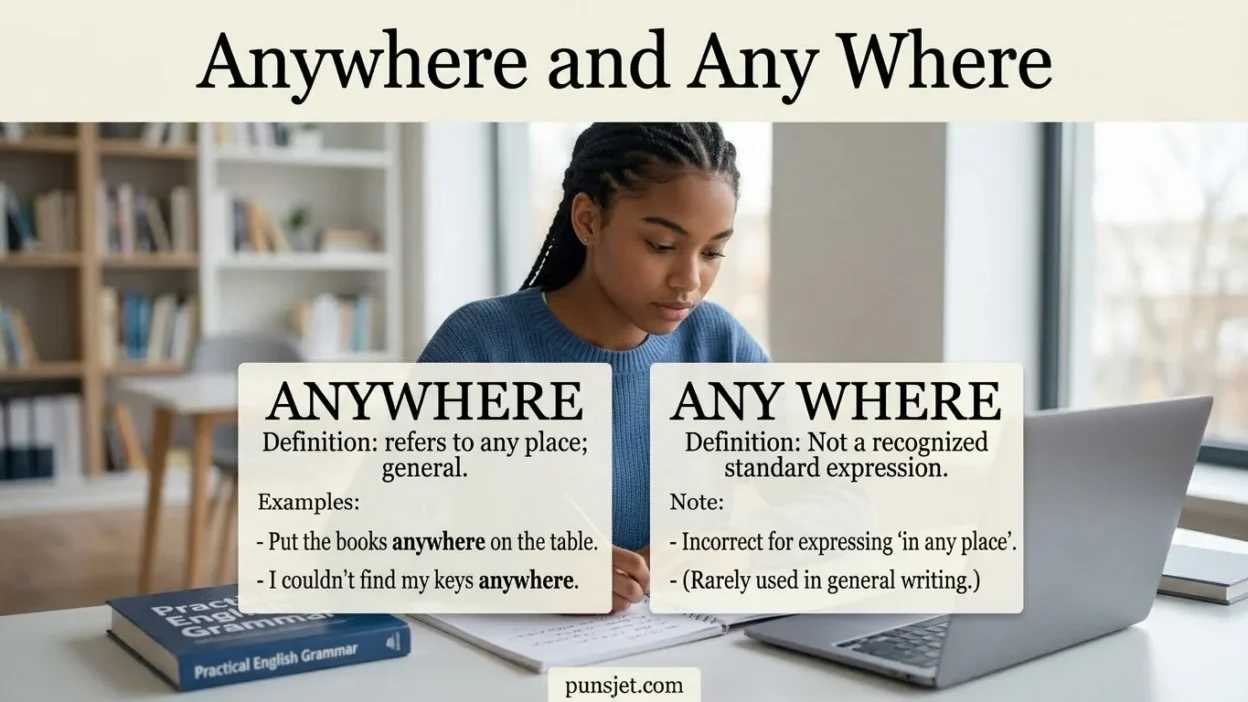
When learning English, small spaces between words can sometimes cause big confusion. Anywhere and any where look almost the same, but they do not normally work in the same way.
The good news is that the difference is simple. In everyday English, anywhere is the normal word. It means “in, at, or to any place.” For example, “You can sit anywhere.”
Any where is usually not written as two separate words. It may appear only when any and where have separate jobs in a special sentence structure.
Understanding this difference will help you write more naturally in schoolwork, emails, messages, and everyday conversations.
Quick Answer: Anywhere or Any Where?
- Anywhere is the correct and common form when you mean “any place.”
- Anywhere can mean in any place, at any place, or to any place.
- Any where is very uncommon in normal modern English.
- In most sentences, write anywhere as one word.
- Example: You can find good books anywhere.
- Incorrect for the usual meaning: You can find good books any where.
- If you are unsure, anywhere is almost always the word you need.
What Does “Anywhere” Mean?
Anywhere is an adverb that refers to an unspecified place. It does not identify one particular location.
For example:
I can’t find my phone anywhere.
This means the speaker has looked in many possible places but has not found the phone.
Another example:
We can go anywhere you want.
Here, anywhere means any place that the person chooses.
The word can be used when talking about movement, location, or the possibility of something being in a place.
Examples of “Anywhere”
- You can sit anywhere.
- Did you go anywhere yesterday?
- I looked anywhere I could think of.
- We couldn’t find a taxi anywhere.
- You can buy these products anywhere.
- Is there anywhere we can park?
In each example, anywhere refers to a place without naming a specific location.
What About “Any Where”?
Any where is not normally used as a fixed phrase in modern English.
The words any and where can appear next to each other in unusual sentence structures, but that does not mean they form the word “anywhere.”
For example, imagine a sentence where any is describing a noun and where begins another part of the sentence:
You may choose any place where you feel comfortable.
Here, any belongs with place, while where introduces information about that place.
This is different from:
You may sit anywhere.
Because anywhere itself means “any place.”
For students and beginners, the easiest rule is:
If you mean “any place,” use “anywhere.”
A Simple Background of “Anywhere”
English has many words made by joining smaller words together. Words such as somewhere, nowhere, everywhere, and anywhere all relate to places.
They follow a useful pattern:
| Word | Basic meaning |
|---|---|
| Somewhere | Some place |
| Anywhere | Any place |
| Everywhere | Every place |
| Nowhere | No place |
These words make English shorter and more natural.
Instead of saying:
You can go to any place you like.
We can simply say:
You can go anywhere you like.
This is one reason anywhere is so common in everyday English.
Anywhere vs. Any Where: The Main Difference
The main difference is whether the words work together as one word.
Anywhere
Anywhere is one word. It means any place.
Example:
You can put the box anywhere.
The meaning is:
You can put the box in any place.
Any Where
Any where is two separate words. In normal writing, it is generally not used when you simply mean “any place.”
If you write:
You can put the box any where.
the sentence looks incorrect to most modern English readers.
The natural version is:
You can put the box anywhere.
Comparison Table
| Feature | Anywhere | Any where |
|---|---|---|
| Number of words | One | Two |
| Common in modern English | Yes | No, very uncommon |
| Meaning “any place” | Yes | Usually not |
| Used in everyday speech | Very common | Rare |
| Used in normal writing | Yes | Generally avoid |
| Example | Sit anywhere. | Usually incorrect |
| Best choice for learners | Yes | Usually no |
When Should You Use “Anywhere”?
Use anywhere when you are talking about an unspecified place.
1. When You Mean “Any Place”
You can choose anywhere.
This means the person can choose any place.
2. In Questions
Anywhere is often used in questions.
Did you go anywhere?
Is there anywhere nearby to eat?
Can we park anywhere?
These questions ask about an unspecified place.
3. In Negative Sentences
Anywhere is also common in negative sentences.
I don’t see my keys anywhere.
She couldn’t find her bag anywhere.
There isn’t anywhere to sit.
Here, anywhere means no place that fits the situation.
4. When Talking About Freedom of Choice
You can travel anywhere during your vacation.
Pick anywhere you like.
We can meet anywhere near the station.
Again, the exact place is not specified.
Common Mistakes With Anywhere
Mistake 1: Writing “Any Where”
One of the most common mistakes is separating anywhere into two words.
❌ I don’t want to go any where.
✅ I don’t want to go anywhere.
Mistake 2: Confusing “Anywhere” With “Everywhere”
These words are related, but their meanings are different.
Anywhere means any possible place.
You can sit anywhere.
Everywhere means all places or many places.
I looked everywhere for my keys.
The first sentence gives freedom to choose a place. The second says the person searched in all possible places.
Mistake 3: Confusing “Anywhere” With “Somewhere”
Somewhere usually means an unknown or unspecified place that exists.
My phone is somewhere in the house.
Anywhere often means any possible place.
You can leave your phone anywhere.
The difference becomes easier when you think about choice:
- Somewhere = one unknown place
- Anywhere = any possible place
Mistake 4: Using “Any Where” Because You Can Hear Two Parts
English pronunciation can sometimes make words seem separate. But anywhere is one word in standard writing.
Just like:
- somewhere
- everywhere
- nowhere
- anywhere
they are normally written as single words.
Anywhere in Everyday English
You will see anywhere in many ordinary situations.
In Emails
Please let me know if you need help anywhere in the process.
In Messages
We can meet anywhere you want.
At School
You can choose anywhere on the page to write your answer.
At Work
You can save the document anywhere on your computer.
In Travel
You can stop anywhere along the road.
In Social Media
Good food can be found anywhere if you know where to look.
These examples show how natural anywhere is in everyday English.
Anywhere at the Beginning, Middle, or End of a Sentence
Anywhere can appear in different parts of a sentence.
Beginning
Anywhere is better than waiting here.
Middle
You can anywhere?
This particular structure is not natural. A better sentence would be:
You can go anywhere.
End
We can meet anywhere.
For beginners, it is useful to remember that anywhere commonly appears after the main verb or at the end of a sentence.
A Simple Trick to Remember
Here is an easy test:
Replace “anywhere” with “any place.”
If the sentence still makes sense, anywhere is probably the correct choice.
For example:
You can sit anywhere.
Replace it:
You can sit in any place.
The meaning is still clear.
Another example:
I couldn’t find it anywhere.
Replace it:
I couldn’t find it in any place.
The wording sounds less natural, but the basic meaning is clear.
So remember:
Anywhere = any place
This simple connection can help you avoid the mistake of writing any where.
When “Any Where” May Appear
Although anywhere is the normal word, there can be rare cases where any and where are separate words because they have different grammatical roles.
For example, in a sentence such as:
Any place where children can learn is valuable.
Here, any modifies place, and where introduces information about the place.
Notice that this sentence does not use “any where” as a replacement for anywhere.
This is why learners should not automatically put any and where together or apart based only on their meanings. Look at how they function in the sentence.
For ordinary writing, however, if your intended meaning is simply “any place,” choose anywhere.
A Quick Practice Exercise
Choose anywhere or any where.
- You can sit ______ you like.
- I couldn’t find my notebook ______.
- Did you go ______ after school?
- We can meet ______ near the library.
- She doesn’t want to travel ______ this weekend.
Answers
- anywhere
- anywhere
- anywhere
- anywhere
- anywhere
All five use anywhere because they refer to an unspecified place.
Learning Section for Students and Beginners
If you are learning English, do not worry about memorizing complicated grammar rules. Start with the most useful idea:
Remember This:
Anywhere is one word.
It means:
anywhere = any place
Try making your own sentences:
- I can study anywhere.
- We can go anywhere.
- You can sit anywhere.
- I don’t see it anywhere.
- Did you go anywhere?
Reading these sentences aloud can also help you become familiar with the word.
Learn Related Words Together
A useful way to remember anywhere is to learn it with similar place words:
Somewhere → an unspecified place
Anywhere → any possible place
Everywhere → all places
Nowhere → no place
Once you understand this group, anywhere becomes much easier to remember.
FAQs:
1. Is “anywhere” one word?
Yes. Anywhere is normally written as one word.
2. Is “any where” correct?
Usually no. If you mean “any place,” use anywhere.
3. What does anywhere mean?
Anywhere means “any place” or “in, at, or to any place.”
4. Can I use anywhere in a question?
Yes. For example:
Did you go anywhere?
5. Can anywhere be used in a negative sentence?
Yes.
I can’t find my wallet anywhere.
6. What is the difference between anywhere and somewhere?
Anywhere means any possible place, while somewhere usually means an unspecified place.
We can go anywhere.
My keys are somewhere in the house.
7. What is the difference between anywhere and everywhere?
Anywhere refers to any possible place. Everywhere refers to all places or many places.
You can sit anywhere.
I looked everywhere.
8. How can I remember the spelling of anywhere?
Remember the simple connection:
anywhere = any place
When you mean “any place,” write anywhere as one word.
Conclusion
The difference between anywhere and any where is much easier than it first appears.
In normal modern English, anywhere is the correct choice when you mean “any place.” It is one word and is used very often in questions, negative sentences, instructions, conversations, emails, and everyday writing.
For example:
You can go anywhere.
I can’t find my phone anywhere.
Did you go anywhere yesterday?
In contrast, any where is not normally used as a two-word version of anywhere.
The easiest rule to remember is:
Anywhere = any place.Whenever that is the meaning you want, keep the word together: anywhere.

Emily Margaret is a writer and humor enthusiast at PunsJet.com. She enjoys creating clever puns and lighthearted content that entertains readers and adds a spark of humor to everyday life. With a love for wordplay and creativity, Emily aims to share fun, relatable jokes that make people smile and laugh.