A lot, allot, and alot look very similar, so it is easy to mix them up. However, they do not have the same meaning, and one of them is not considered a standard English word.
The confusion usually happens because a lot is commonly used in everyday English, while allot is a real word with a completely different meaning. Alot, on the other hand, is a common spelling mistake.
Learning the difference is simple. Once you know what each form means, you can quickly choose the correct one when writing an email, school assignment, message, or social media post.
Quick Answer
- A lot means many, much, or frequently.
- I have a lot of homework.
- She travels a lot.
- Allot is a verb that means to give or divide something for a particular purpose.
- The teacher will allot ten minutes for the activity.
- Alot is not the standard spelling of the phrase a lot.
- ❌ I have alot of books.
- ✅ I have a lot of books.
Easy way to remember
Think of it this way:
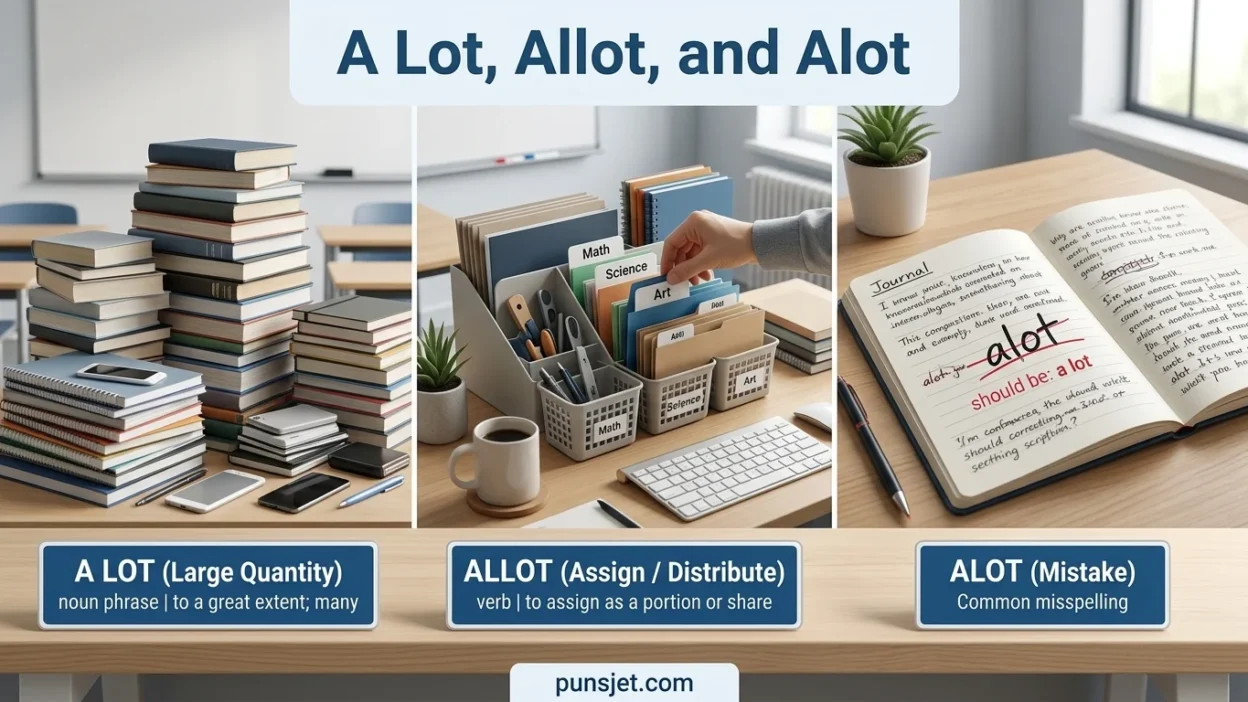
A lot = a large amount
Allot = give or divide
Alot = incorrect spelling
A Simple Background
The expression a lot has been used in English for a long time to describe a large number or amount. Today, it is one of the most common ways to say that there is much or many of something.
The word allot has a different history and meaning. It comes from an older word connected with assigning or distributing something. In modern English, allot is used when someone gives a certain amount of something to a person, group, activity, or purpose.
Alot is different. It is usually created when people accidentally join the two words a and lot together. Because the spelling looks natural, especially when typing quickly, this mistake is very common.
The important point is that a lot and allot are separate words with separate meanings.
A Lot: Meaning and Use
A lot usually means a large amount or a large number.
It can be used with both things we can count and things we cannot count.
With countable things
Use a lot of before plural countable nouns.
- I have a lot of books.
- There are a lot of students in the classroom.
- She bought a lot of apples.
- We saw a lot of cars on the road.
With uncountable things
It can also be used with things that are not normally counted one by one.
- He drinks a lot of water.
- We need a lot of time.
- She has a lot of patience.
- They spent a lot of money.
A lot can also mean frequently
When a lot comes after a verb, it can mean often or frequently.
- I read a lot.
- She smiles a lot.
- They travel a lot.
- He talks a lot.
So, a lot can describe either a large amount or something that happens frequently.
Allot: Meaning and Use
Allot is a verb. It means to give, assign, or divide a certain amount for a particular person, activity, or purpose.
It is less common in casual conversation than a lot, but it is a correct English word.
Examples
- The teacher allotted five minutes for the quiz.
- Each student was allotted two pages.
- We need to allot enough time for the meeting.
- The manager allotted money for the new project.
Notice that allot is about assigning something.
For example:
The teacher allotted ten minutes for the test.
This means the teacher gave or set aside ten minutes for the test.
It does not mean “many” or “much.”
Different forms of allot
Because allot is a verb, it can change form.
- Present: allot
- Third person: allots
- Past: allotted
- -ing form: allotting
Examples:
- The school allots time for sports.
- The school allotted one hour for the event.
- The school is allotting extra time to the activity.
Alot: Is It Correct?
In standard English, alot is not the correct spelling when you mean a lot.
For example:
❌ I have alot of work.
Correct:
✅ I have a lot of work.
The word alot is often seen in text messages, comments, informal posts, and other casual writing. People usually mean a lot, but joining the words together is still considered a spelling mistake in standard English.
Why does this mistake happen?
English has many words that are written together, such as:
- always
- already
- although
- another
Because of this, it can feel natural to write alot. But a lot is made of two separate words, so keep the space.
A simple trick is to remember:
If you mean “many,” “much,” or “often,” write two words: a lot.
A Lot vs. Allot vs. Alot
| Form | Correct? | Meaning | Example |
|---|---|---|---|
| a lot | ✅ Yes | Many, much, or frequently | I have a lot of work. |
| allot | ✅ Yes | To assign or give a share | We will allot ten minutes. |
| alot | ❌ No | Common spelling mistake | ❌ I have alot of work. |
The biggest difference is the meaning.
A lot talks about a large amount, large number, or frequent action.
Allot talks about giving or assigning a particular amount.
Alot should normally not be used in standard English.
Which One Should You Use and When?
Choosing the right form becomes easy if you ask yourself what you are trying to say.
Use “a lot” when you mean “many” or “much”
- She has a lot of friends.
- We have a lot of food.
- He has a lot of questions.
Use “a lot” when you mean “often”
- I exercise a lot.
- They visit us a lot.
- She laughs a lot.
Use “allot” when you mean “assign” or “give a share”
- The teacher will allot ten minutes.
- The company allotted money for training.
- Each player was allotted a certain amount of time.
Never use “alot” for standard writing
Instead, separate the words:
❌ There are alot of people here.
✅ There are a lot of people here.
Common Mistakes People Make
1. Writing “alot” instead of “a lot”
This is the most common mistake.
❌ She has alot of homework.
✅ She has a lot of homework.
Remember that a lot always has a space when it means “many” or “much.”
2. Using “allot” when you mean “a lot”
These words sound similar, but their meanings are very different.
❌ I have allot of homework.
✅ I have a lot of homework.
Here, the writer means a large amount of homework, so a lot is correct.
3. Thinking “allot” means “many”
Allot does not mean many or much.
- A lot of students = many students.
- Allot students = assign or distribute something to students.
4. Joining “a lot” together
Even though it may look like one word, standard English keeps it as two words.
❌ alot
✅ a lot
Everyday Real-Life Examples
These three forms can appear in different situations.
In emails
Correct:
I have a lot of questions about the assignment.
Correct:
We have allotted 30 minutes for the meeting.
Incorrect:
I have alot of questions.
In an email, using the correct form makes your writing clearer and more professional.
In news writing
You may see:
The project was allotted additional funding.
Here, allotted means funding was assigned or given to the project.
You may also see:
A lot of people attended the event.
Here, a lot of means many people.
On social media
People often write:
I miss you alot.
The intended meaning is clear, but the standard spelling is:
I miss you a lot.
Social media and casual messages may contain alot, but it is better to use a lot in school, work, and formal writing.
In daily conversation
- I eat a lot.
- We have a lot of work today.
- The coach allotted each player ten minutes.
- She talks a lot.
A Short Learning Guide for Students and Beginners
If you are learning English, do not try to memorize long rules. Use these three simple ideas.
Rule 1: “A lot” means a large amount or number
Ask:
Am I talking about many, much, or often?
If yes, use a lot.
He has a lot of books.
She studies a lot.
Rule 2: “Allot” means assign
Ask:
Am I giving or setting aside a particular amount for someone or something?
If yes, use allot.
The teacher will allot ten minutes to each group.
Rule 3: “Alot” is not standard
If you have written alot, stop and check whether you mean a lot.
Most of the time, you simply need to add a space:
alot → a lot
Quick Practice
Choose a lot, allot, or alot.
- I have ___ of homework tonight.
- The teacher will ___ five minutes for the activity.
- She travels ___ for her job.
- There are ___ people at the concert.
- The company ___ money to employee training.
Answers
- a lot
- allot
- a lot
- a lot
- allotted
If you can understand why each answer is correct, you have learned the main difference.
FAQs:
1. Is “alot” a real word?
In standard English, alot is not the correct spelling of a lot. It is normally treated as a spelling mistake.
2. Is “a lot” one word or two?
It is two words: a lot.
3. What does “a lot” mean?
A lot can mean many, much, or often, depending on the sentence.
4. What does “allot” mean?
Allot means to give, assign, or set aside a particular amount for someone or something.
5. Is “allot” a verb?
Yes. Allot is a verb.
Example:
The teacher will allot ten minutes for the test.
6. Can I use “alot” in an essay?
It is best not to. In standard English writing, use a lot with a space.
7. How can I remember the difference?
Remember:
A lot = many/much/often
Allot = assign
Alot = incorrect spelling
8. Is “a lot” formal English?
A lot is normal and widely used in everyday English. In very formal writing, alternatives such as many, much, or a large number of may sometimes fit better, but a lot is still grammatically correct.
Conclusion
The difference between a lot, allot, and alot is much easier than it first appears.
A lot is used when you mean many, much, or often. It is written as two separate words.
Allot is a completely different word. It is a verb meaning to assign, give, or set aside a certain amount.
Alot is generally an incorrect spelling of a lot in standard English.
The easiest rule to remember is:
Once you remember these three meanings, choosing the correct form becomes simple. If u are writing a school assignment, an email, a message, or a social media post, a small space can make a big difference: a lot, not alot.