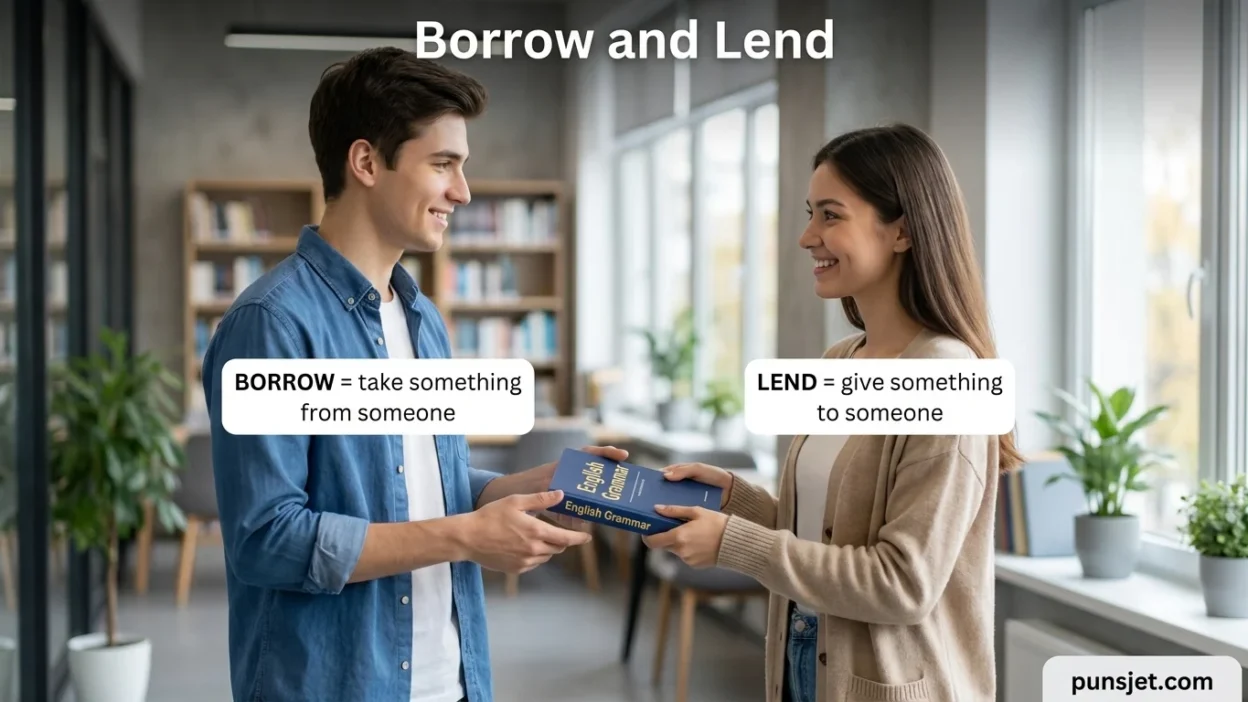
Borrow and lend are two common English words that are easy to confuse. They are connected to the same action, but they describe it from different sides.If you take something from another person and plan to return it, you borrow it. If you give something to another person for a short time and expect it back, you lend it.
For example:
- I borrowed a book from Sarah.
- Sarah lent me a book.
The action is the same, but the person doing the action is different. Understanding this small difference can help you speak and write English more naturally.
Quick Answer: Borrow vs. Lend
Here is the easiest way to remember the difference:
- Borrow = to take something from someone temporarily and return it later.
- Lend = to give something to someone temporarily and expect it back.
- You borrow from someone.
- You lend something to someone.
- The person receiving the thing borrows it.
- The person giving the thing lends it.
Simple example
Ali borrowed a pen from Ahmed.
Ali receives the pen, so Ali borrows it.
Ahmed lent Ali a pen.
Ahmed gives the pen, so Ahmed lends it.
Easy memory trick
Think:
Borrow = receive
Lend = give
A Simple Background of Borrow and Lend
Both borrow and lend are old English words. They have been used for a very long time to describe temporary exchanges of things, money, or other useful items.
The important point is not their history but how they work in modern English.
These words describe the same situation from two different viewpoints.
Imagine that your friend has a calculator and you need one for your homework.
You say:
Can I borrow your calculator?
Your friend might say:
Sure, I can lend you my calculator.
You are talking about receiving the calculator. Your friend is talking about giving it.
This is why the two words are often taught together.
What Does “Borrow” Mean?
Borrow means to take something from another person for a limited time and plan to return it.
The person who receives the item borrows it.
Common pattern
borrow + something + from + someone
Examples:
- I borrowed a book from my teacher.
- She borrowed some money from her brother.
- Can I borrow your phone?
- Tom borrowed a bicycle from his neighbor.
- We borrowed some chairs from the school.
The word from is often useful because it shows where the item came from.
Borrow does not mean keep
When you borrow something, the idea is that you will return it.
For example:
I borrowed your jacket.
This normally means you took the jacket temporarily and should give it back.
What Does “Lend” Mean?
Lend means to give something to another person temporarily, expecting that person to return it.
The person who gives the item lends it.
Common pattern
lend + something + to + someone
Examples:
- I lent my book to Maria.
- He lent his car to his brother.
- Can you lend me your pen?
- Sarah lent some money to her friend.
- The teacher lent me a dictionary.
You can also put the person directly after lend:
Can you lend me your pen?
Here, me is the person receiving the pen.
The Main Difference Between Borrow and Lend
The easiest way to understand these words is to look at the direction of the action.
Borrow
The item moves toward you.
I borrow a book from John.
You receive the book from John.
Lend
The item moves away from you.
John lends a book to me.
John gives the book to you temporarily.
So remember:
Borrow = take temporarily
Lend = give temporarily
Borrow and Lend Comparison Table
| Borrow | Lend |
|---|---|
| Means to receive something temporarily | Means to give something temporarily |
| The receiver borrows | The giver lends |
| Usually used with from | Often used with to |
| “I borrowed a pen from Sam.” | “Sam lent a pen to me.” |
| You plan to return the item | You expect the item to be returned |
One situation, two sentences
Emma borrowed $20 from Jack.
Jack lent Emma $20.
Both sentences describe the same exchange.
The difference is simply the person’s point of view.
Which One Should You Use and When?
Use borrow when you are talking about taking or receiving something temporarily.
Use “borrow” when:
- You need to use someone else’s item.
- You plan to return the item.
- You receive money temporarily.
- You are asking someone for something to use.
Examples:
Can I borrow your notebook?
I need to borrow some money from my brother.
She borrowed my umbrella yesterday.
Use lend when you are talking about giving something temporarily.
Use “lend” when:
- Someone wants to use your item.
- You give something temporarily.
- You expect the item back.
- You give money temporarily.
Examples:
Can you lend me your notebook?
I lent my umbrella to James.
She doesn’t like lending her clothes to other people.
Common Mistakes With Borrow and Lend
1. “Can you borrow me your pen?”
This is a common mistake.
❌ Can you borrow me your pen?
✅ Can you lend me your pen?
You are asking the other person to give you the pen, so lend is correct.
2. “Can I lend your book?”
This is also incorrect if you mean that you want to use the book.
❌ Can I lend your book?
✅ Can I borrow your book?
You are receiving the book, so use borrow.
3. “I borrowed him my car.”
❌ I borrowed him my car.
✅ I lent him my car.
You gave your car to him temporarily, so lent is correct.
4. “She borrowed me some money.”
❌ She borrowed me some money.
✅ She lent me some money.
She gave you the money, so she lent it.
5. “He lent a book from me.”
❌ He lent a book from me.
✅ He borrowed a book from me.
He received the book from you, so he borrowed it.
Borrow and Lend in Everyday English
These words appear in many ordinary situations.
At school
Can I borrow your pencil?
Sure. You can borrow it until the end of class.
I can lend you another pencil if you need one.
With friends
Can I borrow your headphones?
Yes, but please return them later.
I don’t mind lending them to you.
With money
Could I borrow $10 from you?
Sure, I can lend you $10.
At work
Can I borrow your laptop for a few minutes?
I can lend it to you after my meeting.
At home
I borrowed my sister’s charger.
My sister lent me her charger.
Borrow and Lend in Emails
These words are also useful in polite messages and emails.
For example, if you need something from a classmate, you might write:
Could I borrow your notes for tomorrow’s class?
If you are offering something, you could say:
I can lend you my notes if you need them.
In polite English, could and would can make requests sound softer.
For example:
Could I borrow your dictionary?
Would you be able to lend me your charger?
Borrow and Lend in News and Social Media
You may also see these words in news stories, posts, and online conversations.
Examples:
The company borrowed money to build a new office.
The bank lent money to several small businesses.
She borrowed her friend’s dress for the event.
He said he was happy to lend his experience to the project.
The meaning still depends on the direction of the action.
A Useful Grammar Tip
There are several common sentence patterns to learn.
Borrow
borrow + thing + from + person
I borrowed a laptop from Mike.
Lend
lend + thing + to + person
Mike lent a laptop to me.
You can also say:
lend + person + thing
Mike lent me a laptop.
These three sentences are closely connected:
I borrowed a laptop from Mike.
Mike lent a laptop to me.
Mike lent me a laptop.
Learning these patterns can make the difference much easier to remember.
Borrow, Lend, and “Loan”
You may also hear the word loan, especially when talking about money.
Loan can be used as a noun:
I took out a loan from the bank.
It can also be used as a verb, especially in American English:
The bank loaned him the money.
For everyday English, however, borrow and lend are the most important words to understand.
Remember:
You borrow money.
Someone lends you money.
For example:
I borrowed $500 from my uncle.
My uncle lent me $500.
Learn It With One Simple Question
Whenever you are unsure, ask yourself:
“Am I receiving it or giving it?”
If you are receiving it:
➡️ Borrow
If you are giving it:
➡️ Lend
Example
Your friend has a camera.
You want to use it.
You say:
Can I borrow your camera?
Your friend gives it to you.
Your friend says:
I can lend you my camera.
That is the whole difference.
FAQs:
1. What is the difference between borrow and lend?
Borrow means to receive or take something temporarily. Lend means to give something temporarily.
I borrowed his book.
He lent me his book.
2. Do I borrow from someone?
Yes. We normally say borrow something from someone.
I borrowed a pen from Lisa.
3. Do I lend to someone?
Yes. We commonly say lend something to someone.
Lisa lent a pen to me.
You can also say:
Lisa lent me a pen.
4. Is “Can you borrow me your pen?” correct?
No, not in standard English.
Say:
Can you lend me your pen?
You are asking the other person to give you the pen.
5. Is “Can I lend your book?” correct?
Not if you mean that you want to use the book.
Say:
Can I borrow your book?
6. What is the past tense of lend?
The past tense of lend is lent.
I lend him my book every week.
I lent him my book yesterday.
7. What is the past tense of borrow?
The past tense of borrow is borrowed.
I borrow books from the library.
I borrowed a book yesterday.
8. Can borrow and lend describe money?
Yes. Both are commonly used with money.
I borrowed $50 from my friend.
My friend lent me $50.
A Quick Practice Exercise
Choose borrow or lend in each sentence.
- Can I ______ your pencil?
- I ______ my jacket to my brother.
- She ______ a book from the library.
- Could you ______ me some money?
- He ______ my bicycle yesterday.
Answers
- borrow
- lent
- borrowed
- lend
- borrowed or lent, depending on the intended meaning.
For example:
He borrowed my bicycle yesterday.
This means he used your bicycle.
But:
I lent him my bicycle yesterday.
This means you gave it to him to use.
Final Conclusion
The difference between borrow and lend is simple once you remember who is receiving and who is giving.
Borrow means to take or receive something temporarily and return it later.
Lend means to give something temporarily and expect it back.
Remember this easy rule:
Borrow = receive
Lend = give
So, if you need your friend’s pen, say:
Can I borrow your pen?
If your friend gives you the pen, your friend can say:
I’ll lend you my pen.
Once you focus on the direction of the action, borrow and lend become much easier to use correctly in conversations, emails, schoolwork, and everyday English.

Joshua Paul is a creative writer and contributor at PunsJet.com who enjoys crafting witty puns and clever wordplay. With a strong sense of humor and a love for language, he creates entertaining content that readers can easily share and enjoy. Joshua’s goal is to spread laughter through fun and memorable jokes.