Brake and break are two English words that often confuse students and beginners. They sound exactly the same when spoken, but they have completely different meanings and uses.
These words are called homophones because they have the same pronunciation but different spellings and meanings. The easiest way to remember them is to connect each word with its main idea:
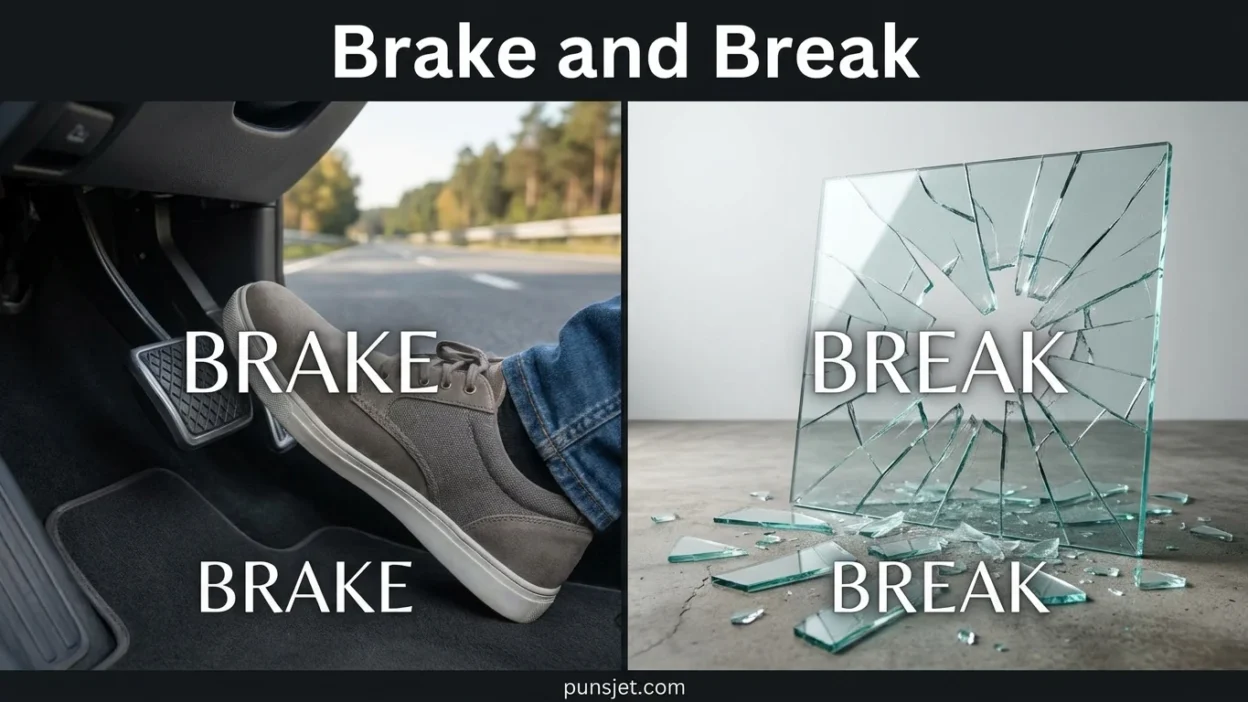
- Brake → something used to slow down or stop a vehicle or machine.
- Break → to damage, separate, stop, or interrupt something.
For example:
Please press the brake when the car approaches the red light.
Be careful not to break the glass.
Although the pronunciation is the same, the meaning tells you which spelling to use. Once you learn the main difference, choosing between brake and break becomes much easier.
Quick Answer: Brake vs. Break
Here is the difference in the simplest way:
- Brake is mainly connected with stopping or slowing down.
- A brake is a device used in cars, bicycles, motorcycles, and other machines.
- Break can mean to damage something so it no longer works or stays whole.
- Break can also mean to separate something into pieces.
- Break can mean to stop or interrupt an activity.
- Break can also mean a short rest, such as a lunch break.
- Both words are pronounced the same: /breɪk/.
- Their spellings and meanings are different.
Easy memory trick:
Think of brake as the thing that helps a vehicle stop. Think of break as the word for something that gets broken, interrupted, or separated.
A Simple Background of the Words
The words brake and break have different histories even though they sound alike today.
Break is a very old English word. It has been used for many centuries to describe things being separated, damaged, or interrupted. Over time, it developed many meanings, including physical damage, taking a rest, interrupting something, and ending a rule or promise.
Brake also has an old history. Its meaning became connected with a device used to control the movement of a vehicle or machine. Today, we commonly use it when talking about cars, bicycles, motorcycles, trains, and other vehicles.
The similar pronunciation can make these words difficult for English learners. However, their meanings are quite different.
What Does “Brake” Mean?
Brake is usually connected with stopping or slowing down movement.
As a noun, a brake is a device that helps a vehicle slow down or stop.
Examples:
- The car’s brakes are not working properly.
- Press the brake before the corner.
- My bicycle has new brakes.
- The driver suddenly hit the brakes.
As a verb, brake means to use a brake to slow down or stop.
Examples:
- The driver braked suddenly.
- She braked when she saw the dog.
- You should brake before going downhill.
- He braked to avoid the other car.
Think of “brake” like this:
Brake = slow down or stop a moving vehicle.
What Does “Break” Mean?
Break has many meanings, but its basic idea is often connected with damage, separation, interruption, or stopping something temporarily.
1. Break means to damage something
If you break an object, you damage it or cause it to separate.
- I accidentally broke the cup.
- Don’t break the window.
- She broke her phone.
- The child broke the toy.
2. Break means to separate
Something can also break into pieces.
- The stick broke in half.
- The chocolate broke into small pieces.
- The branch broke during the storm.
3. Break means to interrupt something
We can use break when something interrupts an activity or situation.
- The news broke the silence.
- Someone broke our conversation.
- The loud noise broke my concentration.
4. Break means to take a rest
A break can be a short period when you stop working or studying.
- Let’s take a break.
- I have a 15-minute break.
- The students went outside during their break.
- I usually take a lunch break at noon.
5. Break can mean to violate a rule or promise
We can also say someone breaks a rule, law, promise, or agreement.
- He broke the rules.
- She never breaks her promises.
- You could get in trouble if you break the law.
So, break has many uses, while brake is much more closely connected to slowing or stopping movement.
Brake vs. Break: Comparison Table
| Word | Main meaning | Word type | Example |
|---|---|---|---|
| Brake | A device for slowing or stopping | Noun | The car has new brakes. |
| Brake | To slow or stop a vehicle | Verb | He braked quickly. |
| Break | To damage something | Verb | Don’t break the glass. |
| Break | To become damaged or separated | Verb | The stick broke. |
| Break | A short rest | Noun | We need a break. |
| Break | To interrupt something | Verb | The noise broke the silence. |
| Break | To violate a rule or promise | Verb | He broke the rule. |
Which One Should You Use and When?
Choosing the correct word becomes easier when you look at the meaning of the sentence.
Use brake when talking about:
- Cars
- Bicycles
- Motorcycles
- Trains
- Other vehicles
- Slowing down
- Stopping movement
Example:
The driver pressed the brake.
The word brake is correct because the driver is trying to stop the vehicle.
Use break when talking about:
- Damaging objects
- Separating things
- Taking a rest
- Interrupting something
- Breaking rules
- Breaking promises
- Breaking records
- Ending or stopping something
Example:
I don’t want to break the glass.
Here, break means damage the glass.
Common Mistakes With Brake and Break
Because these words sound the same, spelling mistakes are very common.
Mistake 1: “Press the break”
❌ Press the break.
✅ Press the brake.
When you are talking about the device used to stop a vehicle, use brake.
Mistake 2: “Don’t brake the glass”
❌ Don’t brake the glass.
✅ Don’t break the glass.
You are talking about damaging the glass, so break is correct.
Mistake 3: “I need a brake”
❌ I need a brake.
✅ I need a break.
When you mean a short rest, use break.
Mistake 4: “The car breaked suddenly”
❌ The car breaked suddenly.
✅ The car braked suddenly.
The past tense of the verb brake is braked.
Remember:
- brake → braked
- break → broke → broken
For example:
The driver braked suddenly.
But:
She broke the glass.
Brake and Break in Everyday Life
These words appear in many everyday situations.
In Emails
You might write:
I will take a short break after finishing this task.
Or:
The mechanic says we need to replace the car’s brakes.
The first sentence is about resting. The second is about a vehicle’s stopping system.
In News
News reports may use break in several ways:
The athlete broke the national record.
Or:
Police said the driver braked suddenly.
The meanings are completely different even though the words sound alike.
On Social Media
You may see posts such as:
Time for a coffee break!
Or:
My bicycle brakes need repair.
Again, break means a rest, while brakes are used to slow or stop a bicycle.
In Daily Conversation
You could hear:
“Let’s take a break.”
This means:
“Let’s rest for a while.”
You could also hear:
“Brake before the turn.”
This means:
“Slow the vehicle down before turning.”
Listening to the surrounding words can help you understand which meaning is intended.
A Simple Learning Trick for Students
Here is an easy way to remember the difference.
Remember:
BRAKE = CAR
If you see a car, bicycle, motorcycle, or another vehicle, think about brake.
Car → brake → stop
Remember:
BREAK = DAMAGE OR REST
If something gets damaged, separated, interrupted, or you need a short rest, think about break.
Glass → break
Rule → break
Promise → break
Rest → break
You can also remember this sentence:
Use the brake to stop the car, but take a break when you need to rest.
This single sentence shows the main difference very clearly.
More Example Sentences
Examples with “Brake”
- The driver used the brake.
- My bicycle brakes need fixing.
- Please brake before the sharp turn.
- He braked when the traffic stopped.
- The mechanic checked the car’s brakes.
Examples with “Break”
- Be careful not to break the plate.
- I need a short break.
- She broke her pencil.
- Don’t break your promise.
- The student broke the school rule.
- The glass broke when it fell.
- We took a lunch break.
- The player broke the record.
FAQs:
1. Do brake and break sound the same?
Yes. Brake and break are pronounced the same in standard English. They are homophones.
2. What is a brake?
A brake is a device that helps slow down or stop a vehicle or machine.
The car’s brake is not working.
3. What does break mean?
Break has many meanings. It can mean to damage something, separate something, interrupt something, take a rest, or violate a rule.
Don’t break the glass.
4. Is “take a brake” correct?
No. When you mean a short rest, the correct phrase is take a break.
Let’s take a break.
5. Is “press the break” correct?
No. When talking about the device used to stop a vehicle, use brake.
Press the brake.
6. What is the past tense of brake?
The past tense of brake is braked.
The driver braked suddenly.
The past tense of break is broke.
She broke the glass.
7. Can break be a noun?
Yes. Break can be a noun meaning a short rest.
We have a ten-minute break.
It can also refer to other things, such as a break in a conversation or a break in a pattern.
8. What is the easiest way to remember brake and break?
Remember:
Brake = stop a vehicle.
Break = damage, separate, interrupt, or rest.
Conclusion
Brake and break sound the same, but they do not mean the same thing.
Use brake when you are talking about slowing down or stopping a vehicle, or about the device that does this. For example, you can press the brake, check the brakes, or brake before a turn.
Use break for the many other meanings, such as damaging something, separating something, taking a rest, interrupting something, breaking a rule, or breaking a promise.
The easiest memory trick is simple:
Brake stops a vehicle. Break can damage, interrupt, or give you a rest.
Once you connect brake with vehicles and break with damage or rest, you will be much less likely to confuse these two words.