
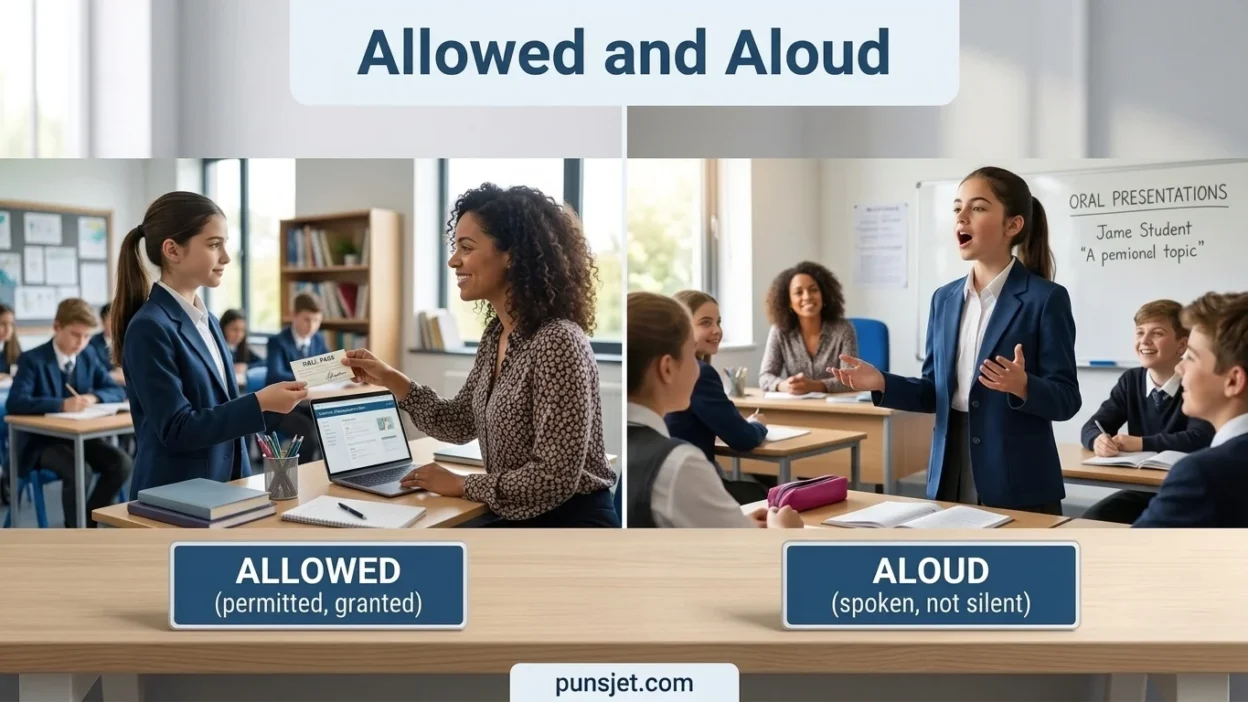
Allowed and aloud are two English words that often confuse students and English learners. They sound exactly the same when spoken, but they have completely different meanings and spellings.
This type of word is called a homophone. Homophones are words that sound alike but have different meanings and are usually spelled differently.
For example, you might read a sentence like:
- “You are allowed to use your phone.”
- “Please read the sentence aloud.”
Both words sound like “uh-lowd,” but they do very different jobs.
The good news is that the difference between allowed and aloud is quite easy to remember once you connect each word with its meaning. This guide explains the two words with simple definitions, examples, common mistakes, and an easy memory trick.
Quick Answer: Allowed vs. Aloud
Here is the difference in the simplest way:
- Allowed means given permission to do something.
- Aloud means spoken so that other people can hear.
- Allowed is related to the verb allow.
- Aloud is related to speaking or reading out loud.
- Both words have the same pronunciation, but they are spelled differently.
- Use allowed when talking about permission or rules.
- Use aloud when talking about speaking or reading so others can hear.
Easy examples
Allowed:
Students are allowed to use calculators during the test.
This means the students have permission to use calculators.
Aloud:
She read the story aloud to the class.
This means she read the story so the class could hear her.
What Does “Allowed” Mean?
Allowed means that someone has permission to do something.
It comes from the verb allow, which means to give permission or to let someone do something.
Examples of “allowed”
- We are allowed to leave early today.
- Are children allowed to play here?
- You are not allowed to park in this area.
- My teacher allowed me to take another try.
- Pets are allowed in this building.
In each example, allowed is connected to permission.
Think of “allowed” as a rule
When you see allowed, ask yourself:
“Is someone being given permission?”
If the answer is yes, allowed is probably the correct word.
For example:
You are allowed to bring one bag.
This means you have permission to bring one bag.
What Does “Aloud” Mean?
Aloud means speaking or making a sound that can be heard by other people.
It is often used with verbs such as:
- say
- read
- speak
- laugh
- think
Examples of “aloud”
- Please read the paragraph aloud.
- He said the answer aloud.
- She laughed aloud when she heard the joke.
- I was thinking aloud while solving the problem.
- The teacher asked me to answer aloud.
In these examples, aloud is connected to sound or speech that can be heard.
Think of “aloud” as sound
When you see aloud, ask yourself:
If yes, aloud may be the correct word.
For example:
Please say your name aloud.
This means you should say your name so people can hear it.
Why Do Allowed and Aloud Sound the Same?
The main reason these words are confusing is their pronunciation.
Allowed and aloud are pronounced almost the same in normal English speech.
However, their meanings are unrelated.
This is why listening alone may not tell you which word someone means. You need to understand the sentence and look at the spelling when writing.
Compare:
You are allowed to enter.
and
Please read it aloud.
The first sentence is about permission.
The second sentence is about speaking so someone can hear you.
A Simple Look at Their Background
The word allowed comes from allow, a word that has been used in English for many centuries to express the idea of permitting or giving permission.
The word aloud is built from the idea of something being said or expressed out loud, rather than silently.
Although the two words eventually developed very different meanings, their sounds became very similar in modern English.
This is one reason English learners can find them difficult. English has many words that sound alike but have different meanings, so learning the meaning of each word is more useful than trying to depend only on pronunciation.
Allowed vs. Aloud: Clear Difference
The easiest way to separate these words is to remember two ideas:
Allowed = Permission
Use allowed when someone has permission to do something.
We are allowed to use the library after school.
The school gives students permission.
Aloud = Heard Speech
Use aloud when something is spoken or read so that it can be heard.
He read the instructions aloud.
He did not simply read them silently. He spoke the words so others could hear.
One easy memory trick
Look at the spelling:
ALLOWed → ALLOW = permission
If something is allowed, someone says, “Yes, you can do it.”
ALoud → LOUD = sound
If you say something aloud, you say it so it can be heard.
This is not a perfect spelling rule, but it is a very useful memory trick for beginners.
Allowed and Aloud Comparison Table
| Word | Meaning | Main Idea | Example |
|---|---|---|---|
| Allowed | Given permission | Permission | We are allowed to stay here. |
| Aloud | Spoken so it can be heard | Sound/speech | She read the letter aloud. |
| Allowed | Permitted | Rules | Phones are not allowed. |
| Aloud | Not silently | Hearing | He answered aloud. |
The fastest test
Ask:
Is the sentence about permission?
→ Use allowed.
Is the sentence about speaking or hearing?
→ Use aloud.
Which One Should You Use and When?
Use “allowed” for rules and permission
Use allowed when someone gives permission or when a rule says something can be done.
Examples:
- Are we allowed to take pictures?
- You are allowed to choose one answer.
- Students are not allowed to run in the hallway.
- Is food allowed inside the room?
- My parents allowed me to go with my friends.
Use “aloud” for speaking and reading
Use aloud when words are spoken so they can be heard.
Examples:
- Read this sentence aloud.
- She counted aloud.
- He spoke his thoughts aloud.
- The teacher asked us to answer aloud.
- I accidentally said my thoughts aloud.
Common Mistakes People Make
Mistake 1: Using “aloud” for permission
Incorrect:
We are aloud to enter the room.
Correct:
We are allowed to enter the room.
Why? The sentence is about permission, so allowed is correct.
Mistake 2: Using “allowed” for speaking
Incorrect:
Please read the paragraph allowed.
Correct:
Please read the paragraph aloud.
Why? The person is being asked to read so others can hear, so aloud is correct.
Mistake 3: Confusing “aloud” with “loud”
Loud and aloud are related to sound, but they are not exactly the same.
- Loud describes a high level of sound.
- Aloud means something is spoken so it can be heard.
For example:
The music is loud.
She read the poem aloud.
A person can read something aloud without shouting or being loud.
Mistake 4: Choosing the word by sound
Because allowed and aloud sound alike, some people choose the spelling that looks right to them.
This can cause errors in writing.
Instead, think about the meaning first:
Permission? → allowed
Speaking? → aloud
Everyday Real-Life Examples
In school
Students are allowed to ask questions.
This is about permission.
The student read the answer aloud.
This is about speaking.
At work
Employees are allowed to work from home on Fridays.
This is a workplace rule or permission.
The manager read the announcement aloud.
The announcement was spoken so people could hear it.
In an email
You might write:
Are we allowed to submit the form tomorrow?
You are asking for permission.
You might also write:
Please read the instructions aloud before starting the activity.
You are asking someone to speak the instructions so they can be heard.
On social media
Someone might post:
“Am I allowed to share this?”
They are asking whether they have permission.
Another person might write:
“I actually laughed aloud when I saw this.”
They mean they laughed audibly.
In daily conversation
“Are we allowed to sit here?”
This asks about permission.
“Can you say that aloud?”
This asks someone to speak so others can hear.
A Short Learning Section for Students and Beginners
If you are learning English, do not try to memorize long definitions. Connect each word with one simple idea.
Remember:
ALLOWED = YES, YOU CAN
You are allowed to use your phone.
Someone has given you permission.
ALOUD = YOU CAN HEAR IT
She read the sentence aloud.
She spoke the sentence so people could hear it.
Try this mini exercise
Choose allowed or aloud in each sentence.
- We are not ______ to enter this room.
- Please say the answer ______.
- Are students ______ to use dictionaries?
- He read the message ______.
- My parents ______ me to stay out late.
Answers
- allowed
- aloud
- allowed
- aloud
- allowed
A useful habit is to explain why you chose the word. If the reason is permission, choose allowed. If the reason is speaking or hearing, choose aloud.
FAQs:
1. What is the difference between allowed and aloud?
Allowed means given permission. Aloud means spoken so that it can be heard.
You are allowed to leave.
Read the sentence aloud.
2. Do allowed and aloud sound the same?
Yes. They are normally pronounced the same or very similarly. Their meanings and spellings are different.
3. Is “aloud” related to “loud”?
Yes. Aloud is connected with the idea of something being heard. However, aloud usually describes speaking or reading so that it can be heard, while loud describes the level of sound.
4. Is “allowed” the past tense of “allow”?
Yes. Allowed is the past tense and past participle of allow.
Examples:
My teacher allowed me to leave early.
We have been allowed to enter.
5. Can I use “aloud” when someone reads?
Yes. Aloud is commonly used when someone reads something so other people can hear it.
Please read the instructions aloud.
6. Can “allowed” describe a rule?
Yes. It is often used when talking about rules and permission.
Food is not allowed in the classroom.
This means the rules do not permit food there.
7. What is an easy trick for remembering allowed and aloud?
Remember:
Allowed = permission.
Aloud = sound.
You can also connect aloud with loud because both relate to hearing.
8. Which spelling is correct: “read it allowed” or “read it aloud”?
The correct phrase is:
Read it aloud.
Here, aloud means “so that it can be heard.”
Conclusion
Allowed and aloud sound alike, but their meanings are completely different.
Use allowed when you are talking about permission, rules, or something that someone can do.
We are allowed to use the computers.
Use aloud when you are talking about speaking, reading, or making a sound that can be heard.
She read the story aloud.
The easiest memory trick is:
Allowed = permission.
Aloud = heard.
Whenever you are unsure, stop and ask yourself what the sentence means. If it is about whether someone can do something, choose allowed. If it is about words being spoken so they can be heard, choose aloud.
Once you connect each spelling with its meaning, these two confusing words become much easier to use correctly.

Donald Andrew is the creative mind behind PunsJet.com, where he shares clever wordplay and humorous puns for readers around the world. With a passion for language and comedy, Donald enjoys crafting witty jokes that bring smiles to everyday conversations. His goal is to make humor simple, fun, and easy to share.