
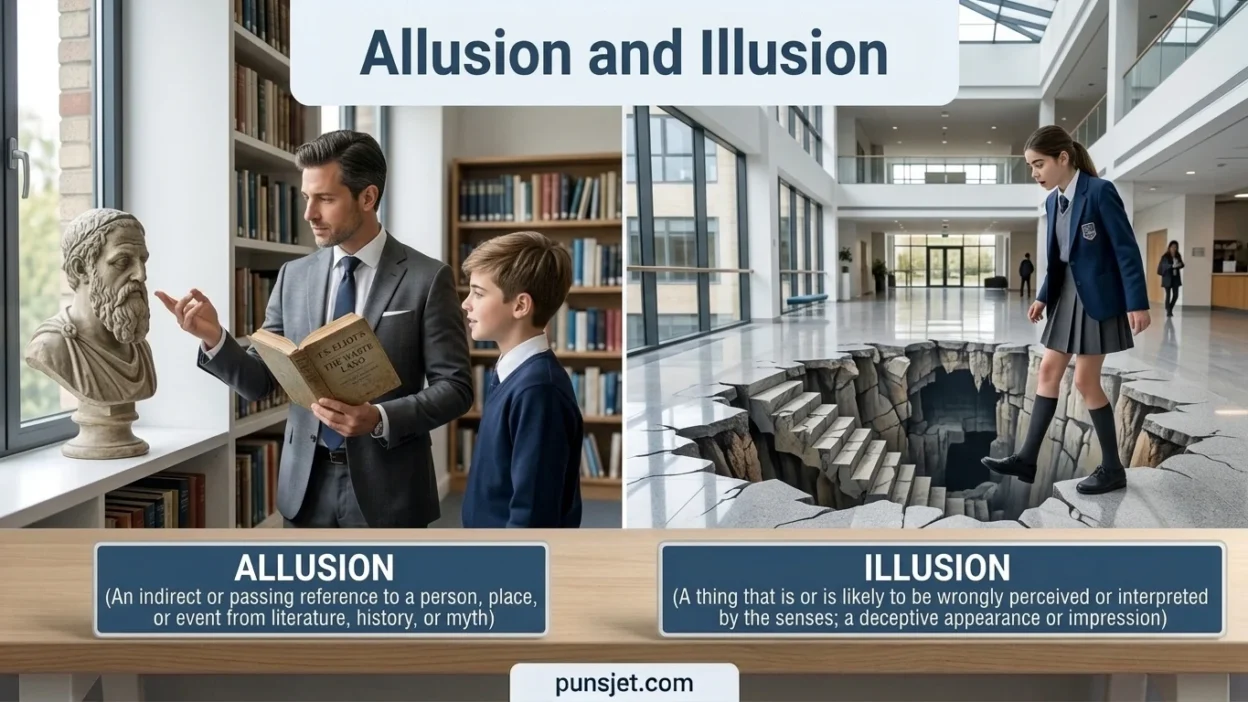
Allusion and illusion are two English words that look and sound very similar. Because they have only one letter difference, many students and English learners mix them up when writing or speaking.However, their meanings are completely different.
An allusion is a brief reference to a person, place, event, book, movie, or idea. It does not explain everything directly. Instead, it expects the reader or listener to understand the reference.
An illusion is something that appears real or true but is actually not. It can be a trick of the eyes, a false idea, or something that gives a misleading impression.Once you learn the simple difference, these words become much easier to use correctly.
Quick Answer: Allusion vs. Illusion
Here is the easiest way to remember them:
- Allusion = a reference to something.
- Illusion = something that seems real but is not.
- An allusion is often used in writing, speaking, books, movies, and conversations.
- An illusion can involve sight, thoughts, beliefs, or appearances.
- Allusion is connected to the idea of referring to something.
- Illusion is connected to the idea of being tricked or misled.
Simple examples
Allusion:
The teacher made an allusion to Shakespeare in her lesson.
The teacher briefly referred to Shakespeare.
Illusion:
The magician created the illusion that the coin disappeared.
The coin seemed to disappear, but it did not really vanish.
The Simple Background of the Two Words
Although allusion and illusion look almost the same, they developed from different Latin roots.
Allusion comes from a Latin word connected with playing or referring to something indirectly. Over time, it developed into the meaning of making a brief or indirect reference.
Illusion comes from a different Latin root connected with mocking, deceiving, or misleading. Its meaning developed toward something that gives a false appearance or makes someone believe something that is not true.
You do not need to remember the Latin roots to use these words correctly. The most useful thing is to remember their modern meanings:
What Does “Allusion” Mean?
An allusion is a short or indirect reference to something familiar.
When someone makes an allusion, they usually do not explain the whole story. They simply mention something that the audience may already know.
The reference could be to:
- A famous person
- A historical event
- A book
- A poem
- A movie
- A religious story
- A myth
- A popular song
- A common cultural idea
- Another well-known event or situation
Example
“He acted like Romeo when he saw her.”
This sentence may be an allusion to Romeo, the famous character from Shakespeare’s Romeo and Juliet.
The writer does not need to explain who Romeo is. Readers who know the story can understand the comparison.
Another example
“She opened Pandora’s box by asking that question.”
This can be an allusion to the story of Pandora’s box. The speaker is suggesting that the question caused many unexpected problems.
An allusion adds meaning without requiring a long explanation.
What Does “Illusion” Mean?
An illusion is something that seems real or true but is not actually what it appears to be.
Illusions can happen through our eyes, minds, or beliefs.
Example
The magician created an illusion of making the rabbit disappear.
The rabbit did not really disappear. The magician created an appearance that made people think it had.
Illusion can also describe a false belief
He had the illusion that everyone agreed with him.
In this case, illusion does not mean an optical trick. It means he believed something that was not true.
Another example:
The large windows created the illusion of a bigger room.
The room did not actually become larger. It only looked larger.
So, an illusion can be:
- A visual trick
- A false impression
- A mistaken belief
- Something that appears different from reality
Allusion and Illusion: The Main Difference
The easiest difference is this:
Allusion points to something.
An allusion is a reference.
The article contains an allusion to a famous historical event.
The writer refers to that event without explaining it fully.
Illusion tricks your perception.
An illusion is an appearance that is not reality.
The painting creates the illusion of movement.
The painting does not actually move, but it looks as if it does.
Think of the words this way:
Allusion → “I am referring to something.”
Illusion → “It looks real, but it is not.”
Comparison Table
| Feature | Allusion | Illusion |
|---|---|---|
| Basic meaning | A reference to something | A false or misleading appearance |
| Main idea | Referring | Seeming |
| Common use | Writing, speech, literature | Sight, beliefs, appearances |
| Example | An allusion to a famous movie | An illusion of movement |
| Is it real? | The thing being referenced is real or known | What appears to be real may not be real |
| Easy memory word | Reference | Appearance |
Which One Should You Use and When?
Choosing between allusion and illusion depends on what you are trying to say.
Use allusion when you mean:
- A reference
- A brief mention
- An indirect connection
- A reference to a famous person or event
- A reference to literature, history, religion, or popular culture
Examples
The speech included an allusion to the country’s history.
The novel contains several allusions to Greek mythology.
His comment was an allusion to an earlier conversation.
Use illusion when you mean:
- A trick
- A false appearance
- Something that only seems real
- A mistaken belief
- A misleading impression
Examples
The magician performed an amazing illusion.
The mirror gives the illusion that the hallway is longer.
She had the illusion that the problem would disappear by itself.
Common Mistakes People Make
1. Using “illusion” when you mean “reference”
Incorrect:
The writer made an illusion to Shakespeare.
Correct:
The writer made an allusion to Shakespeare.
Why? Because the writer is referring to Shakespeare.
2. Using “allusion” for a visual trick
Incorrect:
The magician performed an allusion.
Correct:
The magician performed an illusion.
Why? A magic trick creates an appearance that is different from reality.
3. Confusing “allude” and “elude”
This is another common problem.
Allude means to refer to something indirectly.
She alluded to her childhood in the interview.
Elude means to escape or avoid being caught or understood.
The answer continued to elude him.
So remember:
- Allude = refer indirectly
- Elude = escape or be difficult to understand
4. Thinking the words have the same meaning because they sound similar
They do not.
The spelling is similar, but the meanings are very different.
Allusion = reference
Illusion = false appearance
Learning this short pair can prevent many mistakes.
Everyday Real-Life Examples
In Emails
Imagine a manager writes:
“As I mentioned in our meeting last Monday, we need to improve the schedule.”
If the manager briefly refers to something discussed earlier, that can be described as an allusion to the previous conversation.
An illusion would be different:
“The new design gives the illusion of more space.”
The design makes the space appear larger.
In News
A news article might say:
The politician made an allusion to a famous historical speech.
The politician referred to the speech without discussing every detail.
A news report might also say:
The advertisement creates the illusion of instant success.
The advertisement gives an impression that may not match reality.
On Social Media
Someone might post:
“Winter is coming.”
Depending on the context, this could be an allusion to Game of Thrones.
The person is referring to something familiar.
Now consider:
“This photo makes my small apartment look huge!”
The photo may create an illusion of extra space.
In Daily Conversation
Friend A:
“He thinks he can fix every problem himself.”
Friend B:
“That’s an illusion.”
Here, illusion means a false belief.
Another conversation:
“Did you notice her reference to that old movie?”
You could describe that reference as an allusion if it is indirect.
A Simple Learning Trick
If you are a student or beginner, use this memory trick:
Allusion has “all” at the beginning.
Think:
If a writer alludes to something, the writer makes a reference to it.
Illusion starts with “ill.”
You can connect illusion with something that tricks or misleads your perception.
This is not a perfect word-origin lesson, but it is a simple memory aid.
Practice: Choose the Correct Word
Try to fill in each blank with allusion or illusion.
- The painting creates the ________ of depth.
- The writer made an ________ to an old legend.
- The magician’s trick was an impressive ________.
- The speech contained an ________ to a famous leader.
- The mirror creates the ________ that the room is larger.
- Her comment was an ________ to something we discussed yesterday.
Answers
- illusion
- allusion
- illusion
- allusion
- illusion
- allusion
The key is to ask yourself:
Is this a reference? → Allusion
Is this something that only appears real or true? → Illusion
FAQs:
1. What is the easiest difference between allusion and illusion?
Allusion means a reference to something. Illusion means something that appears real or true but is not.
2. Is an allusion a reference?
Yes. An allusion is usually a brief or indirect reference to something familiar.
For example:
The poem contains an allusion to Greek mythology.
3. Is an illusion always a visual trick?
No. An illusion can be visual, but it can also be a false belief or misleading impression.
For example:
He had the illusion that he could never fail.
This describes a false belief rather than a visual trick.
4. What is an example of an allusion?
“He met his Waterloo.”
This can be an allusion to Napoleon’s defeat at Waterloo. The speaker is referring to a well-known historical event.
5. What is an example of an illusion?
The special lighting created the illusion that the room was larger.
The room did not actually become larger. It only appeared larger.
6. How can I remember allusion?
Remember:
If someone alludes to something, they refer to it without explaining it directly.
7. How can I remember illusion?
Remember:
If something is an illusion, it may look or seem real even though it is not.
8. Can an allusion and an illusion be used in the same sentence?
Yes.
The magician made an allusion to a famous movie while creating an illusion of a disappearing object.
Here, allusion means reference, while illusion means a false appearance.
Final Conclusion
Allusion and illusion may look almost identical, but their meanings are easy to separate once you know the key idea.
An allusion is a reference. It happens when someone briefly or indirectly refers to a person, event, story, book, movie, or idea.
An illusion is a false appearance or impression. Something may look real, seem true, or appear different from reality.
The simplest rule to remember is:
Whenever you are unsure, ask yourself what the sentence is doing. If it is referring to something, choose allusion. If something is only seeming real or true, choose illusion.
With this simple distinction, you can use both words confidently in essays, conversations, emails, and everyday English.

Joshua Paul is a creative writer and contributor at PunsJet.com who enjoys crafting witty puns and clever wordplay. With a strong sense of humor and a love for language, he creates entertaining content that readers can easily share and enjoy. Joshua’s goal is to spread laughter through fun and memorable jokes.