
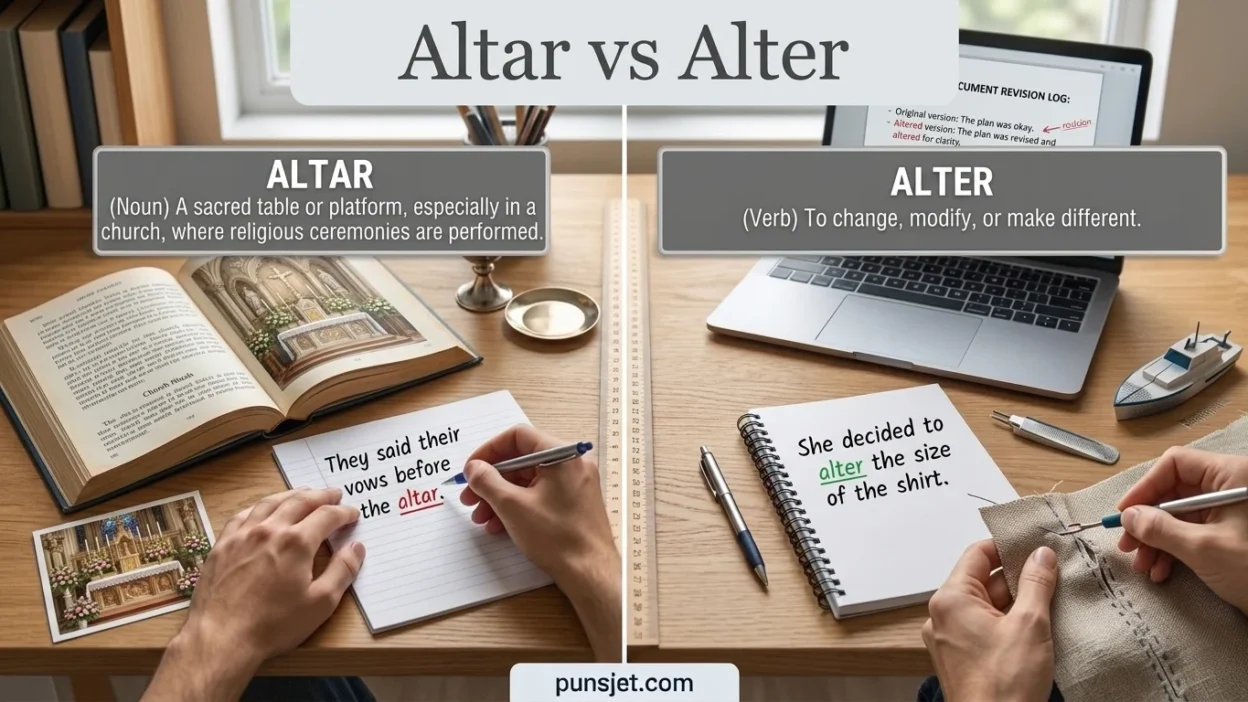
Altar and alter are two English words that sound almost the same, but they have completely different meanings. This can make them confusing, especially for students, ESL learners, and beginners.
The good news is that the difference is simple once you connect each word with its meaning.
Altar is a noun. It usually means a special table or raised place used in religious ceremonies.Alter is usually a verb. It means to change something, often by making it different in some way.
For example:
- The couple stood before the altar.
- We need to alter the plan.
The words differ by only one letter, but they cannot be used in the same way. Learning a simple memory trick and seeing them in real sentences can help you remember them easily.
Quick Answer: Altar vs. Alter
Here is the difference in the simplest form:
- Altar = a special place or table used for religious ceremonies.
- Alter = to change something.
- Altar is normally a noun.
- Alter is normally a verb.
- Altar is connected with religion or worship.
- Alter is connected with change or adjustment.
Easy examples
Altar:
The priest stood near the altar.
Alter:
We may need to alter the schedule.
Easy memory trick
Think:
Altar = a place
Alter = change
If you are talking about changing something, use alter.
If you are talking about a special religious table or place, use altar.
A Simple Look at Their Background
Although altar and alter look and sound similar, they come from different word histories.
Where “altar” comes from
The word altar has a long history connected with religion and worship. It developed from older words used for a raised place or structure where religious offerings were made.
Today, an altar can be found in different religious settings. It may be a table, platform, or special area used during worship or ceremonies.
For example:
Flowers were placed on the altar.
The word altar has remained connected with religious ceremonies for many centuries.
Where “alter” comes from
Alter comes from a different word family and is connected with the idea of making something different.
When you alter something, you change it without necessarily replacing it completely.
For example:
She altered her dress to make it fit better.
The dress is still the same basic dress, but some changes have been made.
What Does “Altar” Mean?
Altar is a noun. It refers to a special table, platform, or raised place used in religious worship or ceremonies.
Altars can appear in churches, temples, and other places of worship, depending on the religion and tradition.
Examples of “altar”
- The candles were placed on the altar.
- The bride and groom stood near the altar.
- The church has a beautiful wooden altar.
- Flowers decorated the altar.
- The priest walked toward the altar.
In each sentence, altar refers to a physical place or structure.
Altar in weddings
One common use of altar appears in wedding-related writing.
For example:
The couple stood before the altar during the ceremony.
People sometimes say someone is “walking down the aisle to the altar.” Here, altar refers to the special place where the wedding ceremony takes place.
However, not every wedding has an altar. The word is most appropriate when the ceremony actually involves one.
What Does “Alter” Mean?
Alter is a verb that means to change something.
The change may be small or large, depending on the situation.
For example:
We need to alter the design.
This means that the design needs to be changed.
Examples of “alter”
- We had to alter our plans.
- The tailor will alter the jacket.
- The teacher decided to alter the lesson.
- You can alter the settings later.
- The experience altered his opinion.
The word can be used for plans, clothes, designs, opinions, schedules, systems, and many other things.
“Alter” does not always mean completely replace
This is an important point for beginners.
If you alter something, you usually make a change to it. You do not necessarily destroy it or replace it completely.
For example:
She altered the dress.
This could mean that she shortened it, changed its shape, or adjusted it so that it fits better.
Altar and Alter: Comparison Table
| Word | Part of Speech | Meaning | Example |
|---|---|---|---|
| Altar | Noun | A special religious table or place | The flowers were placed on the altar. |
| Alter | Verb | To change something | We need to alter the plan. |
| Altar | Noun | A place used during some religious ceremonies | They stood near the altar. |
| Alter | Verb | To make something different | She altered the dress. |
The easiest difference
Altar = religious place or table
Alter = change
That one distinction can solve most mistakes.
Which One Should You Use and When?
The best way to choose the correct word is to ask yourself a simple question:
Are you talking about a religious place or table?
If yes, use altar.
The candles are on the altar.
Are you talking about changing something?
If yes, use alter.
We need to alter the design.
You can also look at the grammar.
Altar is a noun
A noun names a person, place, thing, or idea.
The altar was decorated with flowers.
Here, altar is the name of a thing.
Alter is a verb
A verb can describe an action.
They decided to alter the schedule.
Here, alter describes the action of changing the schedule.
Common Mistakes With Altar and Alter
Because these words sound so similar, spelling mistakes are common.
Mistake 1: Using “alter” for a religious table
Incorrect:
The flowers were placed on the alter.
Correct:
The flowers were placed on the altar.
The sentence is about a religious place, so altar is correct.
Mistake 2: Using “altar” when you mean “change”
Incorrect:
We need to altar the plan.
Correct:
We need to alter the plan.
The sentence describes changing a plan, so alter is correct.
Mistake 3: Thinking they are different forms of the same word
They are not simply two spellings of one word.
Altar and alter have different meanings and different uses.
- Altar → religious place or table
- Alter → change
Mistake 4: Choosing by sound alone
In many accents, the two words sound very similar. If you choose the spelling only by pronunciation, it is easy to make a mistake.
Instead, think about the meaning first.
Ask:
“Am I talking about a religious place, or am I talking about a change?”
That question usually gives you the answer immediately.
Everyday Examples of Altar and Alter
Understanding these words in normal situations makes them easier to remember.
In emails
Imagine someone is discussing a wedding ceremony:
Please make sure the flowers arrive before the ceremony and are placed near the altar.
Here, altar refers to the place used during the ceremony.
Now imagine a work email:
We may need to alter the meeting time because several team members are unavailable.
Here, alter means change.
In news writing
You might read:
The historic church has restored its old altar.
The word refers to a religious structure.
Another news sentence might say:
The company decided to alter its business plans.
Here, alter means change.
On social media
Someone might post:
The flowers around the altar looked beautiful at the wedding.
Another person might write:
I had to alter my travel plans because of the weather.
Again, the meanings are completely different.
In daily conversation
You might say:
The church has a beautiful stone altar.
Or:
Can we alter the design slightly?
Both are correct because each word matches a different meaning.
A Simple Learning Trick for Students
If you are a student or ESL learner, do not try to memorize complicated rules. Use a short association.
Remember “Altar” with “religion”
Picture a church, candles, flowers, and a special table.
That picture can help you remember:
Altar = religious place or table
Remember “Alter” with “adjust”
Picture someone changing a plan, fixing clothing, or modifying a design.
That gives you:
Alter = change
Try this quick test
Fill in the blanks:
- The priest stood beside the ______.
- We need to ______ the schedule.
- The flowers decorated the ______.
- She asked the tailor to ______ her dress.
Answers:
- altar
- alter
- altar
- alter
If you can answer these correctly, you understand the basic difference.
More Examples to Build Confidence
Altar
The church’s wooden altar was decorated for the ceremony.
The couple stood in front of the altar.
Candles were placed on the altar.
The painting above the altar was very old.
Alter
We may need to alter our plans.
The tailor altered the sleeves of the jacket.
The new information altered my opinion.
You can alter the document before sending it.
Notice how altar always works as a thing or place, while alter describes an action.
Altar vs. Alter: A Quick Memory Chart
ALTAR
🕯️ Religious
⛪ Special place or table
📌 Noun
Example: The flowers are on the altar.
ALTER
🔄 Change
✏️ Modify or adjust
📌 Verb
Example: We need to alter the plan.
A useful sentence to remember is:
The altar is a place; alter means change.
FAQ
1. What is the difference between altar and alter?
Altar is a noun that usually means a special religious table or place. Alter is a verb that means to change something.
2. Is “altar” a noun?
Yes. Altar is a noun because it names a thing or place.
Example:
The priest stood beside the altar.
3. Is “alter” a verb?
Yes. Alter is usually a verb meaning to change, adjust, or modify something.
Example:
We need to alter the schedule.
4. Is the wedding word “altar” or “alter”?
The correct word is usually altar when referring to a religious place or structure where a wedding ceremony takes place.
Example:
They stood together at the altar.
5. How can I remember altar and alter?
Use this simple rule:
Altar = religious place or table.
Alter = change.
You can also connect alter with the idea of adjusting something.
6. Do altar and alter sound the same?
In many varieties of English, they are pronounced the same or very similarly. This makes them homophones or near-homophones depending on pronunciation. Their meanings and spellings are different.
7. Can “alter” be used for clothes?
Yes. Alter is often used when clothing is changed to improve its size or fit.
Example:
The tailor altered my trousers.
8. What is the easiest way to choose the correct word?
Look at the meaning.
If you mean a religious place or table, choose altar.
If you mean to change something, choose alter.
Conclusion
Altar and alter may look and sound almost identical, but their meanings are easy to separate.
Altar is a noun connected with religion. It usually means a special table, platform, or place used during worship or ceremonies.
Alter is a verb that means to change, adjust, or modify something.
Remember this simple rule:So, you might stand at an altar, but you alter a plan.
Once you connect each word with its meaning, this common spelling confusion becomes much easier to avoid.