
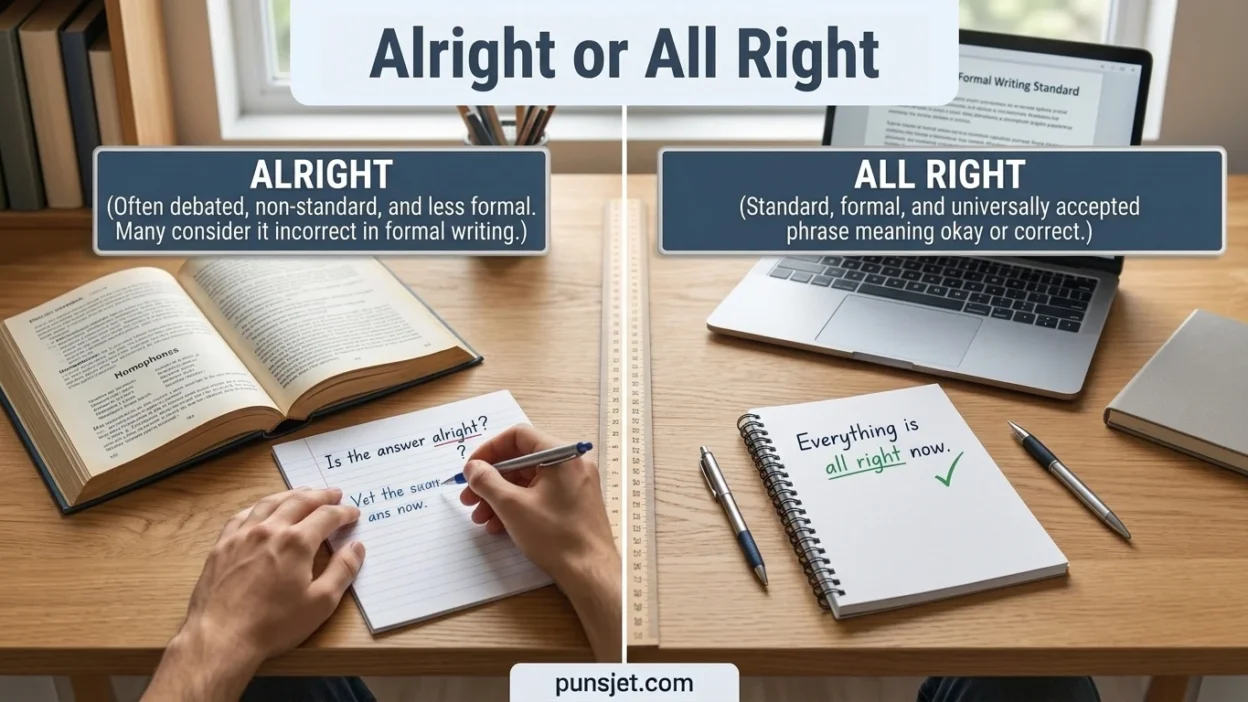
Have you ever written “alright” and wondered if you should have written “all right” instead?
You are not alone. These two forms look almost identical, sound the same in everyday speech, and are often used in similar situations. That makes them confusing, especially for students and people learning English.
The good news is that the difference is simple.
“All right” is the traditional and widely accepted form. “Alright” is also commonly used, especially in informal writing, but some teachers, editors, and formal writing guides still prefer “all right.”
Understanding when to use each form can help you write more clearly and avoid mistakes.
Quick Answer: Alright or All Right?
Here is the easiest way to remember the difference:
- All right is the traditional form and is accepted in formal writing.
- Alright is a common one-word form, especially in casual and informal writing.
- Both can mean okay, fine, or satisfactory.
- All right can also mean completely correct or safe and well.
- If you are writing an essay, school assignment, business document, or formal message, all right is usually the safer choice.
- In texts, chats, social media, and casual writing, alright is very common.
- Neither form means “very good” in every situation. The exact meaning depends on the sentence.
Simple rule
Formal writing → all right
Informal writing → alright or all right
Where Did “All Right” Come From?
The phrase all right is made from two ordinary words: all and right.
It has been used in English for a long time to express ideas such as being correct, safe, satisfactory, or okay.
For example:
Everything is all right.
This means everything is okay.
Over time, people began writing the expression as one word:
Everything is alright.
The one-word form became very common in everyday English. However, not everyone accepted it as the standard form.
That is why you may see both alright and all right today.
The important point is that alright is not simply a spelling mistake. It is a widely used form of the expression. However, all right remains the safer choice when you want to follow traditional formal writing rules.
Alright vs. All Right: The Main Difference
The biggest difference is not pronunciation or basic meaning. The main difference is style and acceptance in writing.
1. “All Right” Is the Traditional Form
All right is the older and more established form.
It can mean:
- okay
- fine
- safe
- correct
- satisfactory
- acceptable
Examples
Are you all right?
Here, the speaker is asking if someone is okay or safe.
Your answer is all right.
This can mean the answer is correct or acceptable.
Everything will be all right.
This means everything will be okay.
Because all right is widely accepted in formal English, it is usually the best choice for academic and professional writing.
2. “Alright” Is a Common One-Word Form
Alright is often used in everyday and informal English.
It usually has the same basic meaning as all right.
Examples
Are you alright?
It’s alright. Don’t worry.
I’ll be alright.
Alright, let’s begin.
You will often see alright in conversations, text messages, online posts, and informal communication.
However, some people still consider alright less formal than all right.
So if you are unsure, use all right.
Comparison Table
| Point | All Right | Alright |
|---|---|---|
| Number of words | Two | One |
| Meaning | Okay, fine, correct, safe | Usually okay, fine, or acceptable |
| Traditional form | Yes | No |
| Common in conversation | Yes | Yes |
| Common in informal writing | Yes | Very common |
| Safe for formal writing | Yes | Less preferred by some |
| Used in school assignments | Recommended | Better avoided if your teacher prefers traditional usage |
| Used in texts and chats | Yes | Yes |
| Pronunciation | Usually the same | Usually the same |
What Does “All Right” Mean?
The phrase all right has several related meanings.
Meaning 1: Okay or Fine
I’m all right now.
The person means they are okay.
Meaning 2: Safe or Not Hurt
Is your brother all right?
This asks whether the brother is safe or unharmed.
Meaning 3: Acceptable
The movie was all right.
Here, the movie was okay, but perhaps not excellent.
Meaning 4: Correct
Your answer is all right.
This means the answer is correct or acceptable.
Meaning 5: Agreement
“All right” can also be used to show agreement.
All right, I’ll help you.
This means:
Okay, I’ll help you.
What Does “Alright” Mean?
Alright usually carries the same basic meanings.
Examples:
Are you alright?
Meaning: Are you okay?
Don’t worry. Everything is alright.
Meaning: Everything is okay.
Alright, let’s go.
Meaning: Okay, let’s go.
The food was alright.
Meaning: The food was okay, but not especially great.
The meaning comes from the sentence, not simply from whether the writer uses one word or two.
Which One Should You Use?
If you are a student or beginner, the easiest rule is:
Use “all right” when you want the safest choice.
This is especially useful in:
- school assignments
- academic writing
- formal letters
- professional documents
- official communication
- exams
For example:
I hope you are all right after the accident.
This is a safe choice in any type of writing.
Use “alright” in casual situations.
It is common in:
- text messages
- chats
- social media
- informal conversations
- casual personal writing
For example:
Alright, I’ll see you tomorrow!
This sounds natural and relaxed.
Common Mistakes With Alright and All Right
Mistake 1: Thinking “Alright” Is Always Wrong
Some people say that alright is always incorrect.
That is too simple.
Alright is a real and widely used form in modern English. However, it is less traditional and may not be preferred in formal writing.
So the better rule is:
Alright is common and informal; all right is the safer traditional form.
Mistake 2: Thinking They Have Different Pronunciations
In normal speech, alright and all right are generally pronounced the same way.
The difference is mainly in how they are written.
Example
Are you all right?
and
Are you alright?
These sentences normally sound the same when spoken.
Mistake 3: Writing “Allright”
A common spelling mistake is:
Allright
This is not the standard form.
Use either:
or:
Do not combine the two into allright.
Mistake 4: Using “Alright” in Every Formal Situation
Even though alright is widely used, some teachers, editors, and formal writing styles still prefer all right.
For an important school paper, application, report, or formal letter, choosing all right avoids unnecessary disagreement about style.
Everyday Examples
Seeing these words in real situations makes the difference easier to understand.
In an Email
Formal:
I hope you are all right after your recent trip.
Casual:
Hope you’re alright!
Both are understandable, but the first is more traditional and formal.
In a Text Message
Are you alright? You sounded worried earlier.
This is completely natural in casual communication.
You could also write:
Are you all right?
Both are understandable.
In Social Media
Alright, who is ready for the weekend?
The one-word form fits casual online communication well.
At School
A teacher might write:
Your answer is all right, but you need to explain your reasoning.
For schoolwork, all right is usually the safer form.
In Daily Conversation
“Are you all right?”
“Yes, I’m all right.”
This is a very common exchange.
You could also hear:
“Are you alright?”
“Yeah, I’m alright.”
Both sound natural in conversation.
A Special Use: “All Right” for Emphasis
Sometimes all right is used to emphasize that something is completely okay.
For example:
Everything is all right.
This can reassure someone that there is no serious problem.
You might also hear:
It’s going to be all right.
This is often used when someone is worried, upset, or afraid.
The expression is comforting because it suggests that the situation will become okay.
A Simple Learning Trick
If you are a student or beginner, remember this:
Think of “all right” as two separate words.
All = everything
Right = okay/correct
So:
Everything is all right.
The phrase suggests that things are okay.
For writing, simply remember:
When in doubt, write “all right.”
This rule will work well in almost every situation.
Alright or All Right: Easy Practice
Choose the better form for each sentence.
1. Are you ___ after the accident?
Answer: all right
Are you all right after the accident?
“Alright” is also commonly used, especially informally, but all right is the safer traditional choice.
2. ___, let’s start the lesson.
Answer: Alright or All right
Both are commonly used here.
Alright, let’s start the lesson.
or
All right, let’s start the lesson.
3. Everything will be ___.
Answer: all right
Everything will be all right.
4. The food was ___.
Answer: all right or alright
Both can mean the food was okay.
The food was all right.
or
The food was alright.
Quick Memory Guide
Here is the whole lesson in a few lines:
ALL RIGHT
- Traditional form
- Two words
- Accepted in formal writing
- Means okay, safe, correct, or acceptable
ALRIGHT
- One word
- Common in informal English
- Very common in conversations and casual writing
- Usually means okay, fine, or acceptable
Best choice for formal writing:
All right
Common choice for casual writing:
Alright
FAQs:
1. Is “alright” a correct word?
Yes. Alright is widely used in modern English, especially in informal writing. However, some formal writing styles still prefer all right.
2. Is “all right” more correct than “alright”?
All right is the traditional and widely accepted form. If you are writing something formal and are unsure which one to choose, use all right.
3. Do “alright” and “all right” mean the same thing?
In most everyday situations, yes. Both can mean okay, fine, or acceptable.
4. Should I use “alright” in a school essay?
It is usually safer to use all right, especially if your teacher expects traditional formal English.
5. Can I use “alright” in a text message?
Yes. Alright is very common in casual messages.
For example:
Alright, I’ll call you later.
6. Is “allright” correct?
No. Do not write allright. Use all right or alright.
7. Are “alright” and “all right” pronounced differently?
Usually, no. They are generally pronounced the same in everyday speech.
8. Which one should beginners remember?
Remember all right as the safest form. Once you understand the difference, you can recognize and use alright in casual writing too.
Conclusion
The difference between alright and all right is mainly about writing style and tradition, not pronunciation or basic meaning.
All right is the traditional two-word form. It is widely accepted and is the safest choice for formal writing, schoolwork, professional communication, and important documents.
Alright is the common one-word form. It appears frequently in conversations, texts, social media, and other informal writing. It usually means the same thing as all right.
If you are ever unsure which form to choose, remember one simple rule:
Once you remember that, you will rarely have trouble choosing between alright and all right.

Joshua Paul is a creative writer and contributor at PunsJet.com who enjoys crafting witty puns and clever wordplay. With a strong sense of humor and a love for language, he creates entertaining content that readers can easily share and enjoy. Joshua’s goal is to spread laughter through fun and memorable jokes.