The words alternate and alternative look and sound very similar, so it is easy to mix them up. Both words are connected with the idea of choosing or using something different, but they are not always used in the same way.
For students, English learners, and beginners, the main problem is that alternate can describe things that happen one after another, while alternative usually means another choice or option.
For example:
- We alternate between two activities.
- We need an alternative plan.
Once you understand this small difference, these words become much easier to use.
Quick Answer: Alternate vs. Alternative
Here is the easiest way to remember the difference:
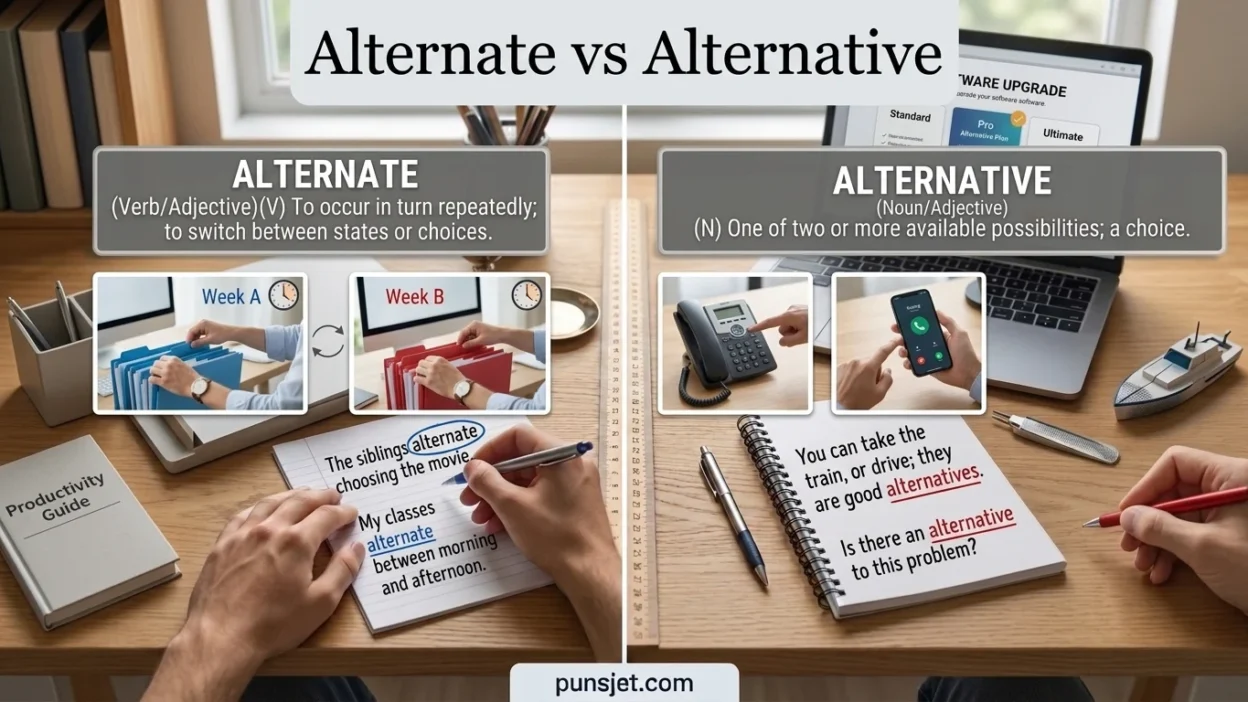
- Alternate can mean to take turns or happen one after another.
- Alternate can also mean a substitute or replacement in some situations.
- Alternative usually means another choice or option.
- Alternate is often connected with taking turns or switching.
- Alternative is often connected with choosing between possibilities.
- Alternate can be a verb, adjective, or noun.
- Alternative can be a noun or adjective.
Simple examples
Alternate:
We alternate between walking and running.
This means the two activities take turns.
Alternative:
We need an alternative to driving.
This means we need another choice instead of driving.
Easy memory trick
Think:
Alternate = take turns
Alternative = another choice
This simple idea will help you in most everyday situations.
A Simple Look at Their Background
Both words have a connection to the idea of changing or choosing something different.
The word alternate comes from a word meaning “to do one thing and then another.” This explains why it is commonly used for things that happen in turns.
For example:
The team alternates between home and away games.
The games switch from one situation to another.
The word alternative is connected with the idea of another possibility or choice.
For example:
We need an alternative solution.
This means we need another solution because the first one may not work or may not be suitable.
Over time, both words developed several uses. That is why you may sometimes see alternate and alternative used in ways that seem very similar.
What Does “Alternate” Mean?
Alternate has several uses, but the main idea is taking turns or switching between two or more things.
Alternate as a verb
As a verb, alternate means to do different things one after another.
For example:
I alternate between studying and exercising.
This means you study, then exercise, then study again, and so on.
Another example:
The two teachers alternate teaching the class.
One teacher teaches at one time, and the other teacher teaches at another time.
More examples
- We alternate between English and Spanish during the lesson.
- She alternates between working at home and working in the office.
- The players alternate turns.
- The lights alternate between red and green.
In each example, there is some kind of switching or turn-taking.
Alternate as an Adjective
Alternate can also describe something that happens every other time.
For example:
We have meetings on alternate Mondays.
This means the meetings happen every other Monday.
Another example:
She works on alternate days.
This means she works one day, does not work the next day, and then works the following day.
So, when you see alternate days, alternate weeks, or alternate years, think every other one.
Alternate as a Noun
An alternate can also be a person who is ready to take someone’s place.
For example:
Sarah was chosen as an alternate for the competition.
This means Sarah can take the place of another person if needed.
You may see this use in competitions, meetings, teams, or official events.
What Does “Alternative” Mean?
Alternative usually means another choice, possibility, or option.
For example:
We need an alternative to this plan.
This means we need another plan.
You might choose the alternative because the original option is too expensive, difficult, unsafe, or simply not suitable.
Examples
Is there an alternative way to solve this problem?
This asks whether another method is available.
We need an alternative to plastic bags.
This means we are looking for another option instead of plastic bags.
Taking the train is an alternative to driving.
Driving is one choice, and taking the train is another.
The main idea is another possibility.
Alternative as a Noun
As a noun, alternative means another choice.
For example:
We have two alternatives.
This means we have two choices.
Another example:
There is no alternative but to wait.
This means there is no other choice except waiting.
You may often hear phrases such as:
- a good alternative
- an affordable alternative
- an easy alternative
- an alternative option
- an alternative solution
- an alternative method
Alternative as an Adjective
Alternative can also describe something that is different from the usual or traditional choice.
For example:
They are looking for alternative energy sources.
This means energy sources that are different from the usual ones.
Another example:
She uses alternative methods of transportation.
This means she uses methods different from the normal or common ones.
Alternate vs. Alternative: Comparison Table
| Word | Main meaning | Common use | Example |
|---|---|---|---|
| Alternate | Take turns or switch | Actions, times, people, days | We alternate between two tasks. |
| Alternate | Every other | Days, weeks, events | We meet on alternate Fridays. |
| Alternate | A substitute | A person or thing that can replace another | He is an alternate player. |
| Alternative | Another choice | Plans, methods, options | We need an alternative plan. |
| Alternative | Different from the usual | Methods, lifestyles, energy, ideas | They use alternative energy. |
Alternate or Alternative: Which One Should You Use?
The easiest way to decide is to ask yourself a question.
Are things taking turns?
Use alternate.
The students alternate between reading and writing.
The activities take turns.
Does something happen every other time?
Use alternate.
We visit our grandparents on alternate weekends.
This means every other weekend.
Are you talking about another choice?
Use alternative.
We need an alternative to this expensive hotel.
You are looking for another option.
Are you talking about something different from the usual?
Use alternative.
They are exploring alternative forms of transportation.
The transportation methods are different from the usual ones.
Common Mistakes
Mistake 1: Using “alternate” when you mean “another choice”
Incorrect:
We need an alternate plan because this one failed.
In some varieties of English, alternate can be used to mean a substitute, so this sentence may be understood. However, alternative plan is often the clearer choice when you simply mean another possible plan.
Better:
We need an alternative plan because this one failed.
Mistake 2: Using “alternative” for taking turns
Incorrect:
The players alternative between offense and defense.
Better:
The players alternate between offense and defense.
Here, the players are switching or taking turns, so alternate is the correct word.
Mistake 3: Confusing “alternate days” with “alternative days”
These phrases do not normally mean the same thing.
Alternate days means every other day.
I exercise on alternate days.
Alternative days would suggest days that are another option or different from the usual days.
So if you mean every other day, use alternate days.
Mistake 4: Thinking the two words are always interchangeable
Although they are related, they have different common uses.
Compare:
We alternate between two restaurants.
This means we take turns using the restaurants.
We chose an alternative restaurant.
This means we chose another restaurant instead of the first one.
The first sentence focuses on switching.
The second focuses on another choice.
Everyday Examples
Understanding real-life examples makes the difference much easier.
In Emails
We can alternate between morning and afternoon meetings.
The meeting times change from one to the other.
If this meeting time does not work, we can find an alternative time.
Here, you are looking for another possible time.
At School
The teacher asks students to alternate between reading and answering questions.
The students switch between two activities.
The teacher offered an alternative way to complete the assignment.
The teacher gave another possible method.
At Work
The employees alternate working from home and from the office.
They switch between the two arrangements.
The manager suggested an alternative solution.
The manager suggested another solution.
In Daily Life
My brother and I alternate washing the dishes.
We take turns.
Walking is a good alternative to taking the bus.
Walking is another choice.
In News and Public Discussions
You may hear:
The government is considering alternative sources of energy.
This means it is considering other choices besides traditional energy sources.
You may also read:
The two teams alternate playing at home and away.
This means the locations change from one game to another.
On Social Media
Someone might write:
I alternate between coffee and tea.
They switch between the two drinks.
Another person might say:
If you do not like coffee, tea is a good alternative.
Tea is another choice.
A Short Learning Section for Students and Beginners
If you are learning English, do not try to memorize every dictionary meaning at once. Start with the two most important ideas.
Remember this:
Alternate → switch or take turns
The boys alternate between football and basketball.
Alternative → another choice
Basketball is an alternative to football.
You can also use this simple test:
Ask: “Are things changing turns?”
If yes, think alternate.
Ask: “Am I looking for another option?”
If yes, think alternative.
Practice
Choose the correct word:
- We ______ between two activities.
- We need an ______ plan.
- She works on ______ days.
- Is there an ______ to this method?
- The two players ______ turns.
Answers:
- alternate
- alternative
- alternate
- alternative
- alternate
Practice sentences like these until the difference feels natural.
FAQs:
1. What is the main difference between alternate and alternative?
Alternate often means to switch, take turns, or happen every other time. Alternative usually means another choice or option.
2. Does alternate mean “every other”?
Yes. Alternate can mean every other when talking about things such as days, weeks, or events.
We meet on alternate Saturdays.
This means every other Saturday.
3. Does alternative mean another choice?
Yes. This is one of its most common meanings.
We need an alternative.
It means we need another choice or possibility.
4. Can alternate mean a substitute?
Yes. Alternate can be used as a noun or adjective for someone or something that can replace another person or thing.
He was selected as an alternate player.
However, when you simply mean “another option,” alternative is often clearer.
5. Is “alternative option” correct?
Yes, it is common, although some people consider alternative alone enough because an alternative is already a choice or option.
For simple writing, you can say:
We need an alternative.
or:
We need another option.
6. Which is correct: alternate days or alternative days?
If you mean every other day, use alternate days.
I go to the gym on alternate days.
7. Can alternate and alternative be used as adjectives?
Yes.
Alternate can describe something that takes turns or serves as a substitute.
Alternative can describe another choice or something different from the usual.
8. How can I remember the difference?
Use this simple rule:
Alternate = switch or take turns.
Alternative = another choice.
If you remember these two ideas, you will get most uses right.
Conclusion
The difference between alternate and alternative is simple once you focus on their main ideas.
Alternate is commonly used when something takes turns, switches, or happens every other time.
We alternate between two activities.
Alternative is commonly used when you mean another choice, option, or possibility.
We need an alternative plan.
Remember:
Alternate = take turns
Alternative = another choice
When you see these words in everyday English, stop and ask whether the sentence is about switching between things or choosing another option. That small question can help you choose the right word with confidence.

Joshua Paul is a creative writer and contributor at PunsJet.com who enjoys crafting witty puns and clever wordplay. With a strong sense of humor and a love for language, he creates entertaining content that readers can easily share and enjoy. Joshua’s goal is to spread laughter through fun and memorable jokes.