Among and amongst are two English words that mean almost exactly the same thing. Both are used when someone or something is surrounded by, included with, or part of a group.
- She was sitting among her friends.
- She was sitting amongst her friends.
Both sentences are correct and have the same basic meaning.
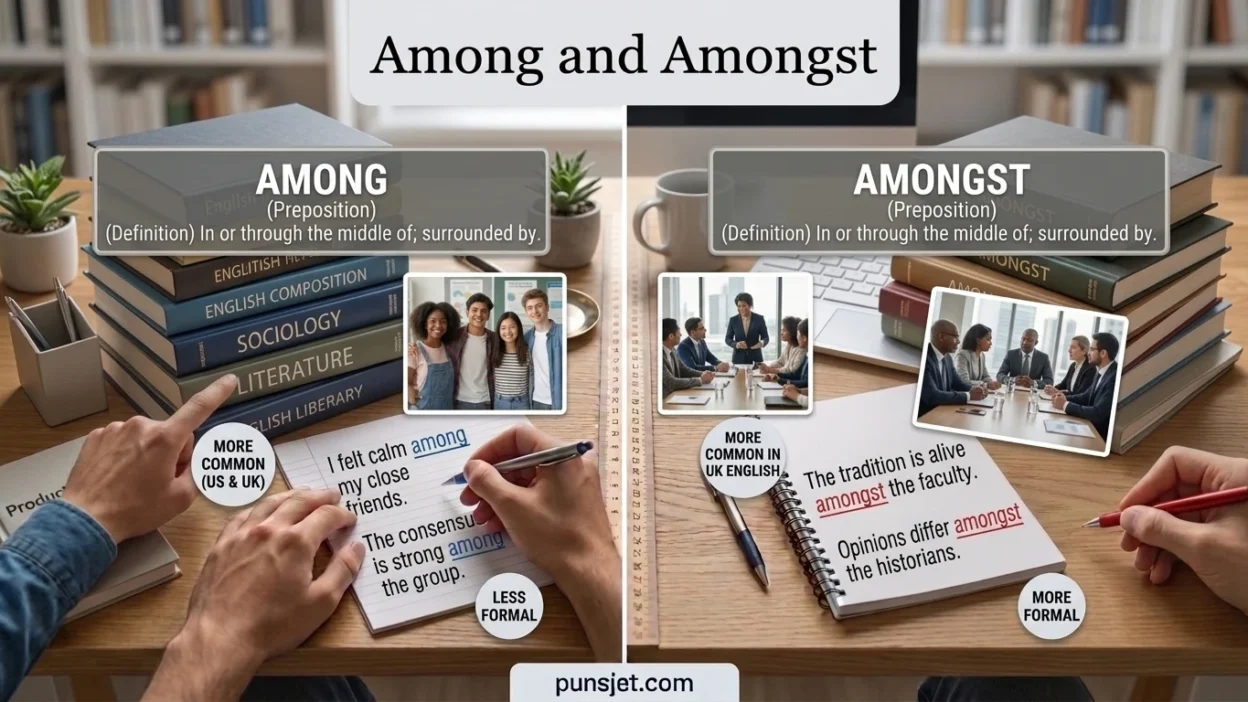
So, why are there two words? The main difference is not meaning. It is style and usage. Among is much more common in modern English, especially in everyday American English. Amongst is less common and can sound more formal, traditional, or British.
This guide explains both words in simple English so you can understand exactly when to use each one.
Quick Answer: Among vs. Amongst
Here is the easiest way to remember the difference:
- Among means surrounded by or included in a group.
- Amongst has the same basic meaning as among.
- Among is much more common in modern English.
- Amongst can sound more formal, old-fashioned, or literary.
- Both words are grammatically correct.
- In everyday writing and speaking, among is usually the safest choice.
- The choice between them usually depends on style, not meaning.
Simple example
The teacher walked among the students.
This means the teacher walked through or was surrounded by the students.
You could also say:
The teacher walked amongst the students.
The meaning stays almost the same.
What Does “Among” Mean?
Among is a preposition used when a person or thing is part of a group or is surrounded by several people or things.
Examples
- She found her phone among the books.
- He felt comfortable among his classmates.
- There was a discussion among the workers.
- The house stood among tall trees.
- I saw my old friend among the crowd.
In each example, something or someone is connected with a group.
Another common use
Among can also describe something being shared or divided within a group.
For example:
The teacher divided the books among the students.
This means the books were distributed to the students.
Another example:
They shared the food among themselves.
Here, among shows that several people shared something.
What Does “Amongst” Mean?
Amongst has almost the same meaning as among.
It can mean:
- in the middle of a group
- surrounded by several people or things
- included in a group
- shared within a group
Examples
- She walked amongst the trees.
- He was popular amongst his classmates.
- The news spread amongst the workers.
- The children played amongst the flowers.
- They divided the money amongst themselves.
All of these sentences are grammatically possible.
However, amongst is not as common as among in modern everyday English.
Where Did “Among” and “Amongst” Come From?
Both words have a long history in English.
Among developed from older forms of English that referred to being in a group or surrounded by others. Amongst developed as a longer form of the same word.
Over time, both remained in the English language.
Today, they still have essentially the same meaning. However, their popularity is different. Among became the more common choice, while amongst remained in use in certain styles and varieties of English.
You may see amongst more often in British English, formal writing, books, speeches, or literary writing. This does not mean that amongst is wrong or that among is only American.
Both are standard English words.
Among vs. Amongst: The Main Difference
The most important point is simple:
There is usually no important difference in meaning between among and amongst.
The main difference is how they sound and how often they are used.
Among
Among is:
- more common
- natural in everyday conversation
- common in American English
- common in British English too
- suitable for formal and informal writing
Amongst
Amongst is:
- less common
- often associated with British English
- sometimes more formal or literary
- sometimes used for style or emphasis
- perfectly correct in suitable contexts
Consider these two sentences:
She lived among the villagers.
She lived amongst the villagers.
The meaning is almost identical. The second sentence may sound slightly more traditional or literary to some readers.
Comparison Table
| Feature | Among | Amongst |
|---|---|---|
| Basic meaning | In or surrounded by a group | In or surrounded by a group |
| Grammar | Preposition | Preposition |
| Meaning difference | Usually none | Usually none |
| Frequency | Very common | Less common |
| Everyday speech | Very natural | Less common |
| Formal writing | Common | Possible |
| British English | Common | Also common |
| American English | Very common | Less common |
| Literary style | Common | Can sound literary |
| Best general choice | Yes | Use when the style fits |
Which One Should You Use?
If you are learning English and are unsure which word to choose, use among.
It is simple, natural, and widely understood.
Use “among” in everyday situations
For example:
I was standing among my friends.
She found the letter among the papers.
He is well known among young people.
The teacher walked among the students.
These sentences sound natural in modern English.
When can you use “amongst”?
You can use amongst when you want a more traditional or literary sound, or when it naturally fits the style of the sentence.
For example:
A small cottage stood amongst the hills.
This has a slightly more literary feeling.
Another example:
She searched amongst the old photographs.
This is also correct, although among would be more common:
She searched among the old photographs.
The choice is mostly about style.
Common Mistakes With Among and Amongst
1. Thinking “amongst” is incorrect
This is one of the biggest mistakes.
Amongst is a correct English word.
It is simply less common than among in many types of modern English.
Incorrect idea:
“Among is correct, but amongst is wrong.”
Better understanding:
Both are correct, but among is more common.
2. Thinking they have completely different meanings
They generally do not.
For example:
The children played among the trees.
and
The children played amongst the trees.
Both tell us that the children were in or surrounded by the trees.
3. Using “amongst” everywhere
Although amongst is correct, using it in every sentence can make your writing sound unnecessarily formal or old-fashioned.
For everyday writing, among is usually a better choice.
4. Avoiding “among” because it sounds too simple
Some learners think a longer word must sound more advanced.
That is not true.
Among is completely correct in formal writing.
For example:
The decision was discussed among the members.
There is no need to replace among with amongst just to make the sentence sound more formal.
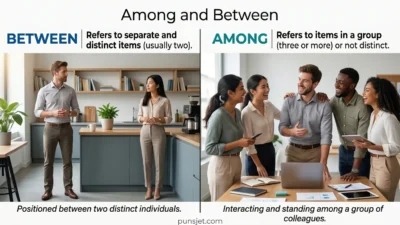
5. Confusing “among” with “between”
Learners sometimes wonder whether they should use among or between when talking about several people.
Traditionally, between is often associated with two people or things, while among is commonly used with groups of three or more.
For example:
The agreement was made between the two companies.
The teacher divided the prizes among the five students.
However, real English usage is more flexible, and between can also be used with more than two people or things when the relationships are considered separately.
For beginners, a simple rule is:
- between → often used for separate relationships
- among → often used for a group
Everyday Examples of Among
Here are some examples you may hear or read in daily life.
At school
She was sitting among her classmates.
At work
The manager shared the information among the team members.
In an email
Please share this message among the staff.
In the news
The decision caused concern among local residents.
On social media
The post became popular among young users.
In daily conversation
I found my keys among the clothes.
In nature
A small bird was hiding among the branches.
Everyday Examples of Amongst
Although less common, amongst can appear in everyday and written English.
Example 1
She walked amongst the crowd.
Example 2
The children ran amongst the trees.
Example 3
He felt relaxed amongst his friends.
Example 4
The message spread quickly amongst the workers.
Example 5
They searched amongst the old boxes.
Each sentence is understandable and grammatically acceptable.
However, in many of these examples, among would sound more natural to a wider range of readers.
A Simple Trick to Remember
If you are unsure, remember this:
Among = the normal choice.
Amongst = the less common alternative.
You do not need to worry about changing the meaning.
Think of it this way:
Among = common and simple
Amongst = less common and sometimes more traditional
For most school assignments, emails, messages, and everyday conversations, among is an excellent choice.
Learning Section for Students and Beginners
If English is not your first language, do not spend too much time worrying about this pair.
First, learn how among works.
Basic pattern
among + group
Examples:
- among friends
- among students
- among people
- among trees
- among the books
- among the crowd
Practice
Choose the word that sounds more natural:
- She was sitting ___ her friends.
- I found the note ___ the papers.
- The teacher walked ___ the students.
- The news spread ___ the people.
For normal modern English, among works naturally in all four sentences.
You can also use amongst in many of them, but it may sound more formal or traditional.
Remember the meaning
When you see among, think:
“in or surrounded by a group.”
When you see amongst, think:
“the same basic idea, with a different style.”
FAQs:
1. Is “amongst” a correct word?
Yes. Amongst is a correct English word. It has almost the same meaning as among.
2. Is “among” more common than “amongst”?
Yes. Among is much more common in modern English, especially in everyday use.
3. Is “amongst” British English?
It is commonly associated with British English, although it is not used only in Britain. It can also appear in other varieties of English.
4. Which is better: among or amongst?
Neither is grammatically better. However, among is usually the safer and more natural choice for general modern English.
5. Can I use “amongst” in formal writing?
Yes. Amongst can be used in formal writing. It may give the sentence a slightly traditional or literary tone.
6. Do among and amongst have different meanings?
Usually, no. They generally have the same basic meaning.
7. Should students use among or amongst?
Students can use either correctly, but among is usually the easiest and most natural choice.
8. Can among mean “in a group”?
Yes. For example:
She felt happy among her friends.
This means she felt happy while she was with her group of friends.
Conclusion
Among and amongst are very similar words. In most situations, they mean the same thing: being in, surrounded by, or included in a group.
The biggest difference is usage and style. Among is much more common and is a natural choice for everyday speaking and writing. Amongst is also correct, but it is less common and can sometimes sound more traditional, formal, or literary.
If you are a student, beginner, or English learner, there is no need to make this complicated. When you are unsure, choose among.
Remember the simple rule:
Among = common, natural, and widely used.
Amongst = correct, but less common and sometimes more traditional.
Once you understand this, you can confidently use either word when the style of your sentence calls for it.

Joshua Paul is a creative writer and contributor at PunsJet.com who enjoys crafting witty puns and clever wordplay. With a strong sense of humor and a love for language, he creates entertaining content that readers can easily share and enjoy. Joshua’s goal is to spread laughter through fun and memorable jokes.