
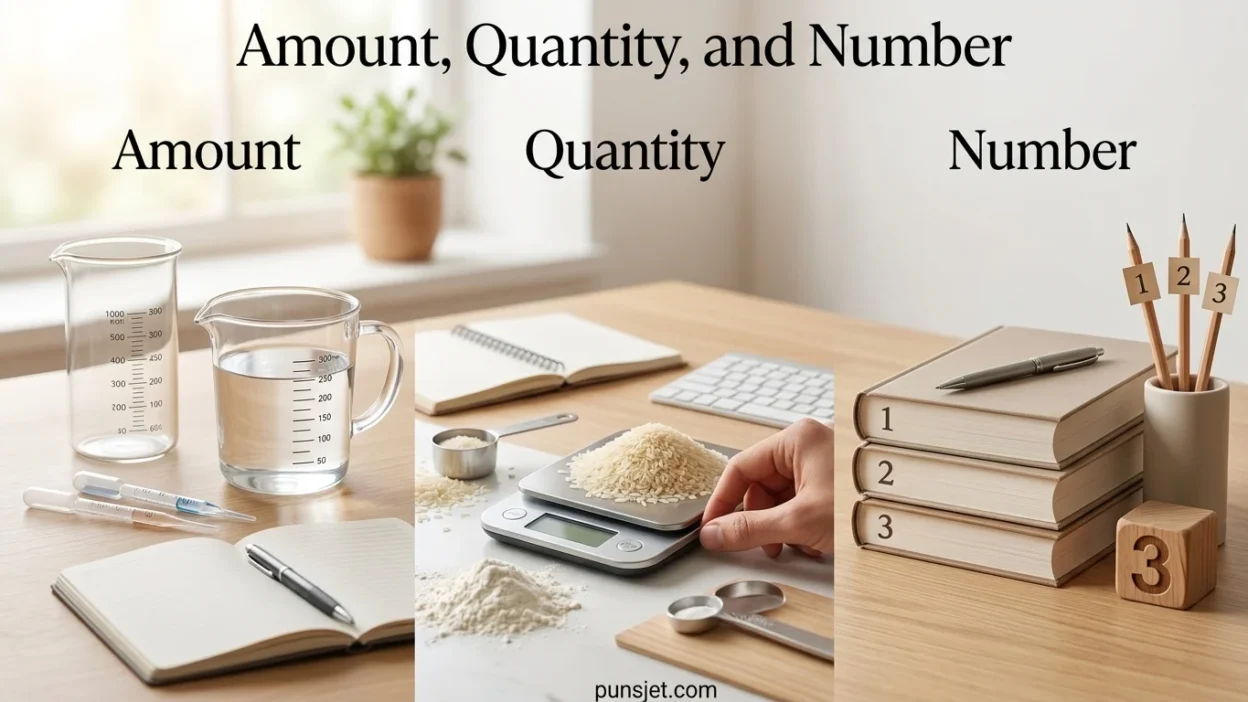
If you are learning English, you may have wondered whether to use amount, quantity, or number. These three words are closely related because they all talk about how much or how many of something there is.
The confusion usually happens because their meanings overlap. For example, you can talk about the amount of money, the quantity of rice, or the number of books. But you cannot always replace one word with another.
The good news is that the basic rule is simple: amount is usually used with uncountable things, number is used with countable things, and quantity can be used more generally for the total amount of something.
Once you understand whether a noun can be counted as separate items, choosing the right word becomes much easier.
Quick Answer: Amount vs. Quantity vs. Number
Here is the easiest way to remember the difference:
- Amount → usually used with uncountable nouns.
- an amount of water
- a small amount of money
- a large amount of information
- Number → used with countable nouns.
- a number of students
- a large number of books
- a small number of mistakes
- Quantity → refers to the total amount of something and can be used with both countable and uncountable nouns, especially in formal or practical contexts.
- a large quantity of rice
- a quantity of products
- a small quantity of chemicals
The easiest rule
Ask yourself:
Can I count the things one by one?
If yes, use number.
If no, amount is usually the natural choice.
Quantity is more general and is especially common when talking about supplies, goods, materials, or measured amounts.
A Simple Background of These Words
The three words have different histories and developed slightly different uses in English.
Amount is connected with the idea of a total or sum. Today, we commonly use it when talking about something that is seen as one whole quantity rather than separate objects.
For example:
She spent a large amount of money.
Money can be counted in dollars, pounds, or coins, but money itself is normally treated as an uncountable noun.
Number is connected to counting. It is naturally used when individual things or people can be counted.
For example:
The number of students in the class is twenty-five.
You can count the students one by one, so number is correct.
Quantity has a broader meaning. It focuses on how much of something exists, is available, is needed, or is being measured.
For example:
We need a larger quantity of rice.
The word quantity often sounds more formal than amount or number, particularly when discussing products, materials, supplies, or measurements.
Amount: Used for Things We Do Not Usually Count
Amount normally goes with uncountable nouns.
Uncountable nouns describe things that are not normally viewed as separate individual units.
Common examples include:
- water
- milk
- money
- information
- advice
- time
- traffic
- furniture
- sugar
- rice
- patience
Examples
I don’t have much time.
She gave me a large amount of information.
We need a small amount of sugar.
He spent a huge amount of money.
There was a surprising amount of traffic on the road.
In each example, the noun after amount of is treated as a whole rather than as separate countable objects.
Amount with abstract ideas
Amount is also common with abstract things:
He showed a great amount of patience.
She has a small amount of confidence.
The project requires a considerable amount of effort.
These things cannot normally be counted as individual items.
Number: Used for Things We Can Count
Number is used with countable nouns.
Countable nouns are things that can be counted individually:
- one student, two students
- one book, three books
- one car, five cars
- one question, ten questions
- one apple, six apples
Examples
A large number of students joined the event.
I have read a small number of books this year.
The teacher asked a number of questions.
A high number of visitors came to the museum.
We received a large number of applications.
The important point is that you can count the noun separately.
You can say:
- one student
- two students
- three students
Therefore:
The number of students is increasing.
is correct.
Number can also refer to an exact figure
Number is especially useful when discussing a specific count:
The number is 45.
What is the number of people attending?
The number of employees increased from 50 to 65.
Quantity: A General Word for How Much
Quantity means the total amount of something.
It can be used with both countable and uncountable nouns, although its use often sounds more formal or practical.
With uncountable nouns
We need a large quantity of water.
A small quantity of sugar was added.
The factory uses a huge quantity of oil.
With countable nouns
You can also see quantity with countable things, especially when discussing goods, products, or supplies:
The store received a large quantity of products.
We ordered a small quantity of bottles.
The company produces large quantities of machines.
In everyday English, however, number is often more natural when you are simply counting separate items.
For example:
A large number of bottles were delivered.
This sounds more natural when the focus is simply on how many bottles there were.
But:
A large quantity of bottles was ordered for the factory.
can make sense when the focus is on the bulk supply rather than simply the count.
Amount vs. Quantity vs. Number: Comparison Table
| Word | Main Use | Usually Used With | Example |
|---|---|---|---|
| Amount | How much of something | Uncountable nouns | an amount of water |
| Number | How many separate things | Countable nouns | a number of books |
| Quantity | Total amount or supply | Countable and uncountable nouns | a quantity of rice |
| Amount | Total or sum | Money, time, information, etc. | an amount of money |
| Number | Count | People, objects, questions, etc. | a number of students |
| Quantity | Bulk or measured supply | Goods and materials | a quantity of products |
Which One Should You Use?
The best choice depends on the noun and what you want to express.
Use “amount” when asking “How much?”
Use amount for uncountable nouns.
How much money do you need?
What amount of money do you need?
She used a small amount of water.
A useful pattern is:
amount of + uncountable noun
Examples:
- amount of time
- amount of money
- amount of work
- amount of information
- amount of food
Use “number” when asking “How many?”
Use number for countable nouns.
How many students are there?
What is the number of students?
A large number of people attended.
A useful pattern is:
number of + plural countable noun
Examples:
- number of students
- number of books
- number of cars
- number of questions
- number of visitors
Use “quantity” when focusing on the total supply
Use quantity when you want to talk about how much of something is available, required, produced, bought, or used.
Examples:
The shop has a large quantity of rice.
We need to reduce the quantity of waste.
The factory produces a large quantity of goods.
It is especially common in business, science, manufacturing, shopping, and instructions.
Common Mistakes
1. Saying “amount of students”
This is a common mistake.
❌ The amount of students is increasing.
✅ The number of students is increasing.
Students are separate people that can be counted.
2. Saying “number of money”
Money is normally uncountable.
❌ The number of money I have is small.
✅ The amount of money I have is small.
You can count dollars or coins, but money itself is generally treated as uncountable.
3. Confusing “amount” with “number”
Remember:
Amount = how much
Number = how many
Compare:
The amount of water in the tank is low.
The number of bottles in the room is low.
Water is uncountable, while bottles are countable.
4. Thinking “quantity” is always wrong with countable nouns
This is not true.
Quantity can be used with countable nouns, particularly when discussing supplies or goods.
The company ordered a large quantity of boxes.
However, if your only purpose is to say how many boxes there are, number is usually the clearer choice.
Everyday Real-Life Examples
These words appear frequently in everyday English.
In emails
Please check the number of files attached to the email.
We need to reduce the amount of information in the report.
Please confirm the quantity of materials required.
In school
The teacher noticed a large number of students were absent.
Students should spend an appropriate amount of time studying.
The experiment requires a small quantity of water.
In shopping
The shop has a limited number of products available.
I don’t want to spend a large amount of money.
The restaurant ordered a large quantity of rice.
In news reports
A large number of people attended the event.
The government spent a significant amount of money on the project.
The country imported a large quantity of goods.
On social media
You may see sentences such as:
A huge number of people watched the video.
She received a large amount of support.
Here, people are countable, while support is generally uncountable.
A Simple Learning Trick for Students
When you are unsure, don’t memorize hundreds of examples. Use this three-step test.
Step 1: Look at the noun
Ask:
Can I count it one by one?
If yes, it is countable.
Examples:
- books
- students
- cars
- questions
Use number.
Step 2: If you cannot normally count it separately
Think of things such as:
- water
- money
- information
- time
- advice
Use amount.
Step 3: Think about bulk, supply, or measurement
If you are talking about a total supply of something, quantity may be a good choice.
Examples:
- a quantity of rice
- a quantity of materials
- a quantity of products
Easy memory sentence
Number counts things. Amount measures uncountable things. Quantity talks about the total supply.
FAQs:
1. Is it “amount of people” or “number of people”?
Number of people is the standard choice because people can be counted individually.
A large number of people attended.
2. Is it “amount of money” or “number of money”?
Use amount of money.
I need a small amount of money.
You can count dollars or coins, but money itself is normally uncountable.
3. Can “quantity” be used with countable nouns?
Yes. Quantity can be used with countable nouns, especially when talking about goods, supplies, or large amounts of products.
A large quantity of boxes was delivered.
But number of boxes is usually better when simply counting them.
4. Is “amount of information” correct?
Yes.
The report contains a large amount of information.
Information is normally uncountable, so amount is appropriate.
5. Is “number of information” correct?
No, not in standard English.
Say:
a large amount of information
not:
a large number of information
6. Is “amount” always used with uncountable nouns?
In standard everyday usage, amount is mainly used with uncountable nouns.
For countable nouns, number is normally the better choice.
7. Which word is more formal: amount or quantity?
Quantity often sounds more formal or technical than amount. It is common in business, science, manufacturing, instructions, and discussions about supplies.
8. What is the easiest way to remember the difference?
Remember these three questions:
- How much? → amount
- How many? → number
- How much is there as a total supply? → quantity
This simple rule will help you choose correctly in most situations.
Final Conclusion
Amount, quantity, and number all talk about how much or how many of something there is, but they are not used in exactly the same way.
Use amount mainly with uncountable nouns such as money, water, time, information, and advice.
Use number with countable nouns such as students, books, cars, questions, and visitors.
Use quantity when talking about a total amount or supply. It works with both countable and uncountable nouns and is especially common in formal, practical, business, and technical situations.
The most useful rule is simple:
Amount = how much
Number = how many
Quantity = total supply or measured amount
Once you learn whether a noun is countable or uncountable, choosing between these three words becomes much easier. With a little practice, you will naturally know whether to say an amount of money, a number of students, or a quantity of materials.

Joshua Paul is a creative writer and contributor at PunsJet.com who enjoys crafting witty puns and clever wordplay. With a strong sense of humor and a love for language, he creates entertaining content that readers can easily share and enjoy. Joshua’s goal is to spread laughter through fun and memorable jokes.