Any one and anyone look almost the same, but they do not always mean the same thing. The small space between the words can change how a sentence works.
This is why students, English learners, and even native speakers sometimes feel confused. When should you write anyone as one word? When should you write any one as two words?
The good news is that the difference is simple once you understand what each form means.
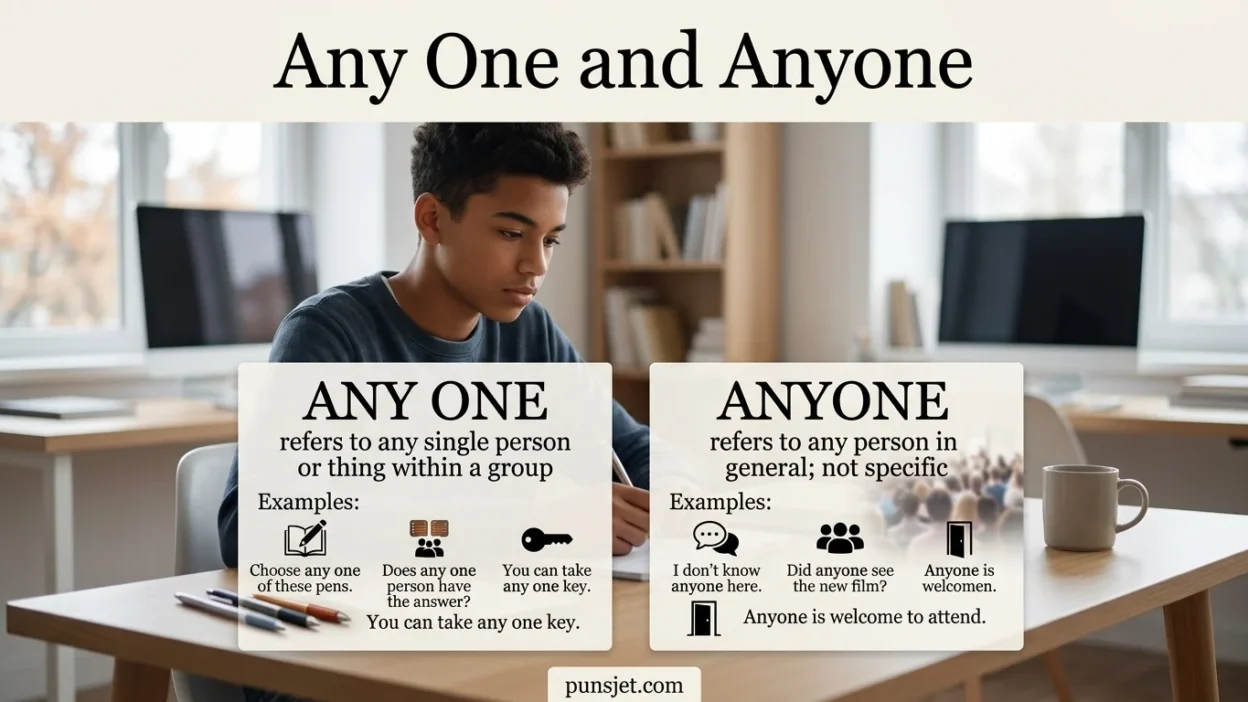
Anyone usually means any person. It is used when you are talking about people in general.
Any one means any single person or thing from a group. The word one has its normal meaning here, so it can point to one particular choice from several options.
Let’s look at the difference with simple explanations and everyday examples.
Quick Answer: Any One vs. Anyone
Here is the easiest way to remember the difference:
- Anyone = any person.
- Any one = any single person or thing from a group.
- Anyone is usually a pronoun.
- Any one is used when you want to stress the idea of one choice.
- Anyone can refer only to people.
- Any one can refer to people or things, depending on the sentence.
- The phrase any one of is very common when choosing one person or thing from a group.
Quick examples
Anyone can learn English.
= Any person can learn English.
You can choose any one of these books.
= You can choose one book from these books.
The first sentence talks about people generally. The second sentence talks about one choice from a group.
What Does “Anyone” Mean?
Anyone is written as one word.
It means any person or any person at all.
We use it when we are talking about people without naming a particular person.
Examples
- Anyone can join the class.
- Does anyone know the answer?
- I don’t think anyone is home.
- Anyone can make a mistake.
- You can ask anyone for help.
In each sentence, anyone refers to a person or people in general.
For example:
This means that any person can learn a new language. We are not choosing one person from a specific group.
Anyone in questions
Anyone is very common in questions.
- Is anyone there?
- Does anyone need help?
- Has anyone seen my phone?
- Did anyone call me?
Here, the speaker does not have a particular person in mind.
What Does “Any One” Mean?
Any one is written as two words.
It means one person or one thing from a group of choices.
The word one is important because the speaker is thinking about a single choice.
Examples
- You may choose any one of these colors.
- Any one of the students can answer the question.
- Take any one of these apples.
- You can pick any one of the three options.
In these examples, there is a group, and you can select one member of that group.
Consider this sentence:
There are several dresses. You may choose one of them.
The phrase any one of is especially useful when you want to make the idea of a single choice clear.
The Simple Difference Between Any One and Anyone
The easiest way to understand the difference is to ask yourself:
Am I talking about any person, or am I choosing one from a group?
If you mean any person, use anyone.If you mean one person or thing from a group, use any one.
There is another useful clue.If the word can be replaced with any person, it is probably anyone.
Example
Anyone can do this.
Replace anyone with any person:
Any person can do this.
The meaning still works.
But:
Choose any one of these bags.
You cannot replace any one with simply any person because the sentence is about selecting one item.
Comparison Table
| Point | Anyone | Any One |
|---|---|---|
| Spelling | One word | Two words |
| Basic meaning | Any person | One person or thing from a group |
| Main idea | People in general | A single choice |
| Can refer to things? | No | Yes |
| Common pattern | Anyone can… | Any one of… |
| Example | Anyone can learn. | Choose any one of these. |
Anyone Can Refer to Any Person
One important thing to remember is that anyone is about people.
For example:
Anyone can apply for the position.
This means any person can apply.
Another example:
I don’t want anyone to worry.
This means the speaker does not want any person to worry.
More examples
- Anyone can make a mistake.
- Anyone could have forgotten.
- Anyone is welcome here.
- I haven’t told anyone.
- Can anyone help me?
Notice that all these examples are about people.
Any One Can Refer to People or Things
Because any one focuses on the word one, it can be used for either people or things.
Talking about people
This means one teacher from the group can explain it.
Talking about things
This means you can select one phone from the available choices.
More examples:
- Take any one of the keys.
- Choose any one of these answers.
- Any one of the players could win.
- Pick any one of these cakes.
When Should You Use “Anyone”?
Use anyone when you mean any person.
Use it for general statements
Use it in questions
Use it in negative sentences
Use it when the exact person does not matter
The focus is on people, not on selecting one specific member of a group.
When Should You Use “Any One”?
Use any one when you mean one from a group or list.
It is especially common before of.
Examples
- Choose any one of these answers.
- You can invite any one of your friends.
- Take any one of the available seats.
- Any one of these methods will work.
Here, the group is clear:
- these answers
- your friends
- available seats
- these methods
The speaker is saying that one member of the group is acceptable.
A Simple Test to Remember the Difference
Try this quick test whenever you are unsure.
Test 1: Can you say “any person”?
If yes, use anyone.
Anyone can help you.
→ Any person can help you.
That works, so anyone is correct.
Test 2: Are you choosing one from a group?
If yes, use any one.
Choose any one of these pictures.
You are selecting one picture from several pictures.
So any one is correct.
Easy memory trick
Think:
Anyone = any person
Any one = any single choice
This small trick can help you remember the difference.
Common Mistakes People Make
Mistake 1: Using “anyone” for an object
Incorrect:
Better:
Why? A book is a thing, not a person. You are also selecting one book from a group.
Mistake 2: Adding a space when you mean “any person”
Incorrect:
Better:
Here, the meaning is any person can join.
Mistake 3: Forgetting “of” when talking about a group
A common and clear structure is:
For example:
This clearly shows that the speaker means one option from a group.
Mistake 4: Thinking the two forms are always interchangeable
They are not always interchangeable.
Compare:
Anyone can answer.
= Any person can answer.
Any one of the students can answer.
= One student from the group can answer.
The meanings are close, but the focus is different.
Everyday Examples
In school
Anyone can ask a question during the lesson.
This means any student or person can ask.
Any one of these students can give the presentation.
This means one student from the group can give it.
In an email
If anyone has questions, please contact me.
Here, the writer means any person who has a question.
Another example:
Please choose any one of the three meeting times.
Here, the reader must select one time from three choices.
On social media
Anyone can share this post.
This refers to people generally.
You can use any one of these photos.
This refers to choosing one photo.
In daily conversation
Does anyone want coffee?
= Does any person want coffee?
Take any one of these chairs.
= Take one chair from the group.
In instructions
Anyone can follow these steps.
This means the instructions are open to all people.
Select any one of the options below.
This means select one option from the list.
Learning Tip for Students and Beginners
Do not try to memorize long grammar rules. Remember the meaning.
Remember these two lines:
Anyone = any person
Any one = one from a group
Then practice with pairs.
Anyone can use this computer.
→ Any person can use it.
Any one of these computers will work.
→ One computer from the group will work.
Another pair:
Anyone can enter the room.
→ Any person can enter.
Any one of the students can enter the room.
→ One student from the group can enter.
When you practice this way, the difference becomes much easier to see.
FAQs:
1. Is “anyone” one word?
Yes. Anyone is normally written as one word when it means any person.
Example:
Anyone can learn English.
2. Is “any one” also correct?
Yes. Any one is correct when you mean one person or thing from a group.
Example:
Choose any one of these books.
3. Can “anyone” refer to things?
Usually, no. Anyone refers to people.
For things, use any one when you mean one item from a group.
Choose any one of these bags.
4. What does “any one of” mean?
Any one of means one person or thing from a particular group.
Example:
Any one of these answers could be correct.
5. Is “anyone of these” correct?
When you mean one item from a group, any one of these is the clearer form.
Example:
You may choose any one of these options.
6. Is “anyone” the same as “everybody”?
No. They can sometimes appear in similar sentences, but they do not have exactly the same meaning.
Anyone means any person.
Everybody means all people in a group or situation.
7. How can I remember the difference?
Use this simple rule:
Anyone = any person.
Any one = one choice from a group.
8. Which form is more common?
Anyone is very common in everyday English because we often use it to talk about people generally.
Any one is also common, especially when making a choice from a group.
Conclusion
The difference between anyone and any one is small in spelling but important in meaning.
Use anyone when you mean any person:Use any one when you mean one person or thing from a group:The easiest way to remember the rule is:
Anyone = any person.
Any one = one from a group.Whenever you are unsure, ask yourself whether you are talking about people in general or one choice from several options. Once you make that distinction, choosing between anyone and any one becomes much easier.