Any more and anymore look almost the same, so it is easy to mix them up. They sound the same when we speak, but they can have different meanings and uses in writing.
The good news is that the difference is quite simple once you know what to look for.
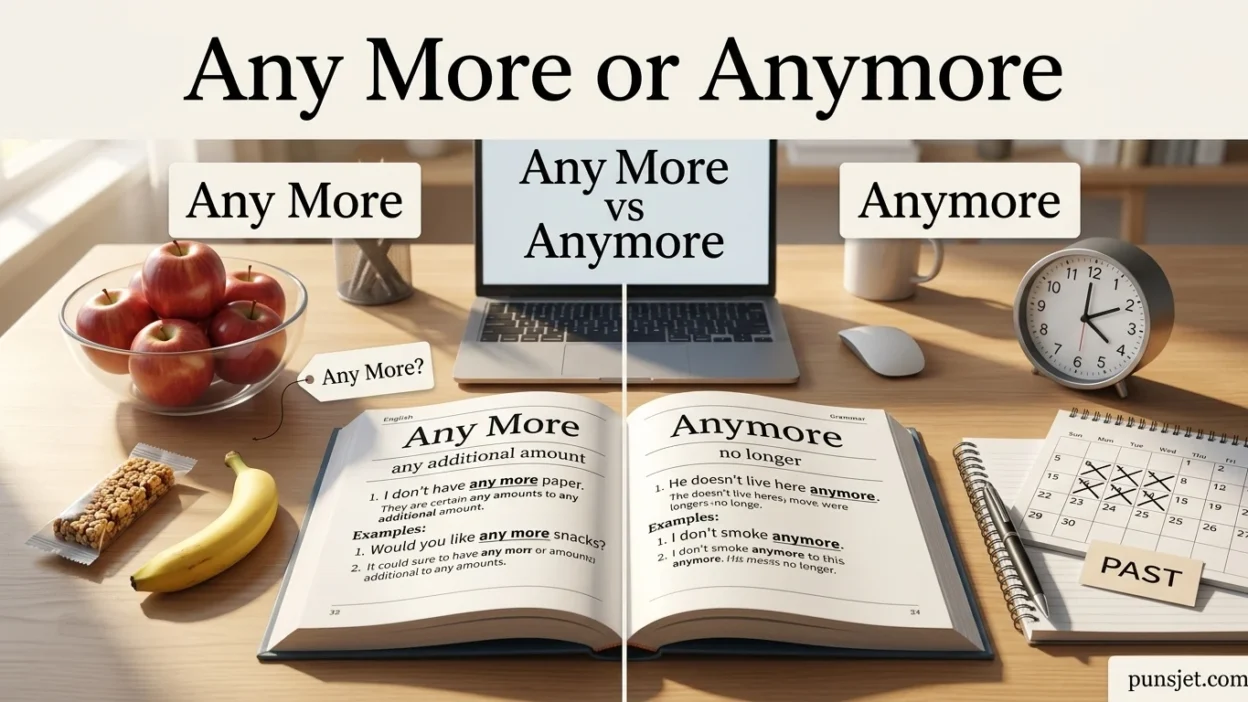
In most cases, any more refers to an additional amount or number of something. Anymore, written as one word, usually means “now” or “any longer,” especially when talking about something that has stopped happening.
For example:
- Do you want any more coffee? → Do you want additional coffee?
- I don’t drink coffee anymore. → I no longer drink coffee.
This guide explains both forms with simple rules, examples, and common mistakes so you can use them confidently.
Quick Answer: Any More vs. Anymore
Here is the easiest way to remember the difference:
- Any more = an additional amount or number.
- Anymore = any longer or from now on.
- Any more is written as two words.
- Anymore is written as one word.
- Any more commonly appears before a noun.
- Anymore is usually connected with something that no longer happens.
- Any more can be used in questions and negative sentences.
- Anymore is especially common in negative sentences such as “I don’t live there anymore.”
Compare:
Would you like any more food?
Here, “any more” means additional food.
I don’t eat there anymore.
Here, “anymore” means any longer.
A Simple Background
The two forms developed from the same basic idea of “any” + “more.” Over time, English speakers began using the expression in different ways.
When the words describe an additional amount or number, they normally remain separate:
- any more water
- any more questions
- any more money
- any more books
When the expression means “any longer,” it can be written as one word:
- I don’t work there anymore.
- She doesn’t call anymore.
- They aren’t friends anymore.
There is also an important regional difference. Anymore meaning “nowadays” or “these days” is used in some varieties of English, especially in parts of North American English. For example:
Anymore, people shop online more often.
This use is less common in formal international English, so learners are usually safer using “nowadays” or “these days” when they mean “these days.”
Any More: Two Words
What Does “Any More” Mean?
Any more means an additional amount or number.
It usually appears when you are asking whether someone wants, needs, has, or can provide something additional.
The word more keeps its normal meaning of additional.
Examples
- Do you need any more help?
- Would you like any more tea?
- Are there any more questions?
- We don’t have any more chairs.
- I don’t want any more food.
- Do you have any more information?
In these examples, you can think of “any more” as additional.
For example:
Do you need any more help?
means:
Do you need additional help?
That simple replacement test can be very useful.
“Any More” With Nouns
One of the easiest clues is that any more often comes directly before a noun.
Examples:
- any more money
- any more time
- any more questions
- any more work
- any more water
- any more people
- any more books
Consider this sentence:
Do you have any more questions?
“Questions” is a noun, and “any more” tells us about additional questions.
Another example:
We don’t need any more chairs.
The speaker means that no additional chairs are needed.
Anymore: One Word
What Does “Anymore” Mean?
Anymore usually means “any longer” or “from this time onward.”
It is commonly used when something that happened before has stopped happening.
Examples
- I don’t live there anymore.
- She doesn’t work here anymore.
- We don’t talk anymore.
- He isn’t angry anymore.
- They don’t visit us anymore.
- I can’t stay here anymore.
Look at this sentence:
I don’t watch television anymore.
The meaning is:
I no longer watch television.
You are not talking about an additional amount of television. You are talking about something that has stopped.
The “Any Longer” Test
A very useful trick is to replace anymore with any longer.
If the sentence still makes sense, anymore is probably correct.
Example
I don’t use that phone anymore.
Replace it:
I don’t use that phone any longer.
The meaning is still clear.
Therefore, anymore is correct.
Another example:
She doesn’t live here anymore.
Replace it:
She doesn’t live here any longer.
Again, the meaning remains the same.
Any More vs. Anymore: Comparison Table
| Point | Any More | Anymore |
|---|---|---|
| Spelling | Two words | One word |
| Main meaning | Additional amount or number | Any longer; no longer |
| Common use | Questions and statements about extra things | Something that has stopped |
| Often followed by a noun | Yes | Usually no |
| Example | Do you need any more water? | I don’t need it anymore. |
| Easy replacement | Additional | Any longer |
| Common negative use | We don’t need any more food. | We don’t eat there anymore. |
Which One Should You Use?
The choice depends on the meaning you want.
Use “Any More” for Something Additional
Use any more when you are talking about an extra amount or number.
Examples:
Would you like any more rice?
Do you have any more questions?
We don’t have any more tickets.
Is there any more milk in the fridge?
A simple question to ask yourself is:
“Am I talking about something extra?”
If yes, use any more.
Use “Anymore” for “Any Longer”
Use anymore when something has stopped or is no longer true.
Examples:
I don’t play that game anymore.
She doesn’t visit us anymore.
He isn’t working there anymore.
We don’t use that old computer anymore.
Ask yourself:
“Can I replace it with ‘any longer’?”
If yes, use anymore.
Common Mistakes
Mistake 1: Writing “Anymore” for an Additional Thing
Incorrect:
Do you want anymore cake?
When you mean additional cake, the standard form is:
Do you want any more cake?
Here, “more” means an additional amount.
Mistake 2: Writing “Any More” When You Mean “Any Longer”
Incorrect:
I don’t live here any more.
This form can be seen in some styles of English, particularly British English, where any more may be used in this sense. However, if you are following the common distinction taught to learners, anymore is the clear one-word form for “any longer”:
I don’t live here anymore.
The important point is to understand that English usage can vary by region.
Mistake 3: Thinking the Pronunciation Is Different
In normal speech, any more and anymore usually sound the same.
That means listening alone may not help you decide which spelling to use.
You need to focus on the meaning.
Mistake 4: Using “Anymore” in Every Sentence
Some learners see “anymore” and assume it can replace “any more.”
It cannot.
Compare:
Do you want any more coffee?
This asks about an additional amount.
I don’t drink coffee anymore.
This means the person no longer drinks coffee.
The meanings are different even though the words sound alike.
Everyday Real-Life Examples
In Emails
Imagine a teacher writes:
Do you have any more questions about the assignment?
The teacher is asking whether students have additional questions.
A different email might say:
I don’t use that email address anymore.
Here, the person no longer uses the address.
In Daily Conversation
At dinner:
At work:
Talking about an old habit:
Talking about a friend:
These examples show how the meaning determines the spelling.
On Social Media
Someone might post:
Another person might ask:
The first sentence means no longer.
The second means additional updates.
In News or Public Information
You might read:
This means the service is no longer available.
You might also see:
In a natural question, this would usually be:
Here, “any more” means additional information.
A Simple Learning Trick
For students and beginners, remember these two questions:
Question 1: Do I mean “additional”?
If yes:
any more
Do you need any more help?
Think: additional help.
Question 2: Do I mean “any longer”?
If yes:
anymore
I don’t need help anymore.
Think: I don’t need help any longer.
This two-question method solves most cases.
More Examples to Practice
Any More
- Can I have any more water?
- Are there any more seats?
- Do you need any more examples?
- We don’t have any more money.
- She doesn’t want any more advice.
- Is there any more work to do?
Anymore
- I don’t work there anymore.
- He doesn’t call anymore.
- She doesn’t play tennis anymore.
- We aren’t using that room anymore.
- They don’t sell that product anymore.
- I can’t wait anymore.
A Quick Practice Test
Choose any more or anymore.
- Do you have ___ questions?
- I don’t live there ___.
- Would you like ___ tea?
- She doesn’t call me ___.
- We don’t need ___ chairs.
- He doesn’t play football ___.
Answers
- any more — additional questions
- anymore — no longer
- any more — additional tea
- anymore — no longer
- any more — additional chairs
- anymore — no longer
If you can explain why each answer works, you understand the main difference.
FAQ
1. Is “anymore” one word?
Yes. Anymore is one word when it means “any longer” or “no longer.”
Example:
I don’t use it anymore.
2. Is “any more” always two words?
When any more means an additional amount or number, yes.
Example:
Do you need any more information?
Here, it means additional information.
3. Are “any more” and “anymore” pronounced the same?
Usually, yes. They normally sound the same in everyday speech.
The difference is mainly in their meaning and spelling.
4. Can “anymore” mean “nowadays”?
Yes. In some varieties of English, especially some North American usage, anymore can mean nowadays or these days.
Example:
Anymore, many people work from home.
However, learners may find nowadays or these days clearer for this meaning.
5. Is “I don’t have anymore money” correct?
If you mean “I don’t have any money left,” standard learner-friendly writing is:
I don’t have any more money.
Here, “any more” describes an additional amount of money.
6. Is “I don’t go there any more” wrong?
Not necessarily. English usage varies by region and style. In some forms of English, any more is also used to mean “any longer.”
However, the spelling distinction any more = additional and anymore = any longer is a very useful standard rule for learners.
7. What is the easiest way to remember the difference?
Use these replacements:
- any more → additional
- anymore → any longer
For example:
Do you want any more cake?
= Do you want additional cake?
I don’t eat cake anymore.
= I don’t eat cake any longer.
8. Which form should I use in formal writing?
Choose the form that matches your meaning and the style of English you are following.
For additional, write any more.
For any longer, anymore is a clear and widely understood choice, although regional differences exist.
Conclusion
The difference between any more and anymore becomes much easier when you focus on meaning rather than pronunciation.
Use any more when you mean something additional:
Do you need any more time?
Use anymore when you mean any longer:
I don’t need it anymore.
The fastest memory trick is:
Any more = additional.
Anymore = any longer.
Once you learn this simple test, you can usually choose the correct form without thinking too much. And remember that English varies by region, so you may sometimes see any more used where another writer would use anymore. The important thing is to understand the meaning and use a consistent style.