Any thing and anything look almost the same, so it is easy to wonder if they mean the same thing. In everyday English, however, they are used differently.
The word anything is very common. We use it when we mean “any object,” “any matter,” or “something of any kind.” For example, “Do you need anything?” means “Do you need something?”
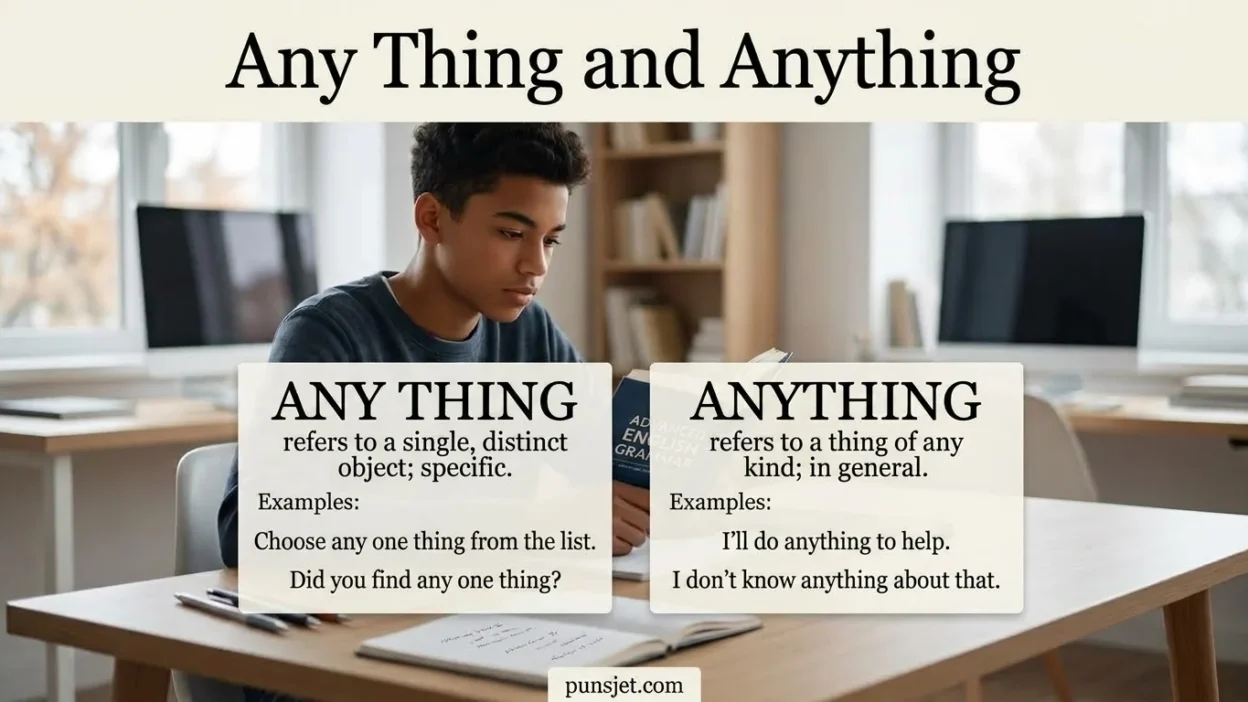
The two-word form any thing is much less common. It is normally used when any describes the noun thing separately. It can be used when a speaker wants to put special attention on the word “thing” or make a contrast.
Understanding this small difference can help you write more naturally and avoid a common spelling mistake.
Quick Answer: Any Thing vs. Anything
Here is the easiest way to remember the difference:
- Anything is one word and is the normal form in most sentences.
- Anything means any object, matter, event, or idea.
- Any thing is two separate words and is used only in special situations.
- In normal questions such as “Do you want anything?” use anything.
- In negative sentences, anything is also common: “I didn’t see anything.”
- Any thing may be used when any directly describes thing for emphasis or contrast.
- If you are unsure, anything will usually be the correct choice.
Simple rule
Use “anything” in normal everyday English. Use “any thing” only when there is a special reason to keep the two words separate.
What Does “Anything” Mean?
Anything is an indefinite pronoun. It can refer to a thing without saying exactly what that thing is.
It can mean:
- any object
- any item
- any matter
- any idea
- any event
- something of any kind
Examples
- Do you need anything?
- You can ask me anything.
- I didn’t buy anything.
- Is there anything I can do?
- Anything is possible if you keep trying.
Notice that anything is written as one word in all these examples.
“Anything” in questions
We often use anything in questions when we do not know what a person may want, need, have, or be looking for.
For example:
This does not ask about one particular food. It means, “Would you like any kind of food?”
Another example is:
The speaker does not know what the person may have found.
“Anything” in Negative Sentences
Anything is also very common after negative words such as not, never, and nothing-related negative expressions.
For example:
- I don’t know anything about it.
- She didn’t say anything.
- We couldn’t find anything useful.
- He never asks for anything.
In these sentences, anything has a meaning similar to “any thing at all.”
Compare these:
I didn’t see anything.
This means I saw no thing at all.
She doesn’t want anything.
This means she does not want any particular thing.
This use is extremely common in everyday English.
What Does “Any Thing” Mean?
Any thing contains two separate words:
- any = a word that can show an unlimited or unspecified choice
- thing = an object, matter, or item
The phrase any thing is uncommon in modern everyday English.
Most of the time, English speakers use anything instead.
However, there are situations where separating the words can make sense. Usually, the writer wants to emphasize thing as a noun or make a clear contrast.
Example
Any thing that you choose must be clearly explained.
Here, the writer may be focusing on the word thing itself. The phrase can also appear in special grammatical constructions where any is acting directly as a determiner before the noun thing.
Still, in ordinary writing, anything is normally the better choice.
The Main Difference Between Any Thing and Anything
The biggest difference is not really the meaning. It is how the words work in a sentence.
Anything
Anything works as one word.
Example:
You can choose anything.
Here, anything replaces a noun phrase. It means “any thing” or “any object or choice.”
Any thing
Any thing keeps any and thing as separate words.
Example:
Any thing you choose should be useful.
This construction treats thing as a separate noun.
In most normal sentences, however, changing any thing to anything makes the sentence more natural.
Comparison Table
| Feature | Anything | Any thing |
|---|---|---|
| Number of words | One | Two |
| Common in modern English | Yes | No, much less common |
| Basic meaning | Any object, matter, idea, or event | Any individual thing |
| Common in questions | Yes | Rare |
| Common in negative sentences | Yes | Rare |
| Used as a pronoun | Yes | No |
| Best choice for everyday English | Yes | Usually no |
| Example | “Did you hear anything?” | “Any thing you select must be checked.” |
The most important point is simple: “anything” is the normal word you should use in most situations.
Which One Should You Use?
For students, beginners, and everyday writers, the answer is easy:
Use “anything” most of the time.
Choose anything when you mean:
- any object
- any item
- any idea
- any subject
- any matter
- any possible thing
Examples
Correct and natural:
- Can I do anything to help?
- I don’t have anything to say.
- Did you buy anything?
- You can eat anything you like.
- She didn’t tell me anything.
These sentences sound natural because anything is the standard form.
When might “any thing” appear?
Use any thing only when the grammar or meaning requires any and thing to remain separate.
For example, a writer might deliberately say:
Here, the writer is treating thing as a separate noun.
But in ordinary conversation and writing, anything would usually be preferred.
Common Mistakes
Mistake 1: Always writing “any thing”
Some learners think that because any and thing are separate words in meaning, they should always be written separately.
That is not correct.
Wrong for normal usage:
Do you need any thing?
Better:
Do you need anything?
Mistake 2: Thinking “anything” is a spelling error
Some learners see anything and think it should be any thing.
Actually, anything is a standard English word.
Just like:
- something
- nothing
- everything
Anything is normally written as one word.
Mistake 3: Using “any thing” in questions
Questions are one of the places where learners commonly make this mistake.
Instead of:
Use:
Instead of:
Use:
Mistake 4: Confusing “anything” with “everything”
These words are related, but they do not mean exactly the same thing.
Anything means any one thing or any possible thing.
Everything means all things.
A simple way to remember it:
anything = any possible thing
everything = all things
Everyday Examples
Knowing how people use anything in real life makes the difference easier to remember.
In emails
This is a natural way to offer help.
Another example:
In conversations
Friend: “Do you want anything from the store?”
You: “No, thanks. I don’t need anything.”
Both uses are very common.
At school
A teacher might say:
A student might reply:
On social media
People often write:
This means people are welcome to ask any question.
Another example:
In daily life
You may hear:
- Is there anything wrong?
- Can I get you anything?
- I didn’t eat anything this morning.
- You can tell me anything.
- Don’t touch anything.
- Do you need anything else?
All of these use anything as one word.
A Simple Trick to Remember
When you are unsure, ask yourself:
“Am I talking about any possible object, matter, idea, or event?”
If the answer is yes, anything is probably the correct choice.
Remember this sentence:
For example:
This means:
You can choose any thing you want.
The second version explains the meaning, but the first version is the natural English sentence.
Learning Section for Students and Beginners
If you are learning English, do not worry too much about the rare use of any thing.
Focus first on mastering anything.
Learn these three patterns
1. Questions
Do you need anything?
Did you see anything?
Is there anything wrong?
2. Negative sentences
I don’t know anything.
She didn’t buy anything.
We haven’t heard anything.
3. General statements
Anything can happen.
You can choose anything.
He will do anything to help his family.
Once these patterns become familiar, you will naturally know when to use anything.
Quick practice
Choose the better form:
- Do you need anything / any thing?
- I didn’t hear anything / any thing.
- You can choose anything / any thing.
- Is there anything / any thing I can do?
- She doesn’t want anything / any thing.
Answers
- anything
- anything
- anything
- anything
- anything
For normal everyday English, anything is the clear choice in all five sentences.
FAQs:
1. Is “anything” one word?
Yes. Anything is normally written as one word.
Example:
2. Is “any thing” always wrong?
No. Any thing can appear when any and thing are intentionally used as separate words. However, this form is uncommon in ordinary modern English.
3. Which is more common: “anything” or “any thing”?
Anything is much more common.
It is the normal form in questions, negative sentences, and many general statements.
4. Should I write “anything” in an English exam?
In normal sentences, yes. If you mean “any object, matter, or idea,” anything is generally the natural choice.
5. Is “anything” a noun?
Anything is an indefinite pronoun. It can stand in place of a noun or noun phrase.
For example:
Here, anything represents an unspecified thing.
6. Can “anything” be used in questions?
Yes. It is very common in questions.
Examples
7. What is the difference between “anything” and “something”?
Something usually refers to an unspecified thing in an affirmative statement.
Anything often appears in questions and negative sentences.
8. What is the easiest way to remember “any thing” and “anything”?
Remember this:
If you mean “any possible thing,” write anything as one word.
Conclusion
The difference between any thing and anything is small but useful to understand.
Anything is the standard and much more common form. It means any object, matter, idea, event, or thing of an unspecified kind. You will often see it in questions, negative sentences, and general statements.
For example:
- Do you need anything?
- I didn’t see anything.
- You can choose anything.
- Is there anything I can do?
Any thing, written as two words, is much less common. It may be used when any and thing need to remain separate for a particular grammatical or stylistic reason.
For everyday English, the safest rule is simple:
Use “anything” as one word when you mean “any possible thing.”
Once you remember this rule and practice a few common examples, the difference becomes much easier to understand.