Aisle, isle, and I’ll are three words that sound very similar when spoken. This is why students, English learners, and even native speakers sometimes mix them up.
The good news is that their meanings are completely different. Once you learn what each word means and look at a few simple examples, the difference becomes much easier to remember.
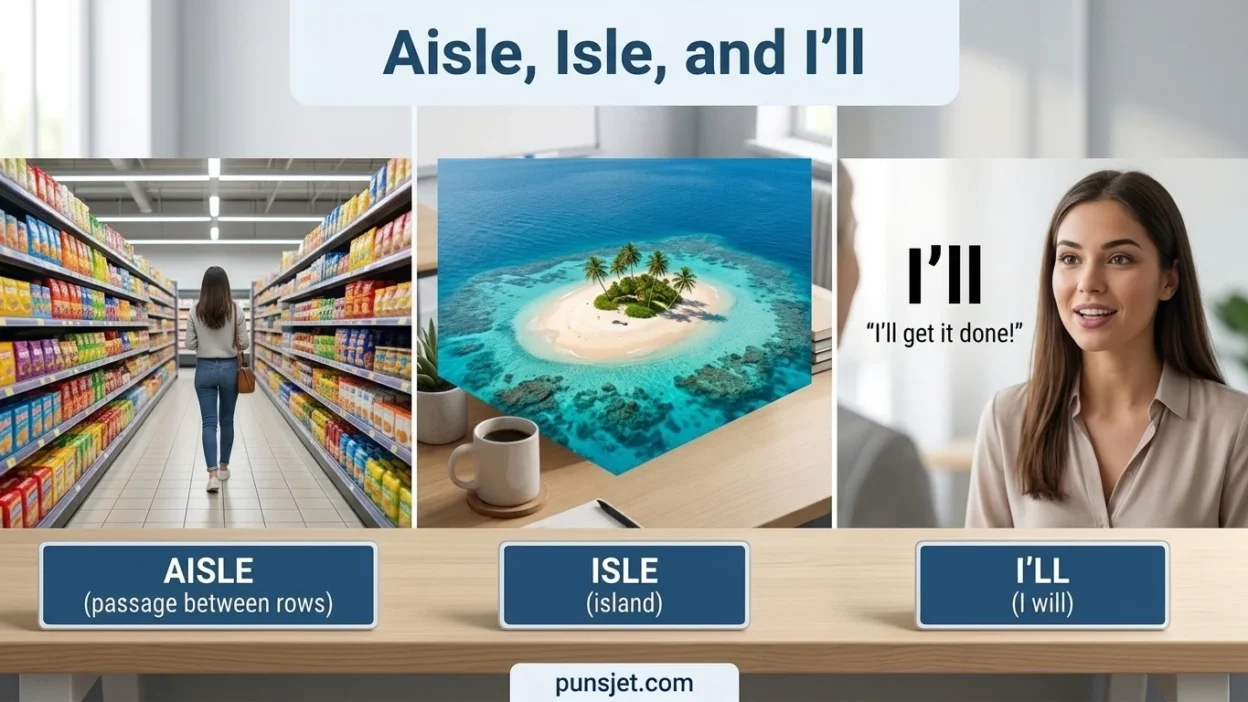
- Aisle is a passage or walkway between rows of seats, shelves, or other things.
- Isle means an island, usually a small one.
- I’ll is the short form of I will or I shall.
The most important thing to remember is that aisle and isle are nouns, while I’ll is a shortened form of two words.
Quick Answer: Aisle vs. Isle vs. I’ll
Here is the difference in the simplest way:
- Aisle = a walkway between rows
- Please walk down the aisle.
- Isle = an island
- They visited a beautiful isle.
- I’ll = I will / I shall
- I’ll call you later.
Easy memory trick
Think of these three words like this:
Aisle → Walkway
Isle → Island
I’ll → I will
Although they sound alike, they are spelled differently and have different jobs in a sentence.
Where Do These Words Come From?
These words have different histories, even though their modern pronunciations are very similar.
Aisle
Aisle comes from an old French word connected with the idea of a wing or side part of a building. Over time, English speakers began using it for a passage or space between parts of a building, especially in churches.
Today, an aisle can be found in many places, including supermarkets, airplanes, theaters, buses, and churches.
Isle
Isle comes from an old French word meaning island. It is now mostly used in names and in more formal or literary writing.
For example:
- The Isle of Man
- a peaceful isle
- a small tropical isle
I’ll
I’ll is different from the other two. It is a contraction, which means two words have been joined together in a shorter form.
I will → I’ll
For example:
- I will help you. → I’ll help you.
- I will be there. → I’ll be there.
The apostrophe in I’ll shows that some letters have been left out.
The Clear Difference Between Aisle, Isle, and I’ll
1. What Does “Aisle” Mean?
An aisle is a clear path or walkway between rows of things.
You can find aisles in places such as:
- Supermarkets
- Airplanes
- Theaters
- Churches
- Libraries
- Trains
- Buses
Examples
- The cereal is in the next aisle.
- She walked down the airplane aisle.
- Please keep the aisle clear.
- We found our seats near the aisle.
You can also hear aisle in the phrase walk down the aisle, which is often used when talking about a wedding.
Example
The bride walked down the aisle.
Here, aisle means the passage between rows of seats.
2. What Does “Isle” Mean?
An isle means an island.
An island is a piece of land surrounded by water. The word isle is often used when talking about a small or beautiful island, or as part of a place name.
Examples
- They spent a week on a quiet isle.
- The sailors reached the distant isle.
- The Isle of Wight is a well-known place.
- We dreamed of living on a tropical isle.
In everyday English, island is much more common than isle.
For example, most people would naturally say:
We visited a beautiful island.
The word isle can sound more descriptive, traditional, or poetic.
3. What Does “I’ll” Mean?
I’ll is a contraction of I will or, in some older or formal uses, I shall.
It is used when talking about something you intend to do, something you expect to happen, or something you are willing to do.
Examples
- I’ll help you with your homework.
- I’ll call you tonight.
- I’ll see you tomorrow.
- I’ll bring some food.
- Don’t worry. I’ll take care of it.
The apostrophe is very important.
I’ll = I will
Ill = sick or unhealthy
Compare:
- I’ll visit you tomorrow.
- I feel ill today.
These two words have completely different meanings.
Aisle, Isle, and I’ll Comparison Table
| Word | Meaning | Part of Speech | Example |
|---|---|---|---|
| aisle | A walkway between rows | Noun | The books are on the next aisle. |
| isle | An island | Noun | They lived on a small isle. |
| I’ll | I will / I shall | Contraction | I’ll call you later. |
The easiest way to remember them
| If you mean… | Use… |
|---|---|
| A walkway in a store or airplane | aisle |
| An island | isle |
| I will | I’ll |
Which One Should You Use and When?
Choosing the correct word depends entirely on what you want to say.
Use “aisle” for a walkway
Use aisle when you are talking about a path between rows.
Correct:
I left my bag in the airplane aisle.
Not correct:
I left my bag on the airplane isle.
The second sentence would suggest an island, which does not make sense.
Use “isle” for an island
Use isle when you mean an island.
Correct:
They discovered a beautiful isle.
You can usually replace isle with island without changing the basic meaning.
Use “I’ll” when you mean “I will”
Use I’ll before a verb when you want to say I will.
Correct:
I’ll finish the work tonight.
You can expand it:
I will finish the work tonight.
Both sentences have the same basic meaning.
Common Mistakes People Make
Because these words sound alike, spelling is the main problem.
Mistake 1: Using “isle” for a walkway
❌ Please keep the isle clear.
✅ Please keep the aisle clear.
A walkway is an aisle.
Mistake 2: Using “aisle” for an island
❌ They visited a beautiful aisle.
✅ They visited a beautiful isle.
However, island would be more common in everyday English.
Mistake 3: Forgetting the apostrophe in “I’ll”
❌ Ill call you later.
✅ I’ll call you later.
Without the apostrophe, I’ll becomes ill, which is a completely different word.
Mistake 4: Writing “I’ll” when you mean “isle”
❌ They traveled to a small I’ll.
✅ They traveled to a small isle.
Remember that I’ll always relates to I will.
Everyday Real-Life Examples
Understanding these words in real situations can make them easier to remember.
In an email
I’ll is very common in emails.
I’ll send the document this afternoon.
Here, I’ll means I will.
Another example:
I’ll let you know when I receive the information.
In the news
Aisle may appear in stories about travel, shopping, politics, or events.
Passengers were asked to remain seated while the crew moved through the aisle.
Isle may appear in stories about geography or travel.
The small isle has become a popular tourist destination.
On social media
People often use I’ll because it is natural in casual writing.
I’ll be there in five minutes!
You may also see aisle in posts about shopping or weddings:
I found the dress in the last aisle.
Or:
Walking down the aisle was an unforgettable moment.
In daily conversation
You might hear all three words in completely different situations:
I’ll meet you in the store.
The milk is in the third aisle.
They are planning a trip to a nearby isle.
The pronunciation may sound similar, but the meaning comes from the context.
A Simple Learning Trick for Students
If you are learning English, do not try to memorize the three spellings at the same time without meaning.
Instead, connect each word with one idea.
Aisle = a path
Think about a supermarket.
Aisle → supermarket walkway
Isle = island
Notice that isle looks a little like the beginning of island in meaning.
Isle → island
I’ll = I will
The apostrophe is your biggest clue.
I’ll → I will
Try making one sentence with each word:
I walked down the aisle.
The isle was beautiful.
I’ll visit you tomorrow.
Writing your own examples is a simple way to make the difference stick.
FAQs:
1. Are aisle, isle, and I’ll pronounced the same?
In most standard English, aisle, isle, and I’ll are pronounced very similarly or the same. Their spelling and meaning are different.
2. What does aisle mean?
Aisle means a passage or walkway between rows of seats, shelves, or other objects.
Example: The customer walked down the supermarket aisle.
3. What does isle mean?
Isle means an island, usually a small island or one referred to in a name or descriptive style.
Example: They stayed on a peaceful isle.
4. What does I’ll mean?
I’ll is the short form of I will.
Example: I’ll call you tonight.
5. Is “I’ll” the same as “ill”?
No. I’ll means I will, while ill means sick or unwell.
- I’ll help you.
- She feels ill.
6. Is aisle the same as island?
No. An aisle is a walkway between rows. An island is land surrounded by water. Isle is another word for an island.
7. Is “isle” common in everyday English?
It is less common than island in normal conversation. You will often see isle in place names, travel writing, or descriptive language.
8. How can I remember the difference?
Use this simple rule:
Aisle = walkway
Isle = island
I’ll = I will
If you remember those three meanings, you can usually choose the correct spelling easily.
Conclusion
Aisle, isle, and I’ll sound alike, but they have completely different meanings.
An aisle is a walkway between rows, such as in a supermarket, airplane, or theater. An isle is an island. I’ll is the contraction of I will.
The easiest memory trick is:
Aisle → walkway
Isle → island
I’ll → I will
When you focus on the meaning instead of the sound, these three words become much easier to use correctly. With a little practice, you will quickly recognize which spelling belongs in each sentence.

Joshua Paul is a creative writer and contributor at PunsJet.com who enjoys crafting witty puns and clever wordplay. With a strong sense of humor and a love for language, he creates entertaining content that readers can easily share and enjoy. Joshua’s goal is to spread laughter through fun and memorable jokes.