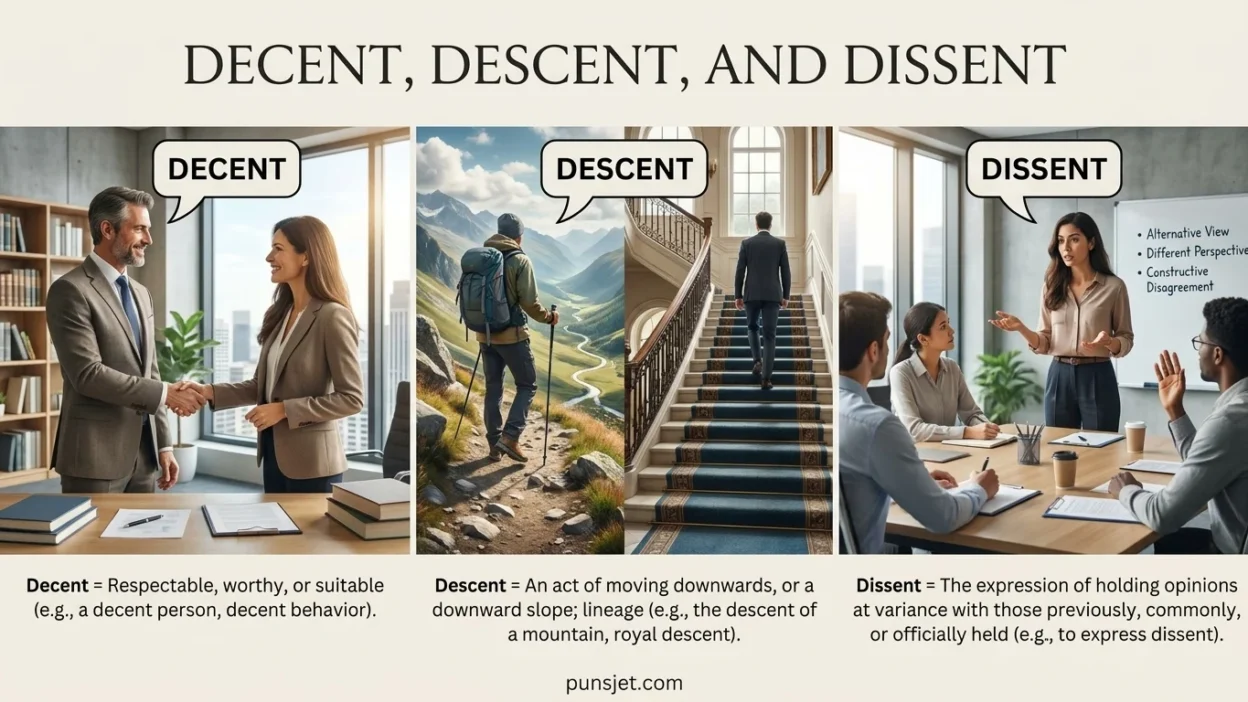
Decent, descent, and dissent look and sound quite similar, so it is easy to mix them up. However, these three words have very different meanings.
- Decent usually describes something that is good enough, acceptable, proper, or respectable.
- Descent means moving downward, or it can describe a person’s family background.
- Dissent means having or expressing an opinion that is different from an accepted or official opinion.
The main difficulty is that all three words contain similar letters and can sound alike in some accents. Learning their meanings and seeing them in simple sentences can make the difference much easier to remember.
Quick Answer: Decent vs. Descent vs. Dissent
Here is the simplest way to understand the three words:
- Decent = good, acceptable, proper, or respectable.
- She found a decent place to stay.
- Descent = a movement downward or family background.
- The plane began its descent.
- He is of Irish descent.
- Dissent = disagreement with an accepted or official opinion.
- Several members expressed dissent.
Easy memory trick
Think of these three ideas:
Decent → Good enough
Descent → Down
Dissent → Disagree
If you remember these three short meanings, you can usually choose the correct word.
Simple Origin and Background
The three words come from different language roots, even though they look similar in English.
Decent
Decent is related to an old Latin word connected with the idea of being suitable or fitting. Over time, English speakers used it for things that are proper, acceptable, or good enough.
Today, decent can describe quality, behavior, appearance, living conditions, or treatment.
For example:
- The hotel was decent.
- He found a decent job.
- Please wear decent clothes to the ceremony.
Descent
Descent is connected with the idea of going down. This meaning is easy to see in words related to movement from a higher place to a lower place.
It can also refer to a person’s family origin or ancestry.
For example:
- The aircraft started its descent.
- She is of Indian descent.
Dissent
Dissent comes from a word meaning to disagree. It is often used when someone’s opinion does not match an accepted, official, or majority opinion.
For example:
- The proposal faced dissent from several members.
- He openly expressed his dissent.
Understanding these different ideas makes the words much easier to separate.
What Does “Decent” Mean?
Decent is usually an adjective. It describes something that is acceptable, reasonably good, proper, or respectable.
The exact meaning depends on the sentence.
Decent can mean “good enough”
When someone says something is decent, they often mean it is reasonably good, even if it is not excellent.
- The restaurant serves decent food.
- I found a decent laptop for a reasonable price.
- She got a decent score on the test.
Here, decent means satisfactory or good enough.
Decent can mean “proper” or “respectable”
It can also describe behavior or appearance that is considered appropriate.
- Please be decent and help your neighbor.
- He was dressed in decent clothes.
- They treated everyone in a decent way.
So, decent is connected with the ideas of good enough, proper, and respectable.
What Does “Descent” Mean?
Descent is a noun with two important meanings.
1. Moving downward
A descent is the act of moving from a higher position to a lower one.
For example:
- The plane began its descent.
- The hikers started their descent from the mountain.
- The road has a steep descent.
The opposite idea is ascent, which means moving upward.
Easy connection
Descent → down
This is one of the easiest ways to remember this word.
2. Family origin
Descent can also describe someone’s family background or ancestry.
- She is of Pakistani descent.
- He is of Japanese descent.
- The writer is of African descent.
In these sentences, descent has nothing to do with physically moving downward. It refers to where a person’s family came from.
What Does “Dissent” Mean?
Dissent means disagreement with an opinion, decision, rule, or position that is accepted by others.
It can be used as a noun or a verb.
Dissent as a noun
- There was some dissent among the team members.
- The decision caused dissent.
- The committee recorded one member’s dissent.
Here, dissent means disagreement.
Dissent as a verb
- Some members dissent from the decision.
- She chose to dissent from the group’s opinion.
When you dissent, you do not agree with the accepted position.
Easy connection
Think:
Dissent → disagree
Both begin with the idea of going against an opinion.
Decent, Descent, and Dissent: Comparison Table
| Word | Part of Speech | Main Meaning | Easy Memory | Example |
|---|---|---|---|---|
| Decent | Adjective | Good enough, proper, respectable | Good enough | He found a decent apartment. |
| Descent | Noun | Moving downward; family origin | Down | The plane began its descent. |
| Dissent | Noun / Verb | Disagreement with an opinion | Disagree | She expressed dissent. |
The shortest difference
Decent = acceptable or good
Descent = downward movement or ancestry
Dissent = disagreement
Which One Should You Use and When?
Choosing the correct word becomes easy when you first think about the meaning you need.
Use “decent” when talking about:
- Quality
- Behavior
- Appearance
- Living conditions
- Treatment
- Something that is reasonably good
Example:
We found a decent restaurant near the station.
You are describing the restaurant as reasonably good.
Use “descent” when talking about:
- Going downward
- A plane coming down
- Walking down a mountain
- Family background or ancestry
Example:
The plane began its descent before landing.
Another example:
She is of Korean descent.
Use “dissent” when talking about:
- Disagreement
- Different opinions
- Opposition to an official decision
- Someone refusing to agree with a common position
Example:
There was strong dissent during the meeting.
Common Mistakes People Make
Because these words look similar, learners often use one in place of another.
Mistake 1: Using “descent” instead of “decent”
Incorrect:
- The hotel was descent.
Correct:
- The hotel was decent.
The hotel is being described as reasonably good, so decent is correct.
Mistake 2: Using “decent” for downward movement
Incorrect:
- The plane began its decent.
Correct:
- The plane began its descent.
A plane moving downward is making a descent.
Mistake 3: Using “decent” instead of “dissent”
Incorrect:
- There was a lot of decent about the decision.
Correct:
- There was a lot of dissent about the decision.
The sentence is about disagreement, so dissent is needed.
Mistake 4: Forgetting the family meaning of “descent”
Some learners only remember that descent means moving downward. However, it can also describe family origin.
- He is of Chinese descent.
This means his family has Chinese ancestry.
Everyday Real-Life Examples
These words appear in many ordinary situations.
In emails
Decent:
Thank you for sending a decent proposal.
Here, the proposal is considered reasonably good.
Dissent:
Several members expressed dissent during the meeting.
Here, people disagreed with the decision or opinion.
In news
Descent:
The aircraft began its descent before landing.
This describes an airplane moving lower.
Dissent:
The new decision faced dissent from some members.
This describes disagreement.
On social media
Decent:
That is a decent explanation.
The explanation is reasonably good.
Dissent:
Many users expressed dissent over the announcement.
Users disagreed with the announcement.
In daily conversation
Decent:
- The movie was decent.
- I got a decent night’s sleep.
- He earns a decent salary.
Descent:
- The descent was difficult.
- The hikers began their descent.
Dissent:
- She openly expressed dissent.
- There was dissent within the group.
A Simple Learning Section for Students and Beginners
If you are learning English, do not try to memorize long dictionary definitions. Use a short word association for each word.
1. Decent = Good enough
Imagine someone asking:
“Was the hotel good?”
You answer:
“Yes, it was decent.”
It means the hotel was reasonably good or acceptable.
2. Descent = Down
Imagine an airplane coming down toward an airport.
Plane → downward → descent
You can also remember:
Descent = down
3. Dissent = Disagree
Imagine a group voting on a decision. One person does not agree.
Different opinion → dissent
Practice
Choose the correct word:
- The plane started its ______ before landing.
- We found a ______ hotel near the beach.
- One member expressed ______ during the meeting.
- She is of French ______.
- He bought a ______ pair of shoes.
Answers
- descent
- decent
- dissent
- descent
- decent
The more you practice these meanings in sentences, the easier the words become.
FAQs:
1. What is the difference between decent and descent?
Decent usually means good enough, acceptable, proper, or respectable. Descent means moving downward or a person’s family origin.
2. What does dissent mean?
Dissent means disagreement with an opinion, decision, or accepted position.
3. Is “descent” related to going down?
Yes. One important meaning of descent is movement from a higher place to a lower place.
4. Can descent mean family background?
Yes. For example, “She is of Indian descent” means her family has Indian ancestry.
5. Is decent an adjective?
Yes. Decent is normally an adjective.
For example:
He found a decent job.
6. Can dissent be a verb?
Yes. Dissent can be both a noun and a verb.
- Noun: There was dissent.
- Verb: They dissent from the decision.
7. What is an easy way to remember all three?
Remember:
Decent = good enough
Descent = down
Dissent = disagree
8. Which word describes a plane coming down?
Use descent.
For example:
The plane began its descent.
Conclusion
Decent, descent, and dissent may look similar, but their meanings are quite different.
Decent describes something that is reasonably good, acceptable, proper, or respectable. Descent means moving downward and can also refer to family origin or ancestry. Dissent means disagreement with an opinion, decision, or accepted position.
The easiest way to remember them is:
- Decent = good enough
- Descent = down
- Dissent = disagree
Once you connect each word with its main idea, choosing the right one becomes much easier. Pay attention to the meaning of the sentence rather than only how the words sound. With a little practice, you will be able to use decent, descent, and dissent correctly in writing and everyday conversation.

Emily Margaret is a writer and humor enthusiast at PunsJet.com. She enjoys creating clever puns and lighthearted content that entertains readers and adds a spark of humor to everyday life. With a love for wordplay and creativity, Emily aims to share fun, relatable jokes that make people smile and laugh.