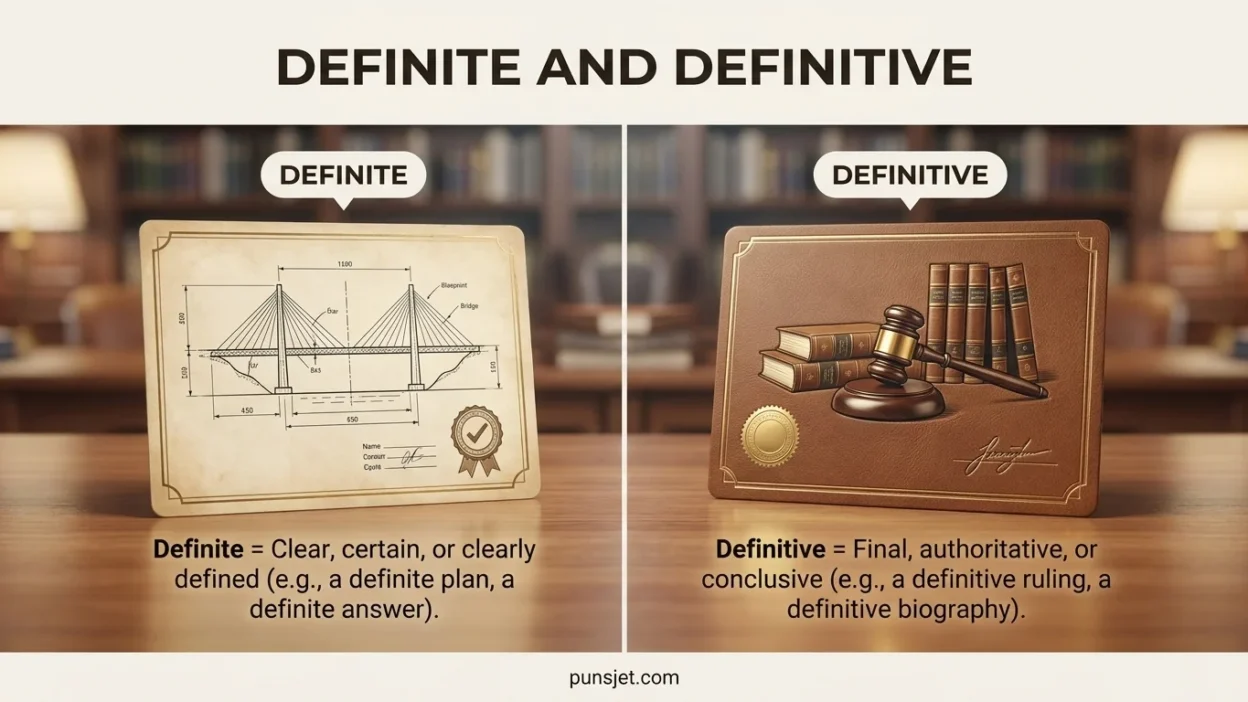
Definite and definitive look and sound very similar, so it is easy to confuse them. Both words are connected with the idea of being clear, certain, or settled. However, they are not used in exactly the same way.
The main difference is simple:
- Definite means clear, certain, fixed, or specific.
- Definitive means final, authoritative, or able to settle a question.
For example, if you have a definite plan, the plan is clear and settled. If you have a definitive answer, the answer is final and gives a clear solution to a question.
Learning this small difference can help you choose the right word in writing, conversation, emails, schoolwork, and everyday English.
Quick Answer: Definite vs. Definitive
Here is the difference in the simplest way:
- Definite = clear, certain, or fixed.
- Definitive = final, authoritative, or conclusive.
- A definite date is a date that has been decided.
- A definitive answer is an answer that settles the question.
- A definite plan is a clear and settled plan.
- A definitive decision is a final decision that is not expected to be changed.
- Definite often describes something that is certain or specific.
- Definitive often describes something that provides the final word or strongest answer.
Easy memory trick
Think of definite as clear or certain.
Think of definitive as final or settling the matter.
Simple Origin and Background
Both words are related to the Latin word definire, which means to set a limit, determine, or define something.
Over time, English developed the words definite and definitive, but they took on slightly different uses.
Definite became strongly connected with something that is clearly known, fixed, or limited.
For example:
We need a definite answer by Friday.
This means we need a clear and certain answer.
Definitive, on the other hand, developed the idea of something that provides a final or authoritative answer.
For example:
The scientist published a definitive study on the subject.
This suggests that the study gives a very important and final answer about the subject.
Knowing their shared background can explain why the words look so similar. Their meanings are related, but their uses are different.
What Does “Definite” Mean?
Definite is an adjective. It describes something that is clear, certain, specific, or fixed.
It is often used when there is little or no uncertainty.
Examples
- We need a definite date for the meeting.
- She gave me a definite answer.
- There is a definite improvement in his work.
- I have a definite plan for the weekend.
- The teacher gave us a definite deadline.
In each example, the idea is that something is clear or certain.
Definite can also mean specific
For example:
I need a definite number of chairs.
This means you need a specific number, not just “some chairs.”
Another example:
Do you have a definite time for the appointment?
This asks for a specific time that has been decided.
What Does “Definitive” Mean?
Definitive is also an adjective. It usually describes something that is final, authoritative, or able to settle a question.
It is often used when something gives the strongest or final answer about an issue.
Examples
- The report provides a definitive answer.
- Scientists have not yet found a definitive explanation.
- This book is considered a definitive guide to the subject.
- The test gave us definitive evidence.
- The court made a definitive ruling.
The important idea is not simply that something is clear. It is that the information, decision, or source has enough authority or certainty to settle the matter.
Definite vs. Definitive: The Main Difference
The easiest way to understand the difference is to compare their main ideas.
Definite focuses on certainty or clarity.
Definitive focuses on finality or authority.
Consider these two sentences:
We have a definite meeting time.
The meeting time is clear and decided.
The manager gave a definitive answer.
The manager’s answer settles the question.
Both words suggest certainty, but definitive carries a stronger sense of being final or conclusive.
Comparison Table
| Feature | Definite | Definitive |
|---|---|---|
| Main meaning | Clear, certain, or fixed | Final, authoritative, or conclusive |
| Main idea | Certainty | Finality |
| Used for specific things? | Yes | Sometimes |
| Used for final answers? | Sometimes | Very commonly |
| Used for plans? | Very commonly | Less commonly |
| Used for evidence? | Less common | Very common |
| Example | A definite date | A definitive answer |
| Simple meaning | Clearly decided | Settles the matter |
Definite and Definitive in Common Phrases
Some phrases make the difference easier to remember.
Common uses of “definite”
- definite answer
- definite date
- definite plan
- definite decision
- definite time
- definite change
- definite improvement
- definite idea
- definite number
These phrases usually focus on something being clear, certain, or specific.
Common uses of “definitive”
- definitive answer
- definitive proof
- definitive evidence
- definitive explanation
- definitive guide
- definitive study
- definitive ruling
- definitive statement
- definitive version
These phrases usually suggest something that is final, authoritative, or settles an issue.
Which One Should You Use and When?
Use definite when you mean:
- clear
- certain
- fixed
- specific
- decided
Example
We need a definite date for the trip.
The date needs to be decided clearly.
Use definitive when you mean:
- final
- authoritative
- conclusive
- settling an issue
Example
We need definitive evidence before making a conclusion.
The evidence needs to be strong enough to settle the question.
A useful test
Ask yourself:
“Do I mean clear or certain?”
If yes, definite may be the right word.
Ask:
“Do I mean final or able to settle the question?”
If yes, definitive may be better.
Common Mistakes People Make
Mistake 1: Treating the words as exact synonyms
Although they are related, they do not always mean the same thing.
We have a definite plan.
This means the plan is clear or settled.
We have a definitive plan.
This can sound unusual in many everyday situations because definitive is not normally needed simply to describe a clear plan.
Mistake 2: Using “definitive” whenever something is certain
Something can be certain without being definitive.
For example:
She gave me a definite time to arrive.
This means the time is clear and fixed.
You would normally not need definitive here because the main idea is not that the time settles a larger question.
Mistake 3: Thinking “definitive” only means “very definite”
The words are related, but definitive has an important extra idea: final authority or a conclusion.
For example:
The investigation found definitive evidence.
This means the evidence is strong enough to settle the issue.
Mistake 4: Confusing “definite” with “definitive” in academic writing
Students sometimes use definitive simply because it sounds more formal.
Do not choose a word because it sounds more impressive. Choose the word that gives the correct meaning.
If you mean clear or certain, use definite.
If you mean final or conclusive, use definitive.
Everyday Real-Life Examples
In Emails
Definite
Please send me a definite date for the meeting.
The writer wants a specific date.
Definitive
Please send me a definitive answer before we make the final arrangements.
The writer wants an answer that settles the issue.
In News
Definite
The government has not yet announced a definite date for the event.
The date has not been fixed.
Definitive
Investigators are still searching for definitive evidence.
They are looking for evidence that can settle the matter.
On Social Media
You might see:
“Do we have a definite time for the event?”
This means:
Has the exact time been decided?
You might also see:
“There is still no definitive answer.”
This means:
There is still no final answer that settles the question.
In School
A teacher might say:
“I need a definite answer from each student.”
The teacher wants a clear answer rather than an uncertain one.
In a research project, a student might write:
“The study did not provide a definitive explanation.”
This means the study did not completely settle the question.
A Simple Learning Trick for Beginners
Remember these two words with two short questions.
Definite = “Is it clear?”
If something is clear, certain, fixed, or specific, think definite.
Example:
We have a definite plan.
The plan is clear.
Definitive = “Does it settle the matter?”
If something gives the final or authoritative answer, think definitive.
Example:
The test gave definitive evidence.
The evidence settles the issue.
One-line memory rule
Definite = clear and certain.
Definitive = final and conclusive.
This simple rule will help you in most everyday situations.
FAQs:
1. Are “definite” and “definitive” the same?
No. They are related, but they have different main uses. Definite usually means clear, certain, fixed, or specific. Definitive usually means final, authoritative, or conclusive.
2. What does “definite” mean?
Definite means something is clear, certain, fixed, or specific.
Example:
We need a definite answer.
This means we need a clear and certain answer.
3. What does “definitive” mean?
Definitive means final, authoritative, or able to settle a question.
Example:
The report gives a definitive answer.
This means the report gives an answer that settles the issue.
4. Can I say “definite answer”?
Yes. Definite answer is natural when you mean a clear or certain answer.
I need a definite answer before Friday.
5. Can I say “definitive answer”?
Yes. Definitive answer is also correct. It suggests an answer that is final or settles the question.
The investigation has not produced a definitive answer.
6. Is “definitive” stronger than “definite”?
In many contexts, yes, because definitive adds the idea of finality or authority. However, the words are not simply two levels of the same adjective.
7. What is a definitive decision?
A definitive decision is a final decision that settles an issue.
8. What is an easy way to remember the difference?
Remember:
Definite = clear or certain.
Definitive = final or conclusive.
Conclusion
Definite and definitive are closely related words, but they have different jobs in English.
Use definite when you want to say that something is clear, certain, fixed, or specific. For example, a definite date is a date that has been decided.
Use definitive when you want to say that something is final, authoritative, or able to settle a question. For example, definitive evidence is evidence that can settle an issue.
The easiest rule to remember is:
Definite = clear and certain.
Definitive = final and conclusive.
Once you remember this small difference, choosing between these two similar words becomes much easier in schoolwork, emails, conversations, news, and everyday writing.