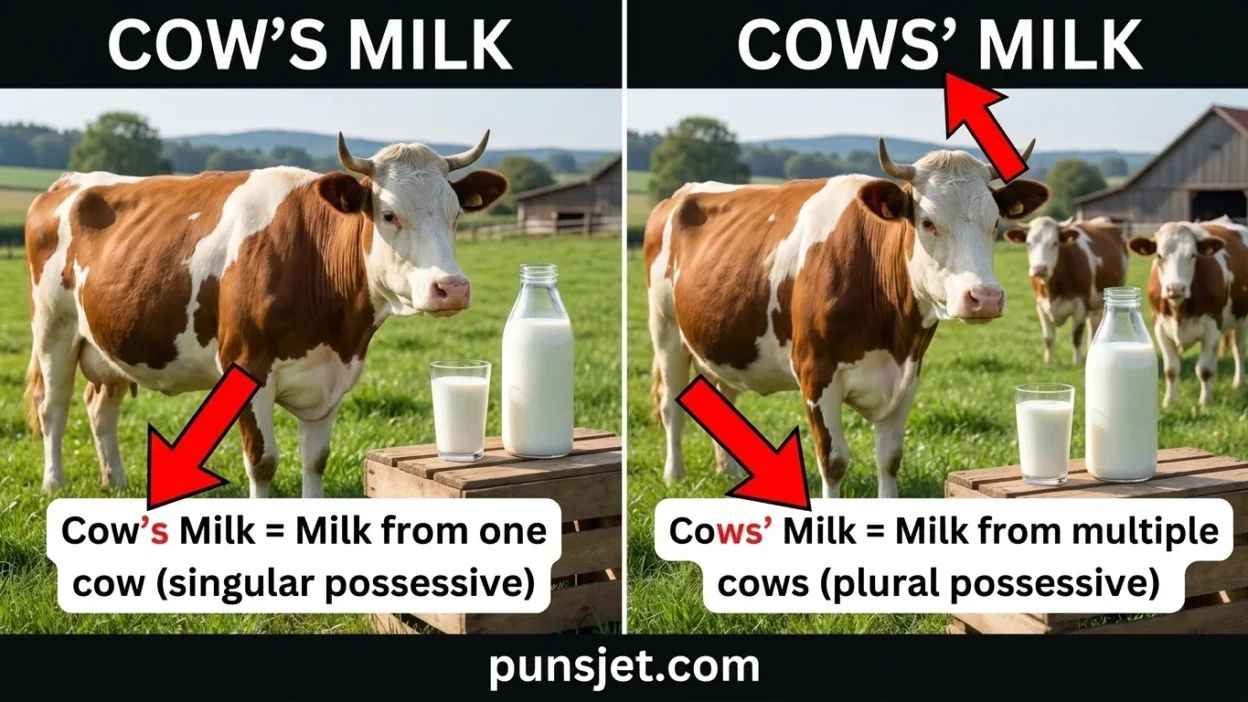
People often become confused when they see cow’s milk and cows’ milk. Both forms may look correct because both use the word cow with an apostrophe. However, there is a small difference in meaning and style.
The good news is that the difference is easy to understand. In everyday English, cow’s milk is the form you will usually see and use. Cows’ milk can also be grammatically possible, but it has a different way of looking at possession.
This guide explains the difference in simple English so students, English learners, and beginners can choose the right form with confidence.
Quick Answer
- Cow’s milk is the usual and most natural expression.
- Cow’s milk means milk that comes from a cow.
- The apostrophe in cow’s comes before the s because cow is singular.
- Cows’ milk treats cows as a plural possessive form.
- In normal writing, food labels, education, and everyday conversation, cow’s milk is generally the clearer choice.
- The word milk is normally treated as a substance rather than something owned by one particular animal.
- Do not write cows milk when you mean the possessive form. The apostrophe is needed if you choose a possessive construction.
A Simple Background: Why Is There an Apostrophe?
To understand these two expressions, it helps to understand how possessives work.
A possessive form often shows that something belongs to, comes from, or is connected with another thing.
For a singular noun, we usually add ’s:
- the girl’s book
- the dog’s bowl
- the farmer’s tractor
- the cow’s milk
Here, cow’s is the possessive form of the singular noun cow.
For a plural noun that already ends in s, we normally put the apostrophe after the s:
- the girls’ books
- the dogs’ bowls
- the farmers’ tractors
- the cows’ food
Therefore:
- cow’s = one cow
- cows’ = more than one cow
This is the basic grammar behind the two expressions.
However, there is an important point: when we talk about milk as a type of milk, English speakers usually prefer the natural phrase cow’s milk, even though milk normally comes from many cows.
What Does “Cow’s Milk” Mean?
Cow’s milk means milk obtained from cows.
The word cow’s is singular possessive. Grammatically, it can suggest a connection with one cow, but in the phrase cow’s milk, it is commonly understood as a general type of milk produced by cows.
For example:
Many children drink cow’s milk with breakfast.
The sentence is not saying that the milk came from one specific cow. It is talking about milk from cows in general.
You can see the same type of pattern in other expressions:
- goat’s milk
- sheep’s milk
- camel’s milk
- buffalo’s milk
These expressions usually describe a kind or source of milk.
Why Is “Cow’s Milk” So Common?
English often uses a singular noun in a general sense when describing a type, class, or source.
For example:
- chicken soup means soup made with chicken.
- goat’s cheese means cheese made from goat’s milk.
- cow’s milk means milk obtained from cows.
So, cow’s milk is a familiar and natural expression.
What Does “Cows’ Milk” Mean?
Cows’ milk uses the plural possessive form.
The word cows means more than one cow, and the apostrophe comes after the s:
cows + ’ = cows’
So, from a strict possessive point of view, cows’ milk can mean milk associated with or obtained from multiple cows.
For example:
The farm sells fresh cows’ milk to local customers.
This wording can be understood, but it is less common in ordinary English than cow’s milk.
It may appear when the writer wants to focus specifically on several cows as the source.
Cow’s Milk vs. Cows’ Milk
The easiest way to remember the difference is to look at the noun before the apostrophe.
| Expression | Grammar | Basic idea | Common use |
|---|---|---|---|
| cow’s milk | Singular possessive | Milk from a cow / cows generally | Very common |
| cows’ milk | Plural possessive | Milk from multiple cows | Less common |
| cows milk | No possessive apostrophe | Incorrect if possession is intended | Avoid |
The important thing is that cow’s and cows’ are not spelled the same way.
Cow’s
Cow’s = one cow + ’s
Example:
The cow’s milk was collected early in the morning.
Here, the sentence can refer to milk from one particular cow.
Cows’
Cows’ = several cows + apostrophe
Example:
The cows’ milk was mixed together in a large container.
Here, the milk came from several cows.
Which One Should You Use?
For most everyday situations, use cow’s milk.
It is the familiar expression used when talking about cow-derived milk as a general type.
For example:
- I drink cow’s milk.
- Cow’s milk contains several important nutrients.
- Some babies may have difficulty with cow’s milk.
- The recipe calls for one cup of cow’s milk.
- This product is made with cow’s milk.
Use cows’ milk when you specifically need to describe milk belonging to, coming from, or connected with several particular cows.
For example:
The farmer kept records of the cows’ milk production.
Here, the sentence focuses on several cows on a farm.
A Useful Tip
Ask yourself:
Am I talking about milk as a general type?
If yes, cow’s milk will usually be the natural choice.
Am I specifically talking about several particular cows?
If yes, cows’ milk may be appropriate.
Common Mistakes
1. Writing “cows milk”
A common mistake is leaving out the apostrophe:
I drink cows milk.
If you are using a possessive form, this should be corrected.
Better:
I drink cow’s milk.
2. Using “cows’ milk” everywhere
Because people know that milk usually comes from many cows, they may think cows’ milk must always be correct.
That is not necessary.
When discussing the general type of milk, cow’s milk is the normal and familiar expression.
3. Confusing “cow’s” and “cows’”
Remember:
- cow’s → one cow
- cows’ → more than one cow
The position of the apostrophe matters.
4. Thinking the apostrophe always means physical ownership
The apostrophe does not always mean that an animal literally owns something.
In cow’s milk, the possessive form shows a relationship or source. It tells us where the milk comes from.
Everyday Examples
Understanding real-life examples makes this difference much easier.
In Daily Conversation
Do you drink cow’s milk?
This is a natural question about a type of milk.
I usually add cow’s milk to my coffee.
Again, cow’s milk is being used generally.
In a School Assignment
Cow’s milk is commonly used as a food and drink.
This sentence discusses cow’s milk as a general product.
In a News Report
The farm increased its production of cow’s milk this year.
The phrase describes the type of milk produced by the farm.
In an Email
Please let us know whether the meal contains cow’s milk.
Here, the writer is asking about an ingredient or source of milk.
On Social Media
I recently switched from cow’s milk to oat milk.
This is a common way to compare different kinds of milk.
When Talking About Particular Cows
The farmer checked the cows’ milk before sending it to the dairy.
Here, cows’ makes sense because the sentence refers to several particular cows.
A Simple Learning Trick
Students can remember this rule:
One cow → cow’s
Several cows → cows’
Think about the apostrophe as a small sign showing where the possessive form is placed.
Examples
One cow:
The cow’s food
Several cows:
The cows’ food
The same rule applies to milk:
One cow:
the cow’s milk
Several cows:
the cows’ milk
But when cow’s milk is used as the general name for milk from cows, English commonly uses the singular possessive form.
Cow’s Milk in Comparison With Other Types
The same pattern can be seen with other animal-based products.
- cow’s milk
- goat’s milk
- sheep’s milk
- camel’s milk
- buffalo’s milk
These expressions identify the source or type of milk.
If you are talking about specific animals, however, the plural possessive can be useful.
For example:
The goats’ milk was collected separately.
This refers to several particular goats.
The key is to look at whether you are naming a general type or talking about particular animals.
FAQs:
1. Is “cow’s milk” correct?
Yes. Cow’s milk is correct and is the usual expression for milk obtained from cows.
2. Is “cows’ milk” grammatically correct?
It can be grammatically correct when cows’ refers to several particular cows. However, it is less common for the general type of milk.
3. Which is more common: cow’s milk or cows’ milk?
Cow’s milk is the more familiar expression in general English.
4. Why does “cow’s milk” have an apostrophe?
Because cow’s is the possessive form of the singular noun cow. The phrase describes milk connected with or obtained from a cow.
5. Should I write “cows milk”?
No, not when you intend a possessive form. Use cow’s milk for the general expression or cows’ milk when referring to several particular cows.
6. Does “cow’s milk” mean milk from only one cow?
Not necessarily. In normal English, cow’s milk is commonly used as a general term for milk from cows.
7. Is “cow milk” also possible?
Cow milk can appear in some contexts, especially as a noun modifier, but cow’s milk is the more familiar and natural expression in ordinary English.
8. How can I remember the difference?
Remember this simple rule:
cow’s = one cow
cows’ = several cows
For the general type of milk, cow’s milk is usually the form you want.
Conclusion
The difference between cow’s milk and cows’ milk is mainly about the singular and plural possessive forms.
Cow’s milk is the common expression used for milk that comes from cows in general. It is the form most students and everyday writers should choose when talking about this type of milk.
Cows’ milk is the plural possessive form. It can be useful when you are specifically talking about milk connected with several particular cows.
The easiest rule is:
Cow’s = one cow
Cows’ = several cows
When you are simply talking about the familiar type of milk, choose cow’s milk. Once you understand where the apostrophe goes and why, this confusing pair becomes much easier to use correctly.

Joshua Paul is a creative writer and contributor at PunsJet.com who enjoys crafting witty puns and clever wordplay. With a strong sense of humor and a love for language, he creates entertaining content that readers can easily share and enjoy. Joshua’s goal is to spread laughter through fun and memorable jokes.