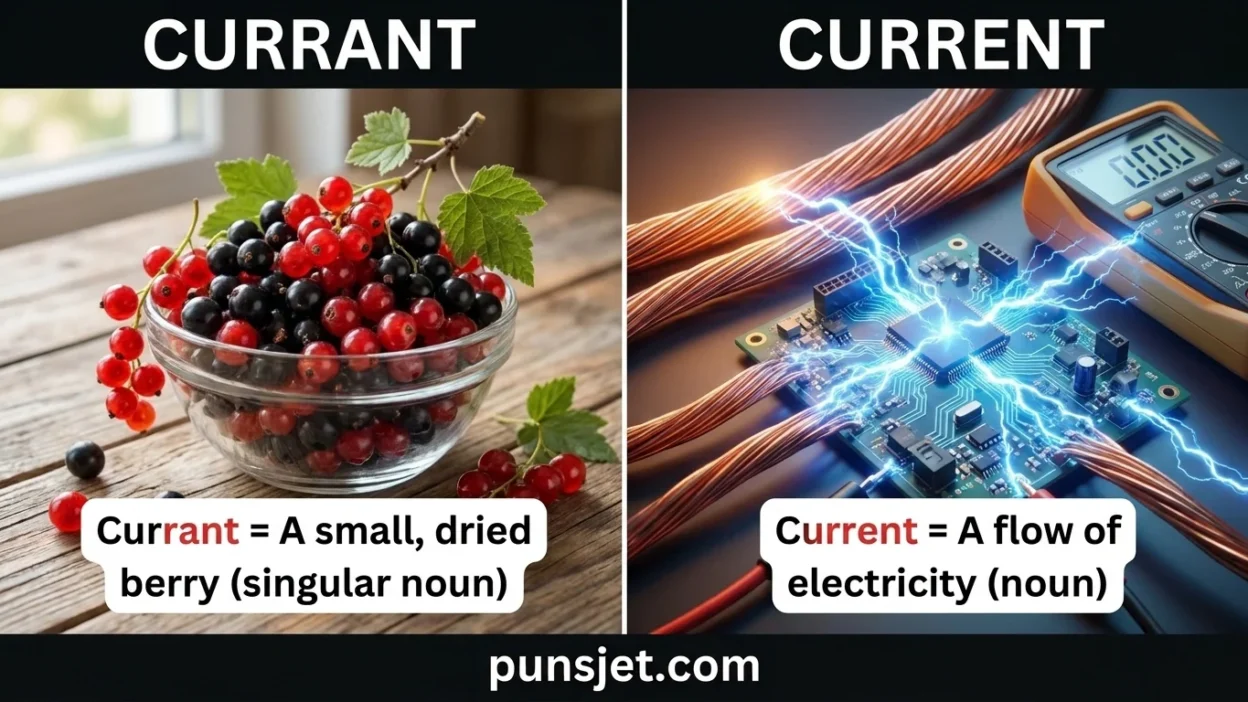
Have you ever seen the words currant and current and wondered whether they mean the same thing? They look and sound very similar, but they have completely different meanings.
This is a common problem for students, English learners, and even native speakers. The main reason for the confusion is simple: currant and current are pronounced almost the same in many types of English.
However, you should not use one word in place of the other. Currant is mainly connected with a small fruit, while current can describe something happening now or the movement of water, air, or electricity.
Learning the difference is easy once you connect each word with its main meaning.
Let’s look at both words step by step.
Quick Answer: Currant vs. Current
- Currant is a small fruit. It can be fresh or dried and is often used in cooking and baking.
- Current usually means something happening or existing now.
- Current can also mean a flow or movement of water, air, or electricity.
- Currant is a noun.
- Current can be an adjective or a noun.
- The two words sound very similar, but their meanings are different.
- A simple memory trick is: currant = fruit, while current = now or flow.
Examples
- I added dried currants to the cake.
- What is your current address?
- The river has a strong current.
- Please check the current news before sharing it.
What Does “Currant” Mean?
Currant is the name of a small fruit.
Currants are related to berries, and the word can refer to different small fruits depending on the context. Some currants are used fresh, while dried currants are commonly used in cakes, breads, cookies, puddings, and other foods.
You may see currants in recipes, grocery stores, gardens, or food articles.
For example:
The recipe needs a handful of dried currants.
Here, currants means small dried fruits.
Another example:
She bought fresh currants from the market.
Again, currants refers to fruit.
Currant as a Food Word
When you see currant in a food-related sentence, it almost always refers to the fruit.
Common combinations include:
- dried currants
- fresh currants
- black currants
- red currants
- currant jelly
- currant cake
- currant bread
- currant sauce
Remember
Think:
Currant = a fruit
That one connection can help you avoid many spelling mistakes.
What Does “Current” Mean?
The word current has several meanings, but two are especially common.
1. Current Means “Happening Now”
When current is an adjective, it often means something that is happening, existing, or being used at the present time.
For example:
What is your current phone number?
This means:
What is your phone number now?
Another example:
The current situation is difficult.
This means the situation that exists now is difficult.
You may see this meaning in everyday conversations, emails, news reports, forms, and school writing.
Examples include:
- current address
- current job
- current price
- current situation
- current information
- current president
- current rules
- current events
2. Current Means a Flow
Current can also be a noun that describes the movement of something, especially water or electricity.
For example:
The swimmer was pulled away by the strong river current.
Here, current means the movement or flow of the water.
It can also describe electricity:
An electric current flows through the wire.
And it can describe moving air:
A cold current of air entered the room.
So, current can describe a flow of water, electricity, or air.
Currant vs. Current: The Main Difference
The easiest way to understand the difference is to remember their main meanings.
Currant is a fruit.
Current usually means:
- happening or existing now, or
- a flow or movement.
They may sound alike, but they are used in completely different situations.
Compare these sentences:
I bought some currants for the recipe.
The word currants refers to fruit.
I checked the current price of the product.
The word current means the price at the present time.
Now compare:
The boat moved slowly because of the strong current.
Here, current means the movement of water.
The meaning becomes clear from the context.
Easy Comparison Table
| Word | Part of Speech | Main Meaning | Example |
|---|---|---|---|
| Currant | Noun | A small fruit | I added currants to the cake. |
| Current | Adjective | Happening or existing now | What is your current address? |
| Current | Noun | A flow or movement | The river has a strong current. |
A Simple Memory Trick
Use this shortcut:
Currant = Fruit
Current = Now or Flow
If you are talking about food, you may need currant.
If you are talking about something happening now, use current.
If you are talking about moving water, electricity, or air, use current.
Which One Should You Use and When?
Choosing the correct word becomes easier when you look at the meaning of the sentence.
Use “Currant” When Talking About Fruit
Use currant when you mean the small fruit.
Examples:
- The bread contains dried currants.
- She planted a currant bush.
- I like currant jam.
- The recipe uses black currants.
Use “Current” for Something Happening Now
Use current when you are talking about the present situation or present information.
Examples:
- Please give me your current address.
- The current price is $20.
- We need current information.
- He is happy with his current job.
Use “Current” for a Flow
Use current when talking about the movement of water, air, or electricity.
Examples:
- The ocean current was very strong.
- The river current carried the small boat downstream.
- An electric current passes through the wire.
- A cool current of air came through the window.
Common Mistakes People Make
Because the words sound so similar, people sometimes use the wrong spelling.
Mistake 1: Using “Currant” for “Now”
Incorrect:
What is your currant address?
Correct:
What is your current address?
An address is something that can change over time, so current is correct.
Mistake 2: Using “Current” for the Fruit
Incorrect:
The cake contains dried current.
Correct:
The cake contains dried currants.
The sentence is about food, so currants is the correct word.
Mistake 3: Confusing a Water Current With a Fruit
Incorrect:
The boat was carried away by the strong currant.
Correct:
The boat was carried away by the strong current.
Here, current means moving water.
Mistake 4: Thinking They Have the Same Meaning
Although the pronunciation can be similar, currant and current are not interchangeable.
Always think about the meaning before choosing the spelling.
Everyday Real-Life Examples
Understanding how these words appear in normal life can make them easier to remember.
In Emails
You might write:
Please confirm your current address.
Here, current means your address now.
Another example:
I will send you the current price list.
The price list contains present information.
In News
News articles often use current when discussing things happening now.
For example:
The current situation is being closely watched.
Or:
Officials discussed the current economic conditions.
In both sentences, current means present or existing now.
In Social Media
Someone might post:
Here is my current favorite book.
This means the book they like most right now.
You could also see:
Current mood: ready for the weekend!
Again, current refers to the present moment.
In Daily Conversation
You may hear:
What is your current job?
This means the job you have now.
Or:
Be careful! The current is strong.
Here, current refers to moving water.
In Cooking
The word currant is more likely to appear in recipes.
For example:
Add the currants and mix well.
Or:
The recipe uses dried currants.
In these examples, currants are food.
A Simple Learning Section for Students and Beginners
If you are learning English, do not try to memorize every possible definition at once.
Start with these three ideas:
1. Currant = Fruit
When you see currant, think about food.
Currant → fruit
Example:
I bought currants for the dessert.
2. Current = Now
When current describes something happening at the present time, think:
Current → now
Example:
What is your current address?
3. Current = Flow
When current is a noun describing movement, think:
Current → flow
Example:
The river current is strong.
Try This Quick Test
Ask yourself what the sentence is talking about.
Sentence: I added ___ to the cake.
Is it about a fruit?
Yes. The answer is currants.
Sentence: What is your ___ address?
Is it about something that is true now?
Yes. The answer is current.
Sentence: The boat was pushed by the water ___.
Is it about moving water?
Yes. The answer is current.
This simple test can help you choose the correct word quickly.
FAQs:
1. What is the difference between currant and current?
Currant is a small fruit. Current usually means something happening now or the flow of water, air, or electricity.
2. Are currant and current pronounced the same?
They can be pronounced very similarly, and in many varieties of English they are homophones or near-homophones. Their meanings and spellings are different.
3. Is currant a fruit?
Yes. A currant is a small fruit. Currants can be used fresh or dried in different foods.
4. What does current mean?
Current can mean something happening or existing now. It can also mean the movement or flow of water, air, or electricity.
5. Is “current address” correct?
Yes. Current address means the address where you live now or the address that is presently valid.
6. Is “dried currants” correct?
Yes. Dried currants are dried small fruits that are commonly used in baking and cooking.
7. Can current be a noun?
Yes. For example:
The current was too strong for the swimmer.
Here, current is a noun because it names the movement of water.
8. What is the easiest way to remember currant and current?
Remember:
Currant = fruit
Current = now or flow
This simple rule will help you in most everyday situations.
Conclusion
The difference between currant and current is simple once you connect each word with its main meaning.
Currant refers to a small fruit and is often used when talking about food, recipes, baking, and plants.
Current has two common meanings. It can describe something that is happening or existing now, such as a current job, current address, or current situation. It can also describe a flow, such as a river current, ocean current, or electric current.Although these words look and sound very similar, their meanings are completely different.When you are unsure, ask yourself one simple question:
Am I talking about a fruit, something happening now, or a flow?If it is a fruit, choose currant. If it means now or flow, choose current.
With this simple distinction, you can use both words correctly and avoid one of the most common spelling and vocabulary mistakes in English.

Emily Margaret is a writer and humor enthusiast at PunsJet.com. She enjoys creating clever puns and lighthearted content that entertains readers and adds a spark of humor to everyday life. With a love for wordplay and creativity, Emily aims to share fun, relatable jokes that make people smile and laugh.