Have you ever seen the words curb and kerb and wondered whether they mean the same thing? If so, you are not alone. These two words look different, but they are closely related. In fact, when they refer to the edge of a road or sidewalk, they usually mean the same thing.
The main difference is where the word is used.
Curb is the usual spelling in American English. Kerb is the usual spelling in British English and is also common in many other varieties of English.
There is one more thing that can make curb confusing. The word curb can also be a verb, meaning to control, limit, or reduce something.
For example:
- The car stopped beside the curb.
- The government wants to curb pollution.
In this article, we will explain the difference between curb and kerb in very simple English so you can use each word correctly and confidently.
Quick Answer: Curb vs. Kerb
Here is the easiest way to remember the difference:
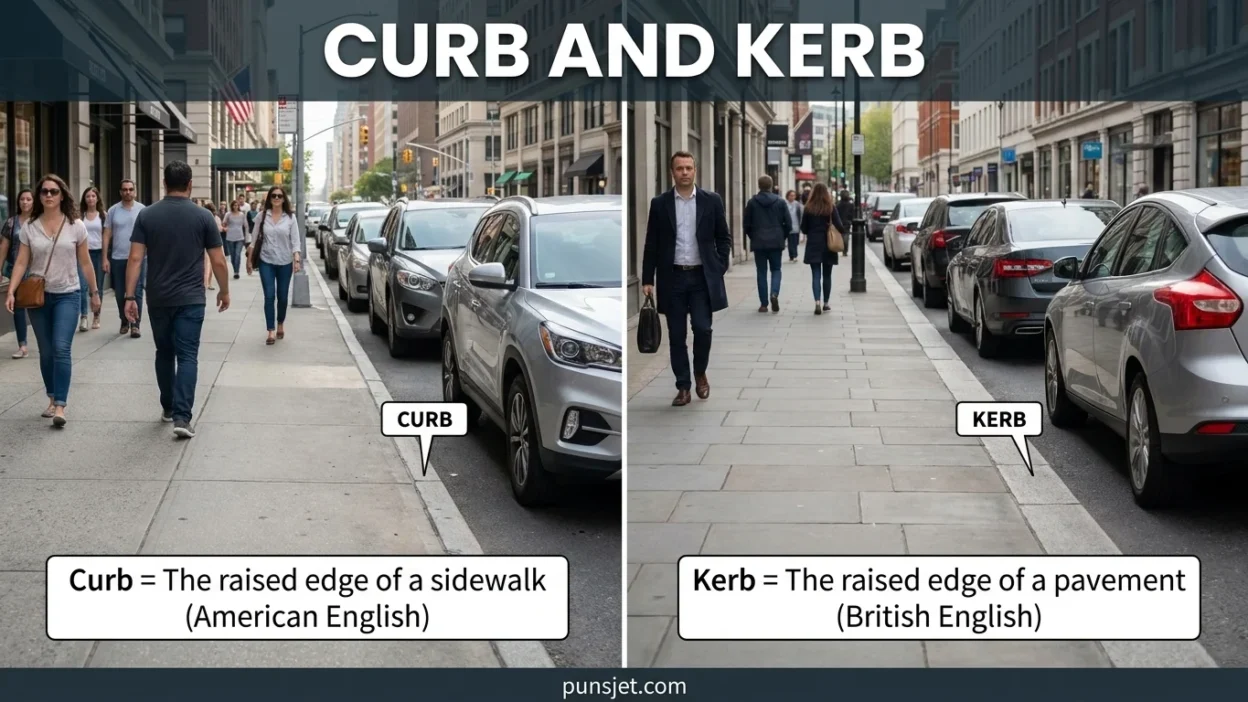
- Curb is the American English spelling for the raised edge between a road and a sidewalk.
- Kerb is the British English spelling for the same thing.
- Curb can also be a verb meaning to control, limit, or reduce something.
- Kerb is generally used for the road edge and does not normally have the same common verb use.
- In American English, use curb.
- In British English, use kerb when talking about the edge of a road.
Easy memory tip
Think:
American English → curb
British English → kerb
The meaning is usually the same when you are talking about the edge of a road.
What Does “Curb” Mean?
The word curb has more than one use.
1. Curb as a noun
As a noun, curb means the raised edge along the side of a road. It is usually next to a sidewalk.
For example:
The driver parked near the curb.
Here, curb means the raised border between the road and the sidewalk.
This is the standard spelling in American English.
2. Curb as a verb
Curb can also be used as a verb. It means to control, limit, or reduce something.
For example:
The city introduced new rules to curb traffic problems.
This means the city introduced rules to reduce or control traffic problems.
Another example:
She tried to curb her spending.
This means she tried to control or reduce how much money she spent.
This second meaning is important because curb is not always about roads.
What Does “Kerb” Mean?
Kerb is mainly used in British English.
It refers to the raised edge of a road beside a sidewalk or footpath.
For example:
The bus stopped beside the kerb.
The kerb is the raised border separating the road from the sidewalk.
You may see this spelling in:
- The United Kingdom
- British newspapers
- British books
- Many British English learning materials
- Countries and regions where British English is commonly used
So, if you are writing in British English, kerb is normally the correct spelling for the road edge.
Curb and Kerb: Simple Origin and Background
The two spellings developed from the same word family. English has changed over many centuries, and different regions have developed different spelling habits.
Today, the easiest difference to understand is regional:
- Curb → mainly American English
- Kerb → mainly British English
The two words are therefore not usually two completely different things. They are often simply different regional spellings of the same road-related word.
However, American English gives curb an additional common use as a verb.
This is why you may see sentences such as:
The city is trying to curb crime.
In this sentence, curb has nothing to do with a sidewalk or road.
Curb vs. Kerb: Clear Difference
The biggest difference is spelling and usage.
Curb
Curb is commonly used in American English.
It can mean:
- The raised edge of a road.
- To control or reduce something.
Examples:
The bicycle was left beside the curb.
The new law aims to curb pollution.
Kerb
Kerb is commonly used in British English.
It normally means:
- The raised edge between a road and a sidewalk.
Example:
Please do not park on the kerb.
The spelling kerb is especially useful when you are following British English spelling.
Easy Comparison Table
| Word | Common English Variety | Main Meaning | Example |
|---|---|---|---|
| Curb | American English | Raised edge of a road | The car stopped at the curb. |
| Curb | American English | Control or reduce | The rules may curb pollution. |
| Kerb | British English | Raised edge of a road | The car stopped at the kerb. |
| Kerb | British English | Road edge beside a sidewalk | Do not park on the kerb. |
The easiest rule
If you are talking about the edge of a road:
- American English → curb
- British English → kerb
If you mean control or reduce something, use:
- curb
Which One Should You Use and When?
Your choice depends mainly on the type of English you are writing.
Use “curb” in American English
Choose curb if you are writing for an American audience.
For example:
The driver parked next to the curb.
You should also use curb when the word means control or reduce.
For example:
The company is trying to curb unnecessary spending.
Use “kerb” in British English
Choose kerb when you are following British English spelling and talking about the edge of a road.
For example:
The cyclist fell near the kerb.
What about international writing?
Both spellings may be understood by English speakers. However, consistency is important.
If your writing uses British spelling, kerb is normally the natural choice for the road edge.
If your writing uses American spelling, curb is normally the natural choice.
Common Mistakes With Curb and Kerb
Mistake 1: Thinking they always have completely different meanings
Many learners believe that curb and kerb describe two different objects.
Usually, they do not.
When talking about the raised edge of a road, they are generally regional spellings of the same word.
Mistake 2: Using “kerb” to mean “control”
A common mistake is writing:
The government wants to kerb pollution.
In standard modern usage, curb is the normal spelling for the verb meaning control or reduce.
Correct:
The government wants to curb pollution.
Mistake 3: Mixing British and American spelling
A writer may use kerb in one sentence and curb in another without a reason.
For example:
The car stopped at the kerb.
The driver walked toward the curb.
If you are writing one piece of work in a particular variety of English, it is better to keep your spelling consistent.
Mistake 4: Thinking “curb” only relates to roads
Remember that curb can also be a verb.
For example:
The company needs to curb costs.
There is no road involved in this sentence.
Here, curb means reduce or control.
Everyday Real-Life Examples
Understanding the words in real sentences can make them much easier to remember.
Example 1: Daily conversation
American English:
Please wait by the curb.
British English:
Please wait by the kerb.
Both sentences refer to the edge of the road.
Example 2: Driving
American English:
The driver pulled over next to the curb.
British English:
The driver pulled over next to the kerb.
The meaning is essentially the same.
Example 3: News
You might read:
The government plans to curb rising costs.
Here, curb means control or reduce.
It does not refer to a road.
Example 4: Social media
Someone in the United States might write:
Don’t park too close to the curb!
Someone using British English might write:
Don’t park too close to the kerb!
The spelling changes, but the road-related meaning stays the same.
Example 5: Everyday writing
American:
There was a bicycle lying beside the curb.
British:
There was a bicycle lying beside the kerb.
Again, the difference is mainly regional spelling.
A Simple Learning Trick for Students
If you often forget which spelling to use, remember this short rule:
Curb = American
Kerb = British
Then remember the extra meaning:
Curb = control or reduce
For example:
We need to curb spending.
You can connect the word curb with the idea of putting a limit on something.
Try this mini-test
Choose the correct word:
- The car stopped beside the ______.
- The new policy aims to ______ pollution.
- In British English, the road edge is called the ______.
- In American English, the road edge is called the ______.
Answers
- curb/kerb, depending on the variety of English
- curb
- kerb
- curb
Curb and Kerb in American and British English
Here is another quick way to see the difference:
American English
The truck is parked near the curb.
The government wants to curb inflation.
British English
The truck is parked near the kerb.
The government wants to curb inflation.
Notice something important: even in British English, curb is normally used when the meaning is control or reduce.
So the regional spelling difference is most important when the word means the edge of a road.
FAQs:
1. Are curb and kerb the same thing?
Usually, yes. When they mean the raised edge of a road, curb and kerb refer to the same thing. The main difference is regional spelling.
2. Is “curb” American or British?
Curb is the usual spelling in American English for the raised edge of a road.
3. Is “kerb” British English?
Yes. Kerb is the usual British English spelling for the raised edge between a road and sidewalk or footpath.
4. Can “curb” be a verb?
Yes. Curb can mean to control, limit, or reduce something.
For example:
We need to curb unnecessary spending.
5. Can I write “kerb pollution”?
In standard modern usage, curb pollution is the usual form for the verb meaning to control or reduce pollution.
6. Which spelling should ESL students learn?
Learn both, but understand the regional difference. Use curb for American English and kerb for British English when talking about the road edge.
7. Do “curb” and “kerb” sound the same?
Yes. When they refer to the road edge, they are normally pronounced the same. The difference is mainly in spelling.
8. Is one spelling more correct than the other?
Neither is simply “more correct.” The appropriate spelling depends on the variety of English you are using. Curb is standard in American English, while kerb is standard in British English for the road-edge meaning.
Final Conclusion
The difference between curb and kerb is simple once you know the regional spelling rule.
Curb is the usual American English spelling for the raised edge of a road. Kerb is the usual British English spelling for the same thing.
There is also an important extra meaning of curb. As a verb, it means to control, limit, or reduce something. For example, you can curb spending, curb pollution, or curb bad habits.
The easiest rule to remember is:
Curb = American English
Kerb = British English
Curb = also means to control or reduce
Once you remember these three points, choosing between curb and kerb becomes much easier. The key is to look at both the meaning and the variety of English you are using.