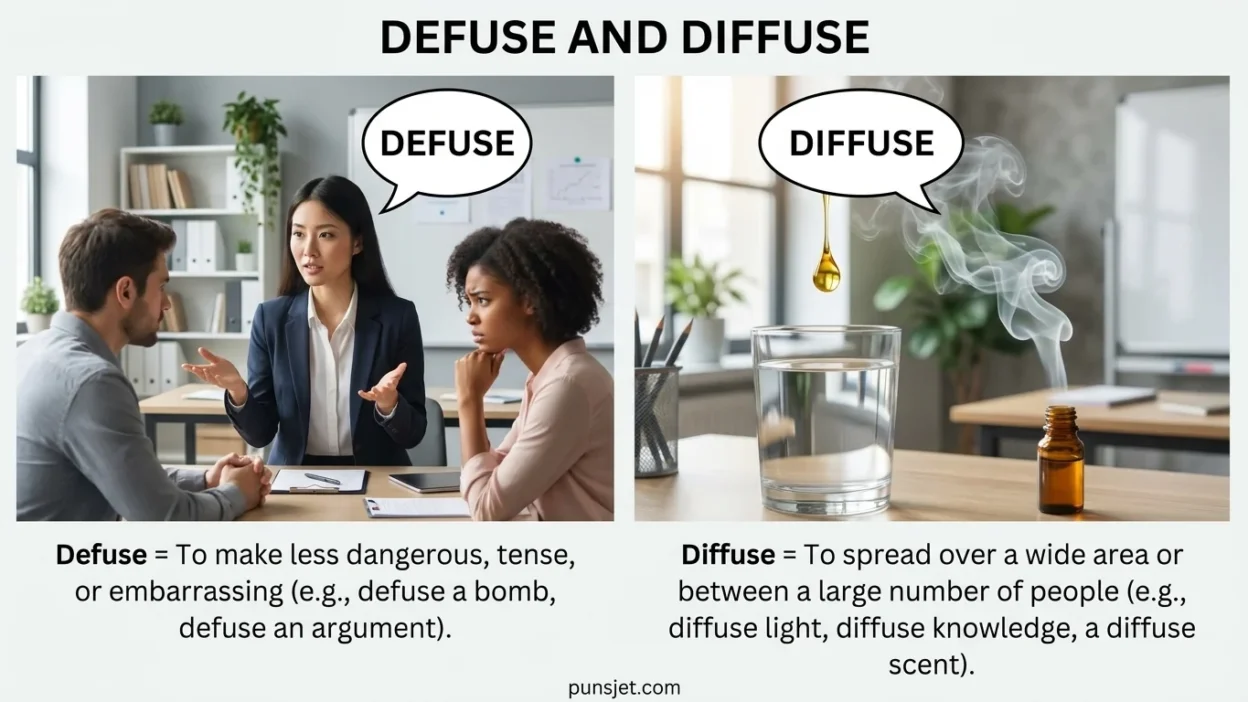
Defuse and diffuse look and sound very similar, so it is easy to mix them up. Both words can be used as verbs, and both are connected with the idea of something spreading or becoming less intense. However, they have different meanings and are used in different situations.
The easiest way to remember them is this:
- Defuse means to make a dangerous or tense situation less serious.
- Diffuse means to spread something over a wider area or to make something less concentrated.
For example, you can defuse an argument, but you can diffuse light.
Once you understand this small difference, choosing the correct word becomes much easier.
Quick Answer: Defuse vs. Diffuse
Here is the difference in simple words:
- Defuse = to make a tense, dangerous, or difficult situation calmer.
- Defuse can also mean to remove the fuse from a bomb or explosive device.
- Diffuse = to spread something out over a large area.
- Diffuse can describe light, smells, gases, ideas, or other things that spread.
- Diffuse can also mean to make something less strong or concentrated.
- Defuse is often connected with conflict or danger.
- Diffuse is often connected with spreading or becoming less concentrated.
Easy memory trick
Think of defuse as remove the fuse.
Think of diffuse as spread out.
What Does “Defuse” Mean?
Defuse usually means to make a difficult, dangerous, or angry situation calmer.
For example:
The teacher tried to defuse the argument between the two students.
The teacher did not simply stop the argument by force. Instead, the teacher helped reduce the anger and tension.
The word can also have a more literal meaning. To defuse an explosive device means to remove or disable its fuse so that it will not explode.
Examples of “defuse”
- She told a joke to defuse the tension.
- The manager spoke calmly to defuse the angry customer.
- Police officers tried to defuse the situation.
- He apologized to defuse the argument.
- The technician was trained to defuse an explosive device.
In everyday English, the figurative meaning is very common. We often talk about defusing tension, anger, conflict, arguments, or difficult situations.
What Does “Diffuse” Mean?
Diffuse usually means to spread something over a wider area.
For example:
The curtains helped diffuse the bright sunlight.
The curtains caused the light to spread more evenly instead of remaining strong in one small area.
Diffuse can also mean that something becomes less concentrated or less focused.
Examples of “diffuse”
- The perfume diffused through the room.
- Clouds diffused the sunlight.
- The smell of food diffused through the house.
- The light became soft and diffuse.
- The organization had a diffuse structure with no clear center.
The word can describe physical things, such as light, gas, heat, or smell. It can also describe less physical things, such as attention, power, or ideas.
A Simple Background of the Two Words
Although defuse and diffuse look almost the same, they developed from different ideas.
Defuse is closely connected with the word fuse. A fuse is a part that can cause an explosive device to activate. To defuse something literally means to remove or disable its fuse. Over time, the word gained its common figurative meaning: to make a dangerous or tense situation less likely to become worse.
Diffuse, on the other hand, comes from an older word connected with the idea of spreading or pouring out. Its meaning still carries that basic idea today.
This gives us a useful connection:
- Defuse → fuse → reduce danger or tension
- Diffuse → spread → move over a wider area
The Main Difference Between Defuse and Diffuse
The most important difference is the action each word describes.
Defuse = calm or reduce danger
Use defuse when something is tense, angry, dangerous, or likely to become worse.
Common phrases include:
- defuse an argument
- defuse a conflict
- defuse tension
- defuse a crisis
- defuse an angry situation
- defuse a confrontation
Example:
The coach tried to defuse the conflict between the players.
The coach wanted to make the conflict calmer.
Diffuse = spread out
Use diffuse when something spreads over a larger area or becomes less concentrated.
Common phrases include:
- diffuse light
- diffuse heat
- diffuse a smell
- diffuse a gas
- diffuse information
- diffuse attention
Example:
The lampshade helps diffuse the light.
The light spreads out instead of remaining strong in one direction.
Defuse vs. Diffuse: Comparison Table
| Word | Main Meaning | Common Use | Example |
|---|---|---|---|
| Defuse | Make something less dangerous or tense | Arguments, conflict, tension, crises | She tried to defuse the argument. |
| Defuse | Disable an explosive device | Bombs or explosives | The expert was trained to defuse the device. |
| Diffuse | Spread something over a wider area | Light, smell, gas, heat | The curtains diffuse the sunlight. |
| Diffuse | Make something less concentrated | Light, energy, attention, ideas | The screen diffuses the light. |
One-line difference
Defuse makes a tense or dangerous situation calmer; diffuse spreads something out.
Which One Should You Use and When?
When you are unsure, look at the thing being affected.
Use “defuse” when you are talking about:
- an argument
- tension
- anger
- conflict
- a crisis
- a confrontation
- a dangerous situation
- an explosive device
Example:
His calm words helped defuse the situation.
Use “diffuse” when you are talking about:
- light
- heat
- smell
- gas
- energy
- information
- attention
- something spreading out
Example:
The curtains diffused the sunlight.
A simple question can help:
Am I trying to calm something down?
If yes, you probably need defuse.
Am I spreading something out?
If yes, you probably need diffuse.
Common Mistakes People Make
Mistake 1: “Diffuse the argument”
A common mistake is writing:
❌ She tried to diffuse the argument.
In most situations, this should be:
✅ She tried to defuse the argument.
The person is trying to make the argument calmer, not spread it across a larger area.
Mistake 2: “Defuse the light”
Another mistake is:
❌ The curtains defuse the light.
The correct word is:
✅ The curtains diffuse the light.
The curtains spread the light more evenly.
Mistake 3: Thinking “diffuse” means “calm”
Because something can become less intense when it spreads out, learners sometimes use diffuse when they mean “calm.”
But when talking about an argument or tense situation, defuse is normally the correct choice.
Mistake 4: Forgetting the “fuse” connection
If you remember that defuse contains fuse, it becomes easier to remember its meaning.
Defuse → remove the fuse → reduce danger → calm the situation.
Everyday Real-Life Examples
These words appear in many ordinary situations.
In an email
I apologized to defuse the tension after our disagreement.
Here, the writer wants the situation to become calmer.
In the news
Officials met to defuse tensions between the two groups.
The goal is to reduce tension.
In a classroom
The teacher used humor to defuse the argument.
The teacher helped make the argument less serious.
At home
Opening the windows helped diffuse the smell of cooking.
The smell spread through the air.
With sunlight
Thin curtains diffuse the sunlight and make the room more comfortable.
The light becomes softer and more evenly spread.
On social media
Her friendly reply helped defuse the heated discussion.
The reply reduced the tension in the discussion.
In photography
A soft material can diffuse light and reduce harsh shadows.
The light is spread more evenly.
A Short Learning Section for Students and Beginners
If you are learning English, do not try to memorize a long definition. Remember these two simple ideas:
DEFUSE = CALM
Defuse is connected with danger, anger, and tension.
defuse an argument
defuse a conflict
defuse tension
defuse a crisis
DIFFUSE = SPREAD
Diffuse is connected with spreading or becoming less concentrated.
diffuse light
diffuse heat
diffuse a smell
diffuse information
Easy memory sentence
You defuse a fight, but diffuse light.
This short sentence can help you remember the difference.
More Examples to Practice
Choose defuse or diffuse in each sentence.
- The manager tried to ______ the angry discussion.
- The lampshade helps ______ the bright light.
- She made a joke to ______ the tension.
- The smell began to ______ through the room.
- He wanted to ______ the conflict before it became worse.
- The clouds ______ the sunlight.
Answers
- defuse
- diffuse
- defuse
- diffuse
- defuse
- diffuse
Notice the pattern: situations become calmer with defuse, while things spread with diffuse.
FAQs:
1. What is the difference between defuse and diffuse?
Defuse means to make a tense or dangerous situation calmer. Diffuse means to spread something over a wider area or make it less concentrated.
2. Is it “defuse an argument” or “diffuse an argument”?
The usual expression is defuse an argument. You are trying to reduce the anger or tension in the argument.
3. Is it “diffuse light” or “defuse light”?
The correct phrase is diffuse light. Light is being spread more evenly.
4. Can defuse be used for a bomb?
Yes. Defuse can literally mean to remove or disable the fuse of an explosive device.
5. Can diffuse describe a smell?
Yes. You can say that a smell diffuses through a room when it spreads through the air.
6. What is an easy way to remember defuse?
Remember the word fuse. A fuse can be connected with an explosive device, so defuse can mean making something less dangerous. It also means calming a tense situation.
7. What is an easy way to remember diffuse?
Think spread. When something diffuses, it spreads out or becomes less concentrated.
8. Are defuse and diffuse pronounced the same way?
They are usually pronounced differently. Defuse has the sound “dee-FYOOZ,” while diffuse as a verb is commonly pronounced “di-FYOOZ.” The spelling and meaning are different as well.
Conclusion
Defuse and diffuse are easy to confuse because they look and sound very similar. However, their meanings are different.
Use defuse when you want to talk about making something dangerous, angry, or tense calmer. You can defuse an argument, defuse tension, or defuse a crisis.Use diffuse when something spreads over a wider area or becomes less concentrated. You can diffuse light, diffuse a smell, or describe something as diffuse when it is spread out.
The easiest rule to remember is:
Defuse = calm or reduce danger.
Diffuse = spread out.
Once you connect defuse with calming and diffuse with spreading, you will have a simple way to choose the right word in everyday English.

Joshua Paul is a creative writer and contributor at PunsJet.com who enjoys crafting witty puns and clever wordplay. With a strong sense of humor and a love for language, he creates entertaining content that readers can easily share and enjoy. Joshua’s goal is to spread laughter through fun and memorable jokes.