Beside and besides look almost the same, so it is easy to mix them up. They differ by only one letter, but they usually have different meanings and uses.
For example:
- “She sat beside me.”
- “Besides English, he studies French.”
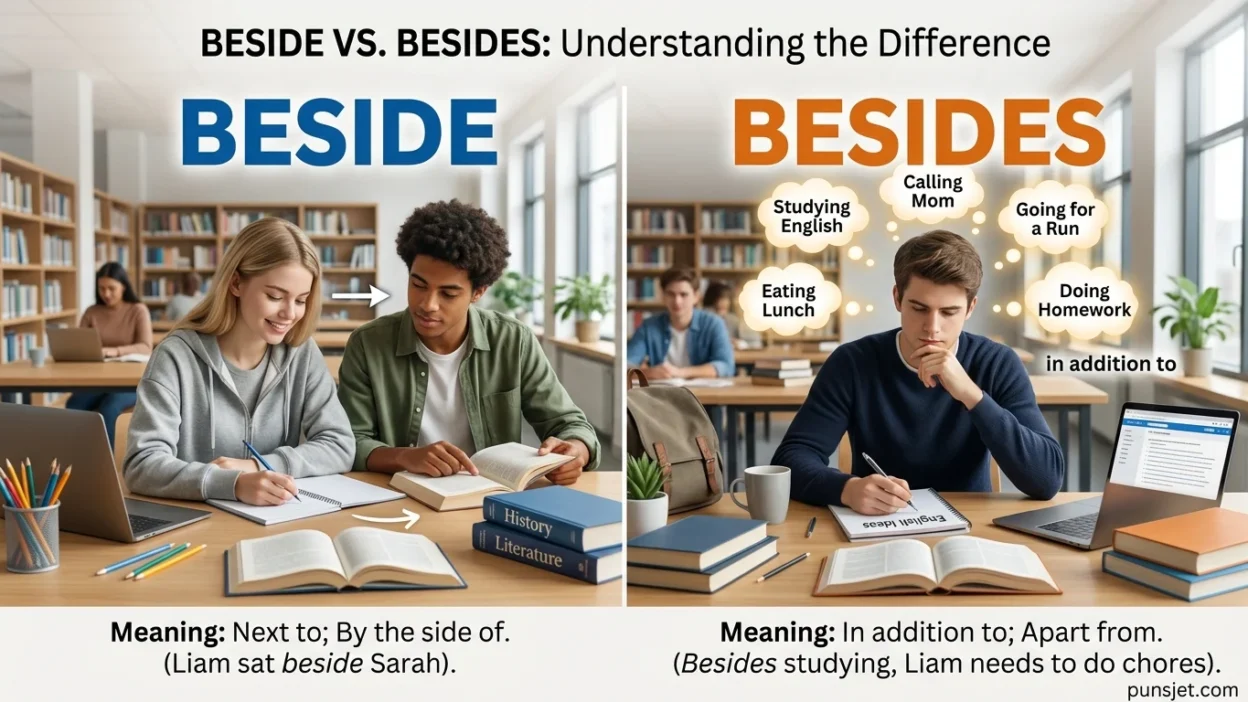
In the first sentence, beside means next to. In the second sentence, besides means in addition to or apart from.
The good news is that the difference is simple once you learn the basic idea. This guide explains beside and besides with easy definitions, examples, common mistakes, and simple memory tricks.
Quick Answer: Beside vs. Besides
Here is the easiest way to understand the difference:
- Beside usually means next to or by the side of something or someone.
- Besides usually means in addition to, also, or apart from.
- Beside is mainly used to talk about location or position.
- Besides is often used to add another person, thing, fact, or reason.
- Beside does not have an s at the end.
- Besides has an s at the end and often gives the idea of something extra.
Easy examples
Beside:
The bag is beside the chair.
Meaning: The bag is next to the chair.
Besides:
Besides coffee, I also like tea.
Meaning: I like coffee and also tea.
A simple memory trick
Think:
Beside = by the side
Besides = extra information
If you are talking about where something is, beside is often the right choice.
If you are adding something or saying “also,” besides is often the right choice.
A Simple Background of the Two Words
The words beside and besides are closely related. Both developed from the idea of something being by the side.
Over time, however, their common uses became different.
Beside kept its strong connection with physical position. When something is beside another thing, it is next to it.
For example:
The school is beside the park.
The school and the park are next to each other.
Besides developed an additional meaning. It can mean something like in addition to or apart from.
For example:
Besides Sara, three other students joined the activity.
Here, the sentence is not describing where Sara is standing. It is adding Sara to the group of people mentioned.
Understanding this difference helps you choose the correct word more naturally.
What Does “Beside” Mean?
Beside is usually a preposition. Its main meaning is next to or at the side of.
It tells us about the position of a person or thing.
Examples of “beside”
Tom is sitting beside his brother.
Tom is sitting next to his brother.
Put the shoes beside the door.
The shoes should be placed next to the door.
She parked her car beside the building.
The car is next to the building.
There is a small table beside my bed.
The table is next to the bed.
He stood beside his teacher.
He stood next to his teacher.
In all these examples, beside gives information about place or position.
Beside can also be used in a figurative way
Sometimes beside does not describe a physical position. It can be used in expressions such as:
That point is beside the main issue.
However, for beginners, the easiest meaning to remember is:
Beside = next to.
What Does “Besides” Mean?
Besides can be used in more than one way, but its most common meanings are in addition to, also, and apart from.
It is often used when we want to add another person, thing, fact, or reason.
“Besides” meaning “in addition to”
Besides English, Maria speaks Spanish.
This means Maria speaks English and also Spanish.
Besides apples, we bought oranges.
We bought apples and also oranges.
Besides his job, he runs a small business.
He has a job and also runs a small business.
“Besides” meaning “apart from”
Who was there besides Ali?
This asks who was there apart from Ali.
Besides John, everyone came to the meeting.
This means everyone came, with John considered separately.
“Besides” can also introduce another reason
Sometimes besides means something close to also or anyway, especially when giving an additional reason.
For example:
I do not want to go. Besides, it is already late.
The speaker gives one more reason for not going: it is late.
This use is different from beside, which normally refers to being next to something.
Beside vs. Besides: Comparison Table
| Word | Main Meaning | Common Use | Example |
|---|---|---|---|
| Beside | Next to | Position or location | She sat beside me. |
| Besides | In addition to | Adding people or things | Besides tea, I like coffee. |
| Besides | Apart from | Excluding or adding someone/something | Who came besides Ahmed? |
| Besides | Also / another reason | Adding information | Besides, we are already late. |
The easiest difference
| If you mean… | Use |
|---|---|
| Next to | beside |
| By the side of | beside |
| In addition to | besides |
| Also | besides |
| Apart from | besides |
| Another reason | besides |
Which One Should You Use and When?
Choosing between these two words becomes easy if you ask yourself one question:
Are you talking about location?
If yes, use beside.
The lamp is beside the sofa.
He stood beside his mother.
The restaurant is beside the hotel.
Here, the word tells us where something or someone is.
Are you adding something?
If yes, use besides.
Besides math, she studies science.
Besides John, two other people attended.
I have no time. Besides, I am tired.
Here, besides gives an additional idea.
Common Mistakes with Beside and Besides
Because the words are so similar, learners often use one when they need the other.
Mistake 1: Using “besides” for physical location
Incorrect:
The chair is besides the table.
If you mean the chair is next to the table, use beside.
Correct:
The chair is beside the table.
Mistake 2: Using “beside” when adding information
Incorrect:
Beside English, I study mathematics.
If you mean “in addition to English,” use besides.
Correct:
Besides English, I study mathematics.
Mistake 3: Forgetting the “s”
This is a common spelling mistake.
Remember:
- Beside = next to
- Besides = in addition to
That final s can help you remember that besides often adds something extra.
Mistake 4: Thinking they always have the same meaning
Although they look and sound similar, they should not always be exchanged.
Compare:
The dog is beside the door.
This describes location.
Besides the dog, there is a cat in the room.
This adds another thing to the information.
The meaning changes when you change the word.
Everyday Examples of Beside and Besides
These words appear frequently in everyday English.
In daily conversation
Can you sit beside me?
Besides pizza, what would you like to eat?
My phone is beside my laptop.
Besides being smart, she is very kind.
In emails
You may see beside when talking about a location:
Please leave the documents beside the printer.
You may see besides when adding information:
Besides the documents, please send the photographs.
In news and formal writing
The new library was built beside the school.
This describes location.
Besides the main road, the city is improving several smaller roads.
This adds another item to the discussion.
On social media
People often use besides when adding another thought:
I love this place. Besides, the food is amazing!
They may use beside when describing where something is:
My cat is sitting beside me while I write this post.
A Simple Learning Trick for Students
Here is a quick trick that can help you remember the difference.
Step 1: Replace the word with “next to”
If next to makes sense, choose beside.
The school is beside the park.
Try:
The school is next to the park.
The meaning stays almost the same.
So beside is correct.
Step 2: Replace the word with “in addition to”
If in addition to makes sense, choose besides.
Besides English, I study French.
Try:
In addition to English, I study French.
The meaning stays almost the same.
So besides is correct.
Quick test
Ask yourself:
“Do I mean next to?”
→ Beside
“Do I mean also or in addition to?”
→ Besides
This simple test works in many everyday sentences.
More Examples to Practice
Beside
- The child sat beside his mother.
- My school is beside a large park.
- There is a chair beside the window.
- She placed her phone beside the book.
- He walked beside his friend.
Besides
- Besides English, I can speak Urdu.
- Besides Sarah, everyone finished the work.
- What do you eat besides rice?
- Besides, we do not have enough money.
- Besides studying, he enjoys playing football.
Beside and Besides in One Short Example
Look at these two sentences:
The boy is sitting beside his father.
This tells us where the boy is.
Now look at:
Besides his father, his mother is sitting there too.
This tells us who else is there.
The difference is clear:
Beside = position
Besides = addition
FAQs:
1. What is the main difference between beside and besides?
Beside usually means next to. Besides usually means in addition to, also, or apart from.
2. Is “beside me” correct?
Yes.
Please sit beside me.
It means “Please sit next to me.”
3. Is “besides me” correct?
Yes, but it has a different meaning.
Who was there besides me?
This means “Who was there in addition to me?” or “Who else was there?”
4. Can “beside” mean “next to”?
Yes. This is its most common meaning.
The bank is beside the supermarket.
The bank is next to the supermarket.
5. Can “besides” mean “also”?
Yes.
Besides being a teacher, she is a writer.
This means she is a teacher and also a writer.
6. Is “besides” always used to add something?
Not always. It can also mean apart from, or it can introduce an additional reason.
For example:
Besides, I am too tired to go.
Here, it introduces another reason.
7. How can I remember the difference easily?
Remember this:
Beside = next to
Besides = extra
If you are talking about location, use beside. If you are adding another idea, person, or thing, use besides.
8. Which is correct: “beside the house” or “besides the house”?
If you mean next to the house, use:
If you mean in addition to the house, then besides the house may be possible, depending on the sentence.
The intended meaning decides the correct word.
Final Conclusion
Beside and besides are easy to confuse because they look almost identical. The most important difference is their meaning.
Use beside when you mean next to or by the side of something or someone:
The cat is beside the chair.
Use besides when you mean in addition to, also, or apart from:
Besides English, she studies French.
The final s in besides can be a useful reminder that you are adding something extra.
So, when you are unsure, stop and ask yourself:
“Do I mean next to?”
Use beside.
“Do I mean also, in addition to, or apart from?”
Use besides.
With this simple rule and a little practice, you can use beside and besides correctly and confidently in conversations, schoolwork, emails, and everyday writing.

Emily Margaret is a writer and humor enthusiast at PunsJet.com. She enjoys creating clever puns and lighthearted content that entertains readers and adds a spark of humor to everyday life. With a love for wordplay and creativity, Emily aims to share fun, relatable jokes that make people smile and laugh.