
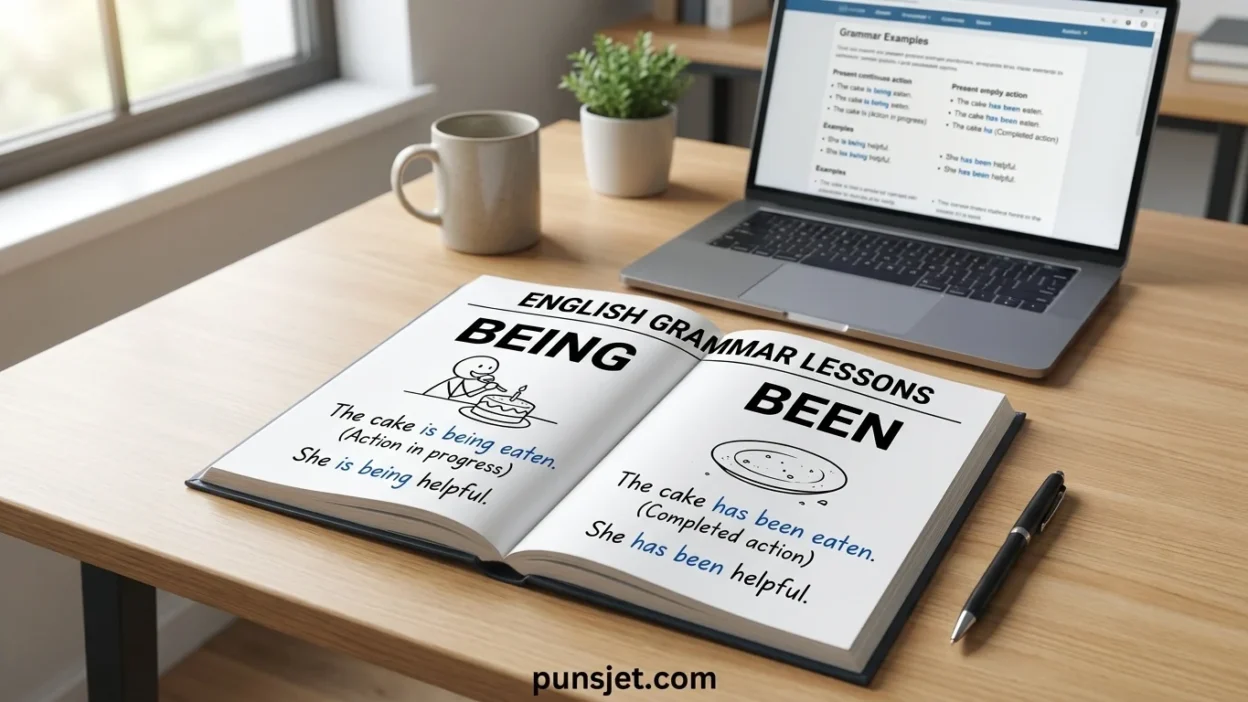
Many English learners get confused by being and been because both words come from the verb be. They look and sound different, but it can still be difficult to know which one belongs in a sentence.
The good news is that the difference becomes much easier when you understand how each word works.
Being is usually used for something happening now, a continuing situation, or a person’s behavior. Been is usually used to talk about something that happened or started in the past and is connected to another time.
In this guide, we will explain being and been in very simple English. You will learn what they mean, how to use them, where they appear in sentences, and how to avoid common mistakes.
Quick Answer: Being vs. Been
Here is the easiest way to remember the difference:
- Being is the -ing form of the verb be.
- Been is the past participle form of be.
- Being is often used with am, is, are, was, or were in certain structures.
- Been is normally used after has, have, or had.
- Being can describe an action or behavior that is happening or continuing.
- Been often talks about a past state, experience, or situation.
- Being can be followed by an adjective, noun, or past participle in different structures.
- Been is commonly used in perfect tenses.
Easy examples
Being:
- She is being very helpful.
- He is being quiet today.
- I like being alone sometimes.
Been:
- She has been very helpful.
- He has been quiet all morning.
- I have been to London.
A simple memory trick is:
What Do “Being” and “Been” Mean?
Both being and been come from the verb be.
The verb be has several forms:
| Form | Example |
|---|---|
| Be | I want to be happy. |
| Am | I am happy. |
| Is | She is happy. |
| Are | They are happy. |
| Was | He was happy. |
| Were | We were happy. |
| Being | She is being helpful. |
| Been | She has been helpful. |
Although these forms belong to the same verb, they do not work in the same way.
The most important thing to remember is that being and been cannot normally replace each other.
You cannot say:
- ❌ I have being there.
- ❌ She is been helpful.
Instead, say:
- ✅ I have been there.
- ✅ She is being helpful.
What Is “Being”?
Being is the -ing form of be.
It is often used when we want to describe a condition, behavior, or situation that is happening or continuing.
Example:
Tom is being rude.
This means Tom is behaving in a rude way at this time.
It does not necessarily mean Tom is always rude. His behavior may be different at another time.
Compare:
Tom is rude.
This can describe his general personality or usual behavior.
Tom is being rude.
This focuses on his behavior right now.
More examples
- You are being very kind.
- She is being careful.
- The children are being noisy.
- He is being silly.
- They are being friendly.
In these examples, being describes behavior or a temporary situation.
Being After “Is,” “Am,” and “Are”
One common use of being is after forms of be such as is, am, and are.
For example:
- I am being honest.
- She is being patient.
- We are being careful.
- They are being polite.
However, this does not mean that every sentence containing is, am, or are needs being.
For example:
- She is happy. ✅
- She is being happy. ⚠️
“She is happy” is normal when describing her condition.
“She is being happy” is unusual in many situations because happy is generally treated as a state rather than a behavior.
But some adjectives work naturally with being:
- He is being rude.
- You are being helpful.
- She is being careless.
- They are being unfair.
What Is “Been”?
Been is the past participle of be.
It is most commonly used with has, have, or had.
Examples:
- I have been busy.
- She has been sick.
- They have been helpful.
- He had been tired.
- We have been friends for years.
This is one of the easiest rules to remember:
Has + been
She has been busy.
Have + been
They have been busy.
Had + been
He had been busy.
You generally cannot use being in these sentences.
- ❌ She has being busy.
- ✅ She has been busy.
- ❌ They have being helpful.
- ✅ They have been helpful.
Being vs. Been: The Main Difference
The biggest difference is their grammatical form and how they are used.
Being is an -ing form.
Been is a past participle.
Look at these examples:
She is being very quiet.
This focuses on what she is doing or how she is behaving now.
She has been very quiet.
This tells us that she was quiet during a period of time leading up to now.
Another example:
He is being careful.
He is behaving carefully at the moment.
He has been careful.
He has behaved carefully during a past period or until now.
Being vs. Been Comparison Table
| Feature | Being | Been |
|---|---|---|
| Basic form | -ing form | Past participle |
| Comes from | Be | Be |
| Commonly used with | is, am, are, was, were | has, have, had |
| Main idea | An ongoing action, behavior, or state | A past or completed state/experience |
| Example | She is being kind. | She has been kind. |
| Another example | They are being careful. | They have been careful. |
| Common structure | be + being | have/has/had + been |
When Should You Use “Being”?
Use being when the sentence needs the -ing form of be.
1. To describe temporary behavior
You are being very nice today.
He is being difficult.
She is being honest with you.
These sentences focus on behavior.
2. After certain verbs
Being can also follow verbs or expressions that naturally take an -ing form.
Examples:
I enjoy being with my family.
She dislikes being late.
He loves being outdoors.
They talked about being successful.
Here, being acts like an -ing form and fits naturally after these expressions.
3. In passive structures
Being can also appear in passive sentences.
The house is being painted.
This means someone is painting the house now.
The car is being repaired.
The repair is happening at the moment.
When Should You Use “Been”?
Use been when the sentence uses a perfect tense.
1. Present perfect
Use has/have + been.
I have been busy all day.
She has been helpful.
We have been friends for years.
2. Past perfect
Use had + been.
I had been tired before the meeting.
She had been nervous before the exam.
They had been married for ten years.
3. Talking about experiences
Been is very common when talking about places you have visited.
I have been to Pakistan.
She has been to Dubai.
Have you ever been to London?
Here, been to means that someone visited a place and returned or has the experience of visiting it.
“Being” and “Been” in Everyday Sentences
Understanding real examples can make the difference easier to remember.
At school
The students are being quiet during the test.
The students are behaving quietly now.
The students have been quiet all morning.
They have remained quiet for a period of time.
At work
My manager is being very helpful today.
The manager is behaving helpfully now.
My manager has been very helpful this week.
The manager has helped during the week.
At home
The children are being noisy.
They are making noise now.
The children have been noisy all afternoon.
They have made noise for a period of time.
Common Mistakes With Being and Been
English learners often make a few common mistakes with these words.
Mistake 1: Using “being” after “have”
Incorrect:
❌ I have being busy.
Correct:
✅ I have been busy.
Remember:
have + been
Mistake 2: Using “been” after “is”
Incorrect:
❌ She is been helpful.
Correct:
✅ She is being helpful.
When the sentence needs the -ing form, use being.
Mistake 3: Saying “I am been”
Incorrect:
❌ I am been there.
Correct:
✅ I have been there.
The expression for past experience is have been, not am been.
Mistake 4: Confusing “being” with permanent personality
Compare:
He is rude.
This may describe his usual character.
He is being rude.
This usually means he is behaving rudely at this moment.
The word being can make the sentence sound more temporary.
Mistake 5: Saying “I have being to…”
Incorrect:
❌ I have being to Lahore.
Correct:
✅ I have been to Lahore.
For an experience of visiting a place, use have/has + been.
Being and Been in Emails
You may see both words in everyday emails.
Being
Thank you for being so helpful.
The documents are being reviewed.
I appreciate you being patient.
Been
Thank you for your help. You have been very helpful.
The documents have been reviewed.
We have been waiting for your response.
Notice how the surrounding words help you choose the correct form.
Being and Been in News and Social Media
Both words are also common in news reports and online posts.
Examples with “being”
The road is being repaired.
Several buildings are being inspected.
The team is being careful about its next decision.
Examples with “been”
The road has been repaired.
Several buildings have been inspected.
The team has been working on the project for months.
A useful clue is:
is/are + being often shows something happening now.
has/have + been often connects the past with the present.
A Simple Trick to Remember the Difference
When you are unsure, look at the word before the blank.
If you see:
has → been
She has been busy.
have → been
They have been busy.
had → been
We had been busy.
If you see:
is → often being
He is being helpful.
are → often being
They are being helpful.
am → being
I am being careful.
This trick will not solve every possible grammar question, but it works for many common sentences.
A Short Learning Exercise
Try choosing being or been.
- She has ___ very helpful.
- He is ___ polite today.
- I have ___ to that city.
- They are ___ noisy.
- We had ___ friends for many years.
- Thank you for ___ patient.
- The house is ___ cleaned.
- She has ___ busy all morning.
Answers
- been
- being
- been
- being
- been
- being
- being
- been
If you can understand why each answer works, you are already much more comfortable with these two words.
Being or Been: Which One Should You Use?
Use being when you need an -ing form, especially for behavior, an ongoing situation, or certain passive structures.
Examples:
- He is being kind.
- They are being careful.
- The room is being cleaned.
- I enjoy being here.
Use been when you need the past participle of be, especially after has, have, or had.
Examples:
- He has been kind.
- They have been careful.
- The room has been cleaned.
- I have been there.
The easiest pattern is:
is/am/are + being
has/have/had + been
FAQs:
1. Are “being” and “been” the same?
No. Both come from the verb be, but they are different forms and are used in different grammar structures.
2. What is the easiest way to remember “been”?
Remember has/have/had + been.
For example:
She has been busy.
They have been helpful.
3. What is the easiest way to remember “being”?
Think about the -ing form.
For example:
He is being rude.
They are being careful.
4. Is “I have been there” correct?
Yes. I have been there is correct when you mean that you have visited or experienced being in that place.
5. Is “I am being tired” correct?
Usually, no. We normally say:
I am tired.
Not:
❌ I am being tired.
However, being can be correct with many other words, especially when describing temporary behavior.
6. Is “She has being nice” correct?
No. The correct sentence is:
She has been nice.
After has, use been, not being.
7. Can “being” be used without “is” or “are”?
Yes. For example:
I enjoy being outside.
Thank you for being honest.
Being patient is important.
8. Which is correct: “has been” or “has being”?
Has been is correct.
She has been very helpful.
The structure has being is not correct in standard English.
Final Conclusion
The difference between being and been may seem confusing at first, but it becomes much simpler when you focus on their grammar.
Being is the -ing form of be. It is often used to describe temporary behavior, something continuing, or an action happening now.
She is being helpful.
Been is the past participle of be. It is commonly used after has, have, and had to talk about a past state, experience, or situation connected to another time.
She has been helpful.
The two most useful patterns to remember are:
is/am/are + being
has/have/had + been
If you remember these patterns and practice them in everyday sentences, choosing between being and been will become much easier. When you see one of these words, do not just look at the word itself. Look at the words around it. They will often tell you which form is correct.