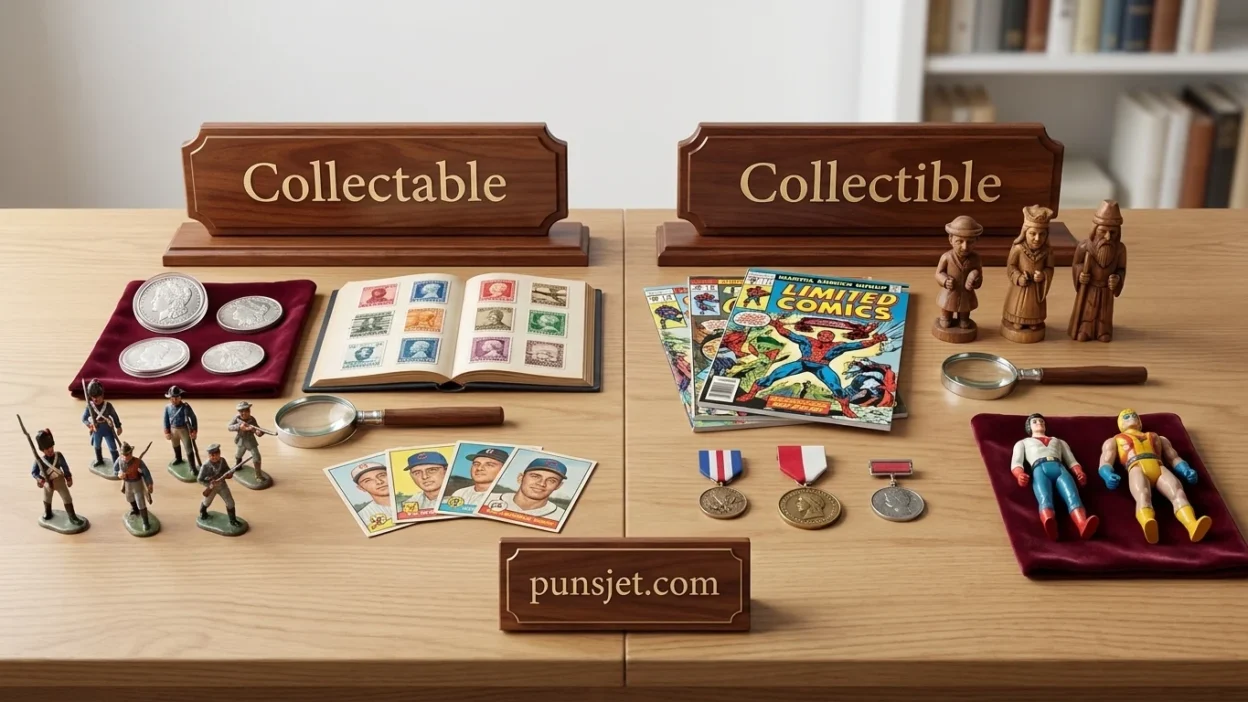
Have you ever seen the words collectable and collectible and wondered which spelling is correct? You are not alone. These two words look almost exactly the same, sound the same, and are often used in the same situations.
The confusion mainly comes from different spelling traditions. Both collectable and collectible are real English words. In many cases, they have the same meaning: something that is worth collecting, especially because it is interesting, rare, valuable, or special.
However, there is a small difference in how the two spellings are commonly used. Collectible is much more common, especially in American English. Collectable is also correct and is often seen in British English.
Understanding this difference can help you choose the spelling that fits your writing.
Quick Answer: Collectable or Collectible?
- Collectible is the more common spelling, especially in American English.
- Collectable is also correct and is more common in British English.
- Both words can describe something that people want to collect.
- A collectible can be a coin, toy, card, book, piece of art, or other special item.
- Collectable can also mean something that can be collected.
- In general writing, collectible is the safer and more widely recognized choice.
- The two words are usually interchangeable when they are used as adjectives or nouns referring to items worth collecting.
Easy example
This rare baseball card is a valuable collectible.
You could also write:
This rare baseball card is a valuable collectable.
Both sentences are correct.
What Does “Collectable” Mean?
Collectable means something that can be collected or is worth collecting.
It is formed from the verb collect and the ending -able. The ending -able often means “can be” or “suitable for.”
For example:
- washable = able to be washed
- readable = easy or possible to read
- breakable = able to be broken
- collectable = able or suitable to be collected
When people talk about special objects, collectable often describes things that people enjoy gathering because of their age, rarity, beauty, or value.
Examples
- The shop sells old collectable toys.
- She found a collectable coin at the market.
- These stamps are highly collectable.
- The limited-edition figures are popular collectables.
In British English, this spelling is perfectly normal.
What Does “Collectible” Mean?
Collectible has the same basic meaning. It describes something that people want to collect.
It is especially common in American English.
A collectible may be something that is rare, unusual, valuable, or connected to a popular hobby.
Examples include:
- trading cards
- coins
- stamps
- comic books
- toys
- sports memorabilia
- signed books
- limited-edition figures
- antiques
Examples
- He bought a rare collectible at the auction.
- The company released a new collectible figure.
- Her room is full of movie collectibles.
- This card could become a valuable collectible.
The word collectible is very common in American books, shops, product descriptions, and everyday conversation.
Where Do These Spellings Come From?
The two spellings developed from the same basic idea: something that can be collected.
English often has different spellings in different regions. British English and American English sometimes choose different forms of the same word.
For example:
- colour / color
- favourite / favorite
- centre / center
- travelling / traveling
Collectable and collectible are another example of spelling variation.
The spelling collectable follows a familiar pattern using -able. The spelling collectible uses -ible.
Over time, collectible became especially common in American English. Collectable remains widely accepted, particularly in British English.
So, this is not a case where one word is right and the other is wrong.
Collectable vs. Collectible: The Main Difference
The biggest difference is spelling and regional preference, not meaning.
Collectable
Collectable is commonly associated with British English. It can mean something that can be collected or something that is worth collecting.
Collectible
Collectible is especially common in American English. It is widely used for objects that people collect as a hobby or because they may have special value.
There can sometimes be a slight difference in emphasis.
Collectable can have the wider meaning of “able to be collected.”
Collectible often suggests a special object that is desirable to collectors.
However, this difference is not strict. Native speakers often use the two forms in the same way.
Easy Comparison Table
| Feature | Collectable | Collectible |
|---|---|---|
| Basic meaning | Something that can or is worth being collected | Something that can or is worth being collected |
| Spelling | Uses -able | Uses -ible |
| Common in | British English | American English |
| Used as an adjective | Yes | Yes |
| Used as a noun | Yes | Yes |
| Refers to special items | Yes | Yes |
| Refers to things worth collecting | Yes | Yes |
| Correct spelling | Yes | Yes |
| Most common choice internationally | Common | Very widely recognized |
The key point is simple: both spellings are correct.
Which One Should You Use and When?
Choosing between these words is usually easy.
Use “collectible” when:
- You are writing mainly for an American audience.
- You are talking about a special item that people collect.
- You want to use the spelling most commonly recognized in American English.
- You are writing about toys, cards, coins, comics, or memorabilia.
Example:
The store has hundreds of rare sports collectibles.
Use “collectable” when:
- You are following British English spelling.
- Your school, workplace, or publication uses British spelling.
- You want to describe something as suitable for collecting.
- You are writing for readers who commonly use British English.
Example:
The museum has several collectable items from the nineteenth century.
The most important rule
Stay consistent.
If your writing uses British English, collectable may fit naturally. If your writing uses American English, collectible is usually the better choice.
Common Mistakes People Make
1. Thinking “collectable” is wrong
Some people believe that collectible is the only correct spelling. That is not true.
Collectable is also a valid English word.
2. Thinking the words always have completely different meanings
In most situations, they mean essentially the same thing.
The spelling difference is more important than the meaning difference.
3. Mixing British and American spelling
A writer may use collectable in one paragraph and collectible in another without a reason.
This can make the writing look inconsistent.
Choose the spelling that matches the variety of English you are using.
4. Using “collectible” only for expensive objects
A collectible does not have to be extremely expensive.
A small toy, card, coin, or book can be a collectible simply because people enjoy collecting it.
5. Forgetting that the word can be a noun
Collectible can describe an object:
This is a collectible toy.
It can also be used as a noun:
He bought a collectible.
The same is true of collectable.
Everyday Real-Life Examples
These words appear in many everyday situations.
In emails
Hi Sarah,
I found several collectable books that might be useful for the display.
An American writer might instead write:
I found several collectible books that might be useful for the display.
In news
A rare collectible coin was sold at an auction for a large amount of money.
News reports may use either spelling depending on the style of English being used.
On social media
Look at my new collectible figure!
People often use collectible when talking about toys, figures, cards, and other hobby items.
In a shop
These limited-edition dolls are popular collectibles.
The word is especially common when businesses are talking about items designed for collectors.
In daily conversation
My brother collects old coins. Some of them are valuable collectibles.
Or:
My brother collects old coins. Some of them are valuable collectables.
Both versions can work.
Collectable or Collectible as a Noun
Both words can work as nouns.
A collectible is an item that people collect.
For example:
This comic book is a collectible.
Plural:
The shop sells comic-book collectibles.
Collectable can also be used as a noun:
The auction included several valuable collectables.
The choice again depends largely on regional spelling and personal or publication preference.
A Simple Trick for Students
If you are learning English, remember this:
Collectible = commonly used for things people collect.
Think:
Collect + ible = collectible
Then remember that collectable is also correct, especially in British English.
Another useful idea is to connect both spellings with the word collect:
collect → collectable / collectible
Both forms are related to the same verb.
If you are unsure which one to write, collectible is a widely understood choice. But always follow the spelling style required by your school, teacher, employer, or publication.
FAQs:
1. Is “collectable” a correct word?
Yes. Collectable is a correct English word. It can mean something that can be collected or something worth collecting.
2. Is “collectible” a correct word?
Yes. Collectible is also correct. It is especially common in American English.
3. What is the difference between collectable and collectible?
Usually, there is no major difference in meaning. The main difference is spelling and regional usage. Collectible is more common in American English, while collectable is common in British English.
4. Which spelling is more common in American English?
Collectible is the usual choice in American English.
For example:
She bought a rare collectible.
5. Which spelling should I use in British English?
Collectable is a common British spelling.
For example:
He owns several valuable collectables.
However, collectible can also be understood and used.
6. Can “collectible” be a noun?
Yes. It can describe an item that people collect.
This toy is a collectible.
It can also be plural:
The store sells collectibles.
7. Does a collectible have to be expensive?
No. An item does not need to be expensive to be a collectible. People may collect things because they are interesting, rare, nostalgic, beautiful, or personally meaningful.
8. Which word should beginners remember?
A simple choice is collectible, especially if you are using American English. But remember that collectable is also correct and is common in British English.
Final Conclusion
Collectable and collectible are both correct English words. They usually have the same meaning and can describe something that can be collected or is worth collecting.
The main difference is regional spelling. Collectible is especially common in American English, while collectable is often preferred in British English.
If you are talking about a rare coin, old book, toy, trading card, stamp, or another item that people enjoy collecting, either word may be appropriate.
The easiest rule to remember is:
Collectable = correct, often British English
Collectible = correct, especially common in American English
When choosing between them, focus on the type of English you are using and keep your spelling consistent. Once you remember this simple difference, you will no longer need to wonder whether collectable or collectible is the correct word.

Donald Andrew is the creative mind behind PunsJet.com, where he shares clever wordplay and humorous puns for readers around the world. With a passion for language and comedy, Donald enjoys crafting witty jokes that bring smiles to everyday conversations. His goal is to make humor simple, fun, and easy to share.