
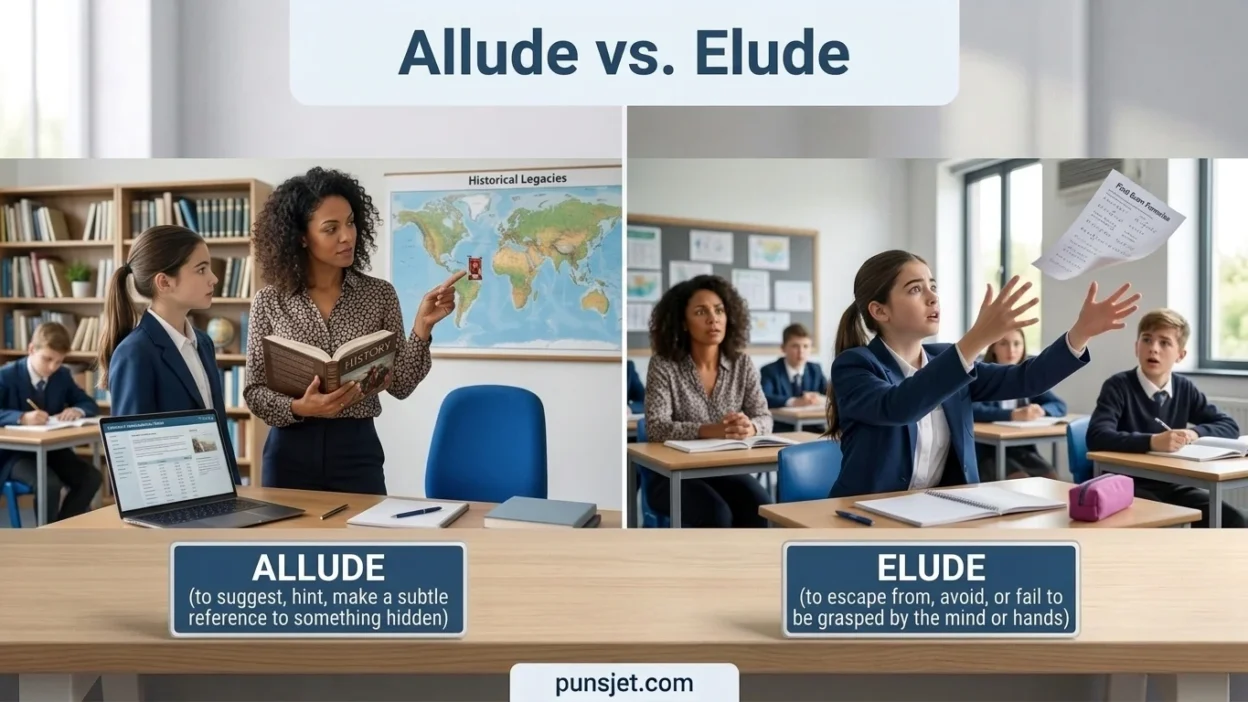
Allude and elude are two English words that often confuse students and even native speakers. They look and sound similar, but they have completely different meanings.
The confusion usually comes from their spelling and pronunciation. Both words begin with “alu-” or “elu-” sounds, so it is easy to mix them up when writing quickly.
The good news is that the difference is simple:
- Allude means to refer to something indirectly.
- Elude means to escape, avoid, or remain difficult to understand or find.
Once you connect each word with its main idea, choosing the correct word becomes much easier.
Quick Answer: Allude vs. Elude
Here is the difference in the simplest form:
- Allude = mention something indirectly without saying it clearly.
- Elude = escape from someone or something, or remain difficult to understand.
- Allude is usually connected with words, ideas, or references.
- Elude is usually connected with escape, failure to catch, or difficulty in understanding.
Easy examples
The speaker alluded to his childhood during the interview.
This means he talked about his childhood indirectly.
The police tried to catch the suspect, but he eluded them.
This means the suspect escaped or avoided being caught.
A useful memory trick is:
Allude = an indirect reference.
Elude = escape.
Where Do “Allude” and “Elude” Come From?
Knowing a little about the history of these words can make them easier to remember.
Allude
Allude comes from a Latin word connected with the idea of playing with or referring to something. Over time, it developed into the modern English meaning of making an indirect reference.
When someone alludes to something, they do not explain it directly. Instead, they give a clue that allows the listener or reader to understand what they mean.
For example:
Maria mentioned “the place we visited last summer,” but she did not name the city. She was alluding to their vacation.
The speaker expects the other person to understand the hidden or indirect reference.
Elude
Elude also comes from Latin. Its history is connected with the idea of escaping or avoiding something.
Today, it can describe a person physically escaping, but it can also describe something that is difficult to understand, remember, find, or achieve.
For example:
The runner eluded the guards.
The runner escaped them.
Or:
The answer eluded me.
The answer was difficult for me to remember or understand.
What Does “Allude” Mean?
Allude is a verb. It means to refer to something indirectly.
When you allude to something, you do not give a complete or direct explanation. You mention a clue, idea, person, event, or subject and expect the listener to understand the connection.
Examples of “allude”
The teacher alluded to an important test next week.
The teacher did not explain the test directly but gave a hint about it.
He alluded to problems at work.
He mentioned the problems without explaining all the details.
The movie alludes to several famous historical events.
The movie makes indirect references to those events.
Common pattern
A very common structure is:
allude to + something
Examples:
- allude to a problem
- allude to a past event
- allude to a person
- allude to a secret
- allude to a difficult situation
You will usually see “to” after allude when the thing being mentioned is stated.
What Does “Elude” Mean?
Elude is also a verb, but its meaning is very different.
It can mean to escape from someone or something, especially when someone is trying to catch you.
The thief eluded the police.
The thief escaped and avoided being caught.
But elude has another common use. Something can “elude” a person when it is difficult to understand, remember, find, or achieve.
Examples of “elude”
The answer eluded me.
I could not remember or find the answer.
Success eluded him for many years.
He tried to become successful but could not achieve it.
The meaning of the poem eluded the students.
The students found the meaning difficult to understand.
The missing key continued to elude the search team.
The team could not find the key.
So, elude does not always involve a person physically running away. It can also describe something that seems to stay out of reach.
Allude vs. Elude: Comparison Table
| Word | Meaning | Main Idea | Example |
|---|---|---|---|
| Allude | Refer to something indirectly | Hint or indirect reference | She alluded to her plans. |
| Elude | Escape or avoid being caught | Get away | The suspect eluded the police. |
| Elude | Be difficult to understand, remember, find, or achieve | Stay out of reach | The answer eluded me. |
The fastest way to remember
Think of these two simple ideas:
Allude → allusion → indirect reference
Elude → escape → get away
If someone is hinting, think allude.
If something is escaping or staying out of reach, think elude.
Which One Should You Use and When?
Choosing between these words becomes easy when you ask yourself one question:
Is someone referring to something indirectly?
If yes, use allude.
The author alluded to the character’s difficult childhood.
The author made an indirect reference to it.
Is someone escaping or avoiding something?
If yes, use elude.
The criminal eluded the police.
The criminal escaped.
Is something difficult to remember or understand?
Use elude.
Her name eluded me.
I could not remember her name.
The solution eluded the students.
The students could not figure out the solution.
Common Mistakes People Make
1. Using “elude” when you mean “allude”
Incorrect:
The writer eluded to his childhood.
Correct:
The writer alluded to his childhood.
The writer is making an indirect reference, so alluded is correct.
2. Using “allude” for physical escape
Incorrect:
The suspect alluded the police.
Correct:
The suspect eluded the police.
The suspect escaped, so eluded is the correct word.
3. Thinking “elude” only means running away
Elude can also describe something that is difficult to understand, remember, find, or achieve.
The answer eluded me.
Nobody is physically running away. The answer is simply difficult to remember or discover.
4. Forgetting “to” after “allude”
We commonly say:
She alluded to the problem.
Not:
She alluded the problem.
The pattern allude to is very common and useful to remember.
Everyday Examples of Allude and Elude
Understanding how these words appear in normal situations can make them easier to use.
In Emails
In my earlier message, I alluded to some changes that may affect the project.
Here, the writer referred indirectly to the changes.
Another example:
The solution has eluded us so far.
The team has not been able to find the solution.
In News Reports
The politician alluded to possible changes in government policy.
The politician hinted at the changes without explaining them fully.
Another example:
The suspect eluded officers for several hours.
The suspect successfully avoided being caught.
In Social Media
Someone might write:
“Some people should really think before they speak.”
If the person is referring indirectly to a particular person without naming them, they may be alluding to that person.
You might also see:
“That perfect photo has eluded me all week!”
Here, the person means they have been unable to get the photo they want.
In Daily Conversation
“I think you know what happened.”
If you are indirectly referring to a past event, you are alluding to it.
On the other hand:
“I knew her name yesterday, but it eludes me now.”
The name is difficult to remember.
A Simple Learning Trick for Students
If you are learning English, do not try to memorize long definitions. Connect each word with one simple picture in your mind.
Allude = Hint
Imagine someone saying:
“You know… the place we went last year.”
They do not say the name, but they give you a clue.
That is alluding.
Elude = Escape
Imagine a person running away while someone tries to catch them.
That person eludes the person chasing them.
Then remember a second meaning:
Elude = stay out of reach.
An answer can elude you. A memory can elude you. Success can elude you.
Try this quick test
Fill in the blanks:
- The author ________ to an earlier event.
- The suspect ________ the police.
- The answer ________ me during the exam.
Answers:
- alluded
- eluded
- eluded
This small exercise shows the difference clearly.
Allude and Elude in One-Minute Review
Before finishing, remember these key points:
- Allude means to refer to something indirectly.
- Elude means to escape or avoid being caught.
- Elude can also mean to be difficult to understand, remember, find, or achieve.
- Allude is commonly followed by to.
- If someone gives a hint, think allude.
- If something gets away or stays out of reach, think elude.
FAQs:
1. What is the main difference between allude and elude?
Allude means to refer to something indirectly. Elude means to escape, avoid, or remain difficult to find, understand, or remember.
2. Is “allude to” correct?
Yes. Allude to is a very common expression.
She alluded to her future plans.
It means she mentioned her plans indirectly.
3. Is “elude” the same as “escape”?
They can have a very similar meaning. Elude can mean to successfully escape or avoid being caught.
The criminal eluded the police.
4. Can an idea or answer elude someone?
Yes. Elude can describe something that is difficult to understand, remember, discover, or achieve.
The answer eluded me.
5. Can I use “allude” when someone escapes?
No. If someone escapes or avoids being caught, use elude.
The prisoner eluded the guards.
6. What is an easy way to remember allude?
Think allude = allusion = indirect reference.
When someone hints at something instead of saying it directly, they allude to it.
7. What is an easy way to remember elude?
Think elude = escape.
If someone or something stays out of reach, it eludes you.
8. Are allude and elude pronounced the same way?
No. They sound similar, but they are not pronounced exactly the same. More importantly, their meanings are completely different, so the context is very helpful when choosing between them.
Conclusion
Allude and elude may look and sound alike, but they describe two very different ideas.
Use allude when someone refers to something indirectly or gives a hint.
The speaker alluded to his past.
Use elude when someone escapes or avoids being caught, or when something is difficult to find, understand, remember, or achieve.
The suspect eluded the police.
The answer eluded me.
The easiest memory trick is:
Allude = hint.
Elude = escape or stay out of reach.
Once you remember those two ideas, you will be much less likely to confuse these words in your writing or conversation.

Emily Margaret is a writer and humor enthusiast at PunsJet.com. She enjoys creating clever puns and lighthearted content that entertains readers and adds a spark of humor to everyday life. With a love for wordplay and creativity, Emily aims to share fun, relatable jokes that make people smile and laugh.