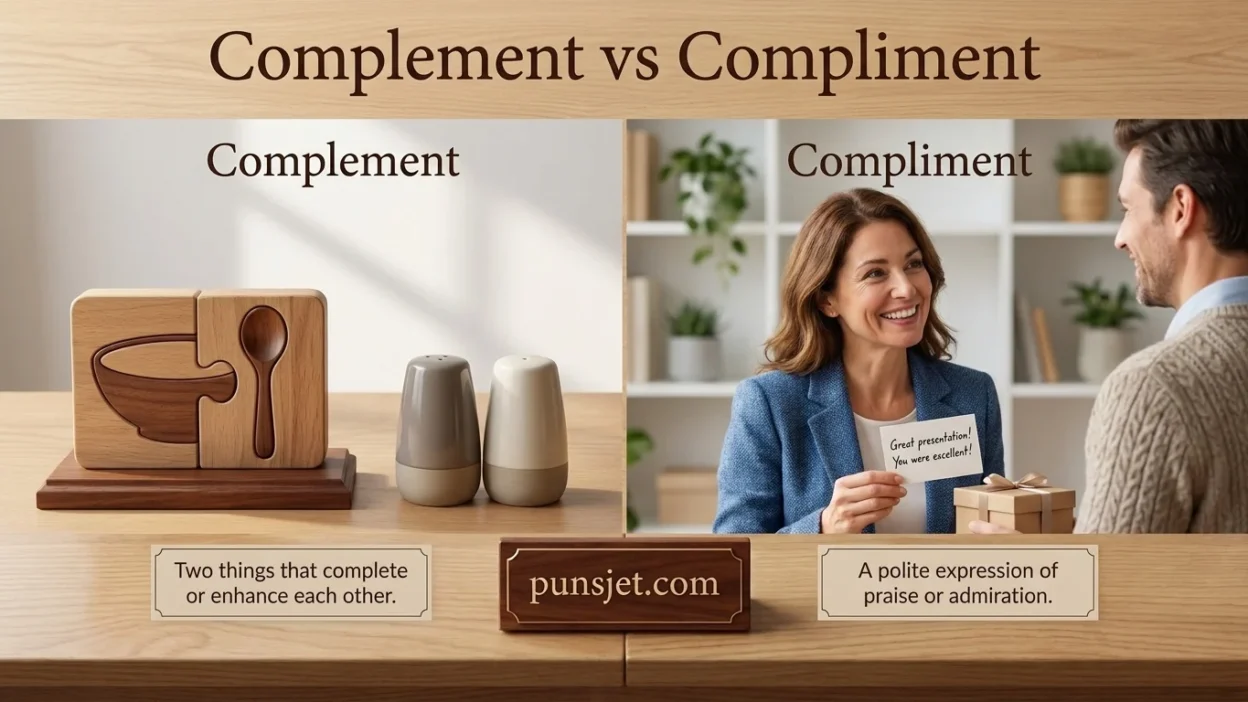
Complement and compliment are two English words that sound exactly the same, but they have different meanings and spellings. This makes them easy to confuse, especially when writing emails, school assignments, social media posts, or everyday messages.
The good news is that the difference is simple once you learn what each word means.
- Complement is connected with something that completes, matches, or improves another thing.
- Compliment is a kind or positive comment about someone or something.
A simple memory trick is this: compliment has an “i” for “I like it.” If you are saying something nice about a person, you probably mean compliment.
Quick Answer: Complement vs. Compliment
Here is the difference in a few simple points:
- Complement means something that completes or goes well with something else.
- Compliment means a kind or positive remark.
- Complement is often used for things that match or improve each other.
- Compliment is usually used when someone praises another person or thing.
- Complementary comes from complement.
- Complimentary can mean “given for free,” as well as “expressing praise.”
Easy examples
- The blue curtains complement the white walls.
- Sarah complimented me on my new jacket.
- Rice is a good complement to the curry.
- The teacher gave him a compliment for his excellent work.
The Simple Origin and Background
The two words come from different Latin roots, even though they later developed similar sounds in English.
Complement is related to a Latin word meaning something that fills up or completes something. This idea is still clear in its modern meaning. When one thing complements another, it adds something that makes the whole thing work or look better.
Compliment, on the other hand, is connected with words related to politeness and courtesy. Its modern meaning developed around expressions of praise or admiration.
Their spellings are very similar, but the small difference in the middle gives you an important clue:
- Complement → complete
- Compliment → praise
Thinking about these two connections can make the words much easier to remember.
What Does “Complement” Mean?
Complement means something that completes, matches, or improves another thing.
It can describe people, objects, colors, food, skills, ideas, or many other things that work well together.
Examples
- The red shoes complement her dress.
- Fresh vegetables complement the main dish.
- His calm personality complements her energetic nature.
- These two skills complement each other.
In each example, one thing works well with another.
Complement as a noun
Complement can also be a noun.
For example:
The lemon was a perfect complement to the fish.
Here, the lemon adds something that works well with the fish.
Another example:
Her cooking skills are a great complement to his baking skills.
The two skills work well together.
What Does “Compliment” Mean?
Compliment means a kind, positive, or approving comment.
When you tell someone that you like their clothes, work, appearance, cooking, or effort, you are giving them a compliment.
Examples
- She complimented me on my presentation.
- He gave his friend a compliment about his new haircut.
- The manager complimented the team on their hard work.
- “You have a beautiful voice” is a compliment.
A compliment is usually something positive that you say or write to make someone feel appreciated.
Compliment as a noun
A compliment is the kind statement itself.
“You did a great job” was a nice compliment.
Compliment as a verb
Compliment can also be used as a verb.
My teacher complimented me on my writing.
This means the teacher praised the writing.
Complement vs. Compliment: Comparison Table
| Word | Meaning | Common Use | Example |
|---|---|---|---|
| Complement | Something that completes or matches something else | Colors, food, people, skills, ideas | The shoes complement her dress. |
| Compliment | A kind or positive remark | Praise, appreciation, admiration | She complimented my dress. |
| Complementary | Matching or completing each other | Colors, skills, ideas | The colors are complementary. |
| Complimentary | Expressing praise or given free | Praise or free services | The hotel offered complimentary breakfast. |
Which One Should You Use and When?
The easiest way to choose the correct word is to ask yourself what you are trying to say.
Use “complement” when things work well together
Use complement when one thing completes, matches, or improves another.
Examples:
- The sauce complements the meal.
- Her skills complement mine.
- The furniture complements the room.
- The colors complement each other.
Use “compliment” when someone is praising something
Use compliment when a person says something nice or positive.
Examples:
- He complimented her on her dress.
- I received a compliment from my teacher.
- She gave me a nice compliment.
- The customer complimented the chef.
A quick test
If you can replace the word with “praise,” use compliment.
If you can replace it with “complete” or “match,” use complement.
Common Mistakes People Make
Mistake 1: Using “compliment” for matching things
Incorrect:
The blue shirt compliments the black trousers.
If you mean that the shirt and trousers look good together, use complements.
Correct:
The blue shirt complements the black trousers.
Mistake 2: Using “complement” when praising someone
Incorrect:
She complemented me on my presentation.
If you mean she praised you, the correct word is complimented.
Correct:
She complimented me on my presentation.
Mistake 3: Confusing “complementary” and “complimentary”
These two words can also cause confusion.
Complementary means things that complete or match each other.
The two colors are complementary.
Complimentary can mean showing praise.
The review was complimentary.
But complimentary can also mean something is provided free of charge.
The hotel provides complimentary breakfast.
So remember:
- Complementary = completes or matches
- Complimentary = praise or free
Everyday Real-Life Examples
Understanding the words in real situations makes them easier to remember.
In emails
Imagine your manager writes:
“Your report was very clear and well organized.”
That is a compliment.
You could say:
My manager complimented me on my report.
In the workplace
Two coworkers may have different skills that work well together:
Maria is good at planning, while James is good at presenting. Their skills complement each other.
Here, nobody is praising anyone. The meaning is that their skills work well together.
In food
You might say:
The spicy sauce complements the grilled chicken.
The sauce and chicken work well together.
But if someone says:
“This is the best chicken I have ever tasted!”
That is a compliment.
On social media
Someone comments:
“Your new photo looks amazing!”
That is a compliment.
But if you say:
The background colors complement your outfit.
You are describing how two things look good together.
In daily conversation
If your friend says:
“I love your new haircut!”
They are giving you a compliment.
If you say:
“That jacket really complements your shoes.”
You mean the jacket and shoes look good together.
A Simple Learning Trick for Students
The spelling can help you remember the difference.
Complement = Complete
Both words begin with comple-:
Complement → complete something
Think:
Complement = complete or match
Compliment = Praise
Think of the “i” in compliment as “I like it.”
Compliment = I like it!
For example:
- “I like your shoes.” → compliment
- “Those shoes match your outfit.” → complement
This small memory trick can help you choose the right word quickly.
More Examples to Practice
Read these examples and notice the meaning.
- The curtains complement the furniture.
- My friend complimented me on my new shoes.
- The fresh salad was a perfect complement to the meal.
- She received a compliment from her teacher.
- His skills complement the skills of the other team members.
- The customer complimented the restaurant’s service.
- The painting complements the color of the walls.
- “You are very hardworking” is a compliment.
The key question is always:
Are things working well together, or is someone saying something nice?
FAQs:
1. What is the difference between complement and compliment?
Complement means something completes, matches, or improves something else. Compliment means a kind or positive comment.
2. Is “You look beautiful” a complement or a compliment?
It is a compliment because you are praising someone.
3. Is “These colors complement each other” correct?
Yes. Complement is correct because the colors work well together.
4. What does “complimented” mean?
Complimented means praised or said something positive about someone or something.
Example:
The teacher complimented the student on her work.
5. What does “complementary” mean?
Complementary means completing or matching something else.
Example:
The two colors are complementary.
6. What does “complimentary” mean?
Complimentary can mean expressing praise. It can also mean something provided for free.
Examples:
He made complimentary comments about her work.
Guests receive complimentary drinks.
7. How can I remember complement vs. compliment?
Remember:
Complement = complete or match.
Compliment = praise.
The phrase “I like it” can help you remember the “i” in compliment.
8. Can complement and compliment be verbs?
Yes.
Complement as a verb:
The shoes complement her outfit.
Compliment as a verb:
He complimented her on her outfit.
Conclusion
Complement and compliment sound the same, but their meanings are different.
Use complement when something completes, matches, or improves something else. Use compliment when someone praises another person or thing.
Remember the easiest rule:
Complement = complete or match.
Compliment = praise.
So, a dress can complement a pair of shoes, while a friend can compliment you on that dress.
Once you connect complement with “complete” and compliment with praise, this commonly confused pair becomes much easier to use correctly.

Emily Margaret is a writer and humor enthusiast at PunsJet.com. She enjoys creating clever puns and lighthearted content that entertains readers and adds a spark of humor to everyday life. With a love for wordplay and creativity, Emily aims to share fun, relatable jokes that make people smile and laugh.