
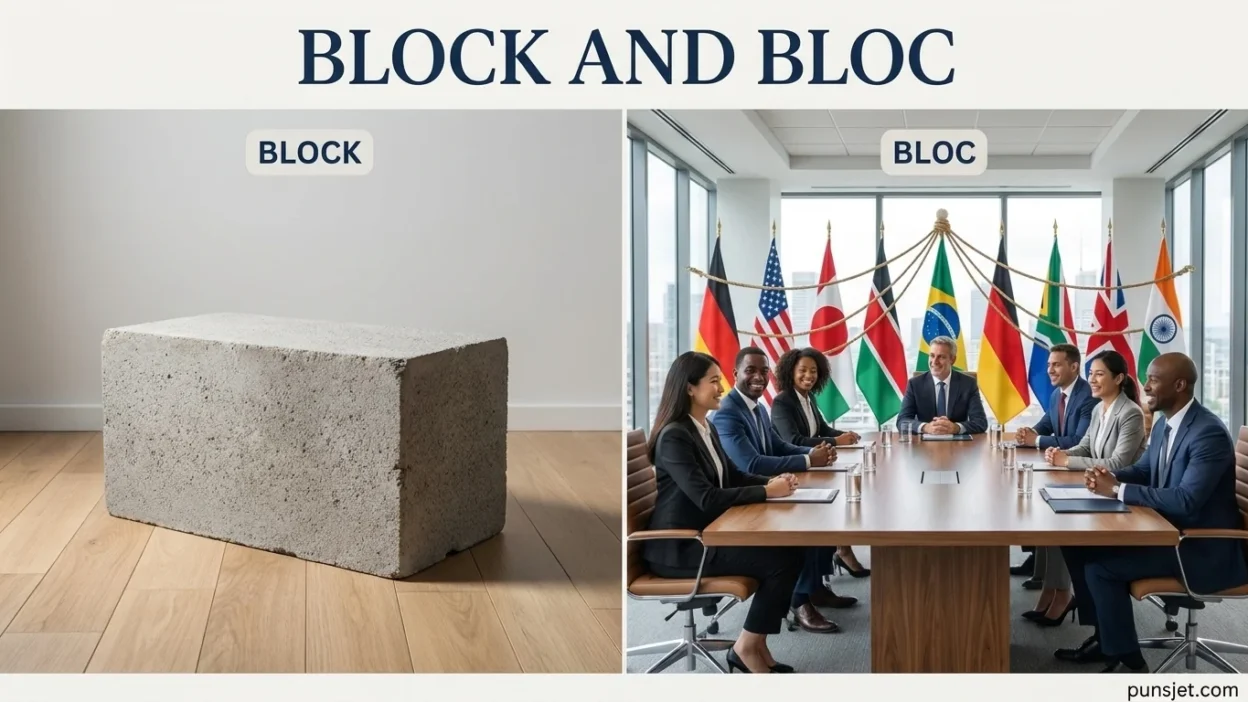
When learning English, some words look almost exactly the same but have completely different meanings. Block and bloc are a good example. They sound alike, but they are not used in the same way.
The word block is very common in everyday English. It can describe a solid piece of material, a group of buildings, something that stops movement, or an action that prevents something from happening.
The word bloc is less common. It usually refers to a group of countries, political groups, or organizations that work together because they share a common interest or goal.
The spelling is different by only one letter, so it is easy to mix them up. The easiest way to remember them is this:
Quick Answer: Block vs. Bloc
Here is the difference in the simplest form:
- Block is a common English word with several meanings.
- Bloc means a group of countries, political parties, or organizations working together.
- Block can be a noun or a verb.
- Bloc is mainly used as a noun.
- Block is used in everyday conversations much more often.
- Bloc is common in discussions about politics, international relations, and organized groups.
- Both words are usually pronounced “blok.”
Easy examples
- There is a block of ice in the glass.
- We live one block from the school.
- The fallen tree blocked the road.
- Several countries formed a trade bloc.
What Does “Block” Mean?
Block has many meanings. Its exact meaning depends on the sentence.
1. Block as a solid piece
A block can be a solid piece of material such as wood, stone, or ice.
Examples:
- The child built a tower with wooden blocks.
- Put a block of ice in the cooler.
- The wall was made from concrete blocks.
Here, block means a solid piece of something.
2. Block as an obstacle
A block can be something that stops a person, vehicle, or object from moving.
Examples:
- A large rock was blocking the road.
- Please move that box. It is blocking the door.
- The police blocked the street.
In these examples, block means to stop movement or prevent something from passing.
3. Block as an area of a city
In American English, a block can mean the distance between two streets or a group of buildings surrounded by streets.
Examples:
- The bank is two blocks away.
- I live on the next block.
- There is a grocery store at the end of the block.
This meaning is especially common when people talk about locations in cities.
4. Block as a group of buildings
A block can also refer to a group of buildings surrounded by streets.
For example:
The new apartments occupy an entire city block.
Here, the word describes an area of a city rather than one physical object.
5. Block as a verb
Block can also be an action. As a verb, it means to stop, prevent, or make something difficult.
Examples:
- The goalkeeper blocked the ball.
- Heavy traffic blocked the road.
- The website blocked my account.
- She blocked the number on her phone.
This is one of the most common uses of block in modern English.
What Does “Bloc” Mean?
Bloc means a group of countries, political parties, organizations, or other groups that cooperate because they have similar interests or goals.
It is most often used when talking about politics, government, business, or international relationships.
Examples:
- The countries formed a regional bloc.
- The political bloc voted against the proposal.
- Several nations belong to the same economic bloc.
- The two parties created a voting bloc.
The important idea is unity or cooperation.
A bloc is not normally a physical object. It is a group acting together.
Where Does “Bloc” Come From?
The word bloc came into English from French. It is related to the idea of a group or solid unit.
Over time, English speakers began using bloc to describe groups that act together, especially in politics and international affairs.
This is why you may see phrases such as:
- political bloc
- voting bloc
- trade bloc
- economic bloc
- regional bloc
The spelling bloc helps distinguish this meaning from the much more general word block.
Block vs. Bloc: The Main Difference
The easiest way to understand these words is to focus on the type of meaning.
Block usually refers to a thing, place, obstacle, or action that stops something.
Bloc refers to a group that works or acts together.
Compare these sentences:
A wall blocks the entrance.
The wall prevents people from entering.
Several political parties formed a bloc.
The parties are working together as a group.
The meanings are completely different even though the words sound the same.
Comparison Table
| Feature | Block | Bloc |
|---|---|---|
| Pronunciation | Usually “blok” | Usually “blok” |
| Main idea | Object, area, obstacle, or stopping action | Group working together |
| Part of speech | Noun and verb | Mainly noun |
| Common in daily English | Yes | Less common |
| Used in politics | Sometimes | Very common |
| Used for physical objects | Yes | No |
| Used for groups | Sometimes | Yes |
| Example | The road is blocked. | A political bloc formed. |
Block and Bloc in Real Sentences
Seeing the words in different situations can make the difference easier to remember.
Block
Physical object:
- He placed a wooden block under the table.
City area:
- The restaurant is three blocks from here.
Obstacle:
- A fallen tree blocked the road.
Technology:
- I had to block an unwanted caller.
Sports:
- The defender blocked the shot.
Bloc
Politics:
- The parties created a political bloc.
International relations:
- The countries belong to the same regional bloc.
Voting:
- The students formed a voting bloc.
Business or trade:
- The nations created a trade bloc.
Which One Should You Use?
Choosing the correct word becomes easy if you ask yourself one question:
Are you talking about a group working together?
If yes, use bloc.
The countries formed a trade bloc.
Are you talking about an object, place, obstacle, or action that stops something?
Use block.
The truck is blocking the entrance.
Are you talking about a city distance?
Use block.
The library is two blocks away.
Are you talking about a physical piece?
Use block.
The children played with wooden blocks.
Common Mistakes With Block and Bloc
Because the two words sound alike, spelling mistakes are common.
Mistake 1: Using “block” for a political group
Incorrect:
Several countries formed a political block.
In this meaning, bloc is the better choice.
Correct:
Several countries formed a political bloc.
Mistake 2: Using “bloc” for a physical object
Incorrect:
The child picked up a wooden bloc.
Correct:
The child picked up a wooden block.
A wooden piece is a block, not a bloc.
Mistake 3: Confusing “block” with “bloc” in city directions
Correct:
The pharmacy is two blocks away.
Do not use bloc when talking about the distance between streets.
Mistake 4: Thinking the words have the same meaning
They do not.
Their pronunciation is similar, but their meanings are different:
- Block → thing, place, obstacle, or stopping
- Bloc → organized group
Block and Bloc in Everyday Life
You may see block in many ordinary situations.
In messages
I had to block that number because the calls would not stop.
At home
Please move the box. It is blocking the hallway.
At school
Our classroom is one block from the library.
In sports
The player made an excellent block.
On social media
She decided to block the account.
The word bloc appears less often in casual conversations.
You are more likely to see it in:
- news reports
- political discussions
- government statements
- international affairs
- economic discussions
- articles about voting groups
For example:
The regional bloc discussed new economic policies.
A Simple Memory Trick
Here is an easy trick for remembering the difference.
BLOCK = B for Barrier
Think:
Block = Barrier
A barrier stops something.
The fallen tree blocked the road.
BLOC = C for Cooperation
Think:
Bloc = Cooperation
A bloc is a group that works together.
The countries formed a trade bloc.
So remember:
BLOCK → barrier or physical thing
BLOC → cooperation or group
This simple connection can help you choose the correct spelling quickly.
Learning Section for Students and Beginners
If you are still learning English, do not try to memorize every meaning of block at once.
Start with these two basic ideas:
Block
Think “something that stops or a physical piece.”
Examples:
- a block of wood
- a block of ice
- block the door
- block the road
- one city block
Bloc
Think “a group acting together.”
Examples:
- political bloc
- voting bloc
- trade bloc
- regional bloc
Try making your own sentences.
For example:
- The car is blocking the gate.
- We live two blocks from the market.
- The countries formed a political bloc.
If you can identify whether the sentence describes a thing/obstacle or a group, you can usually choose the right word.
Block vs. Bloc: Quick Practice
Choose block or bloc in each sentence.
- The fallen tree ______ the road.
- Several countries joined the economic ______.
- The store is two ______ away.
- He used a wooden ______ to support the shelf.
- The political ______ agreed on the proposal.
- Please ______ the unwanted number.
Answers
- blocked
- bloc
- blocks
- block
- bloc
- block
Notice the pattern: physical objects, locations, and stopping actions use block, while organized groups use bloc.
FAQs:
1. Are “block” and “bloc” pronounced the same?
Usually, yes. Both are commonly pronounced like “blok.” Their spelling and meaning are different.
2. What does “bloc” mean?
Bloc means a group of countries, political parties, organizations, or people that work together because they share an interest or goal.
3. What does “block” mean?
Block has many meanings. It can mean a solid piece, a city area, an obstacle, or the action of stopping something.
4. Is “bloc” a verb?
No. Bloc is normally used as a noun. Block, however, can be both a noun and a verb.
5. Which word is more common?
Block is much more common in everyday English. Bloc is more specialized and often appears in political, economic, or international contexts.
6. Is “political bloc” correct?
Yes. Political bloc is a common expression for political groups or parties that cooperate or act together.
7. Is “block of countries” the same as “bloc”?
Not always. Bloc specifically suggests that the countries are cooperating or acting together as a group. Block usually does not carry that meaning.
8. How can I remember the difference?
Remember:
Block = barrier, object, place, or stopping action.
Bloc = group working together.
Final Conclusion
Block and bloc sound almost the same, but their meanings are different.
Use block when you mean a physical piece, a city area, an obstacle, or the action of stopping something. It is a very common English word and can be used as both a noun and a verb.
Use bloc when you mean a group of countries, political parties, organizations, or other groups that cooperate because they share a common interest.
The easiest rule is:
Once you connect block with a barrier and bloc with cooperation, the difference becomes much easier to remember and use correctly.

Emily Margaret is a writer and humor enthusiast at PunsJet.com. She enjoys creating clever puns and lighthearted content that entertains readers and adds a spark of humor to everyday life. With a love for wordplay and creativity, Emily aims to share fun, relatable jokes that make people smile and laugh.