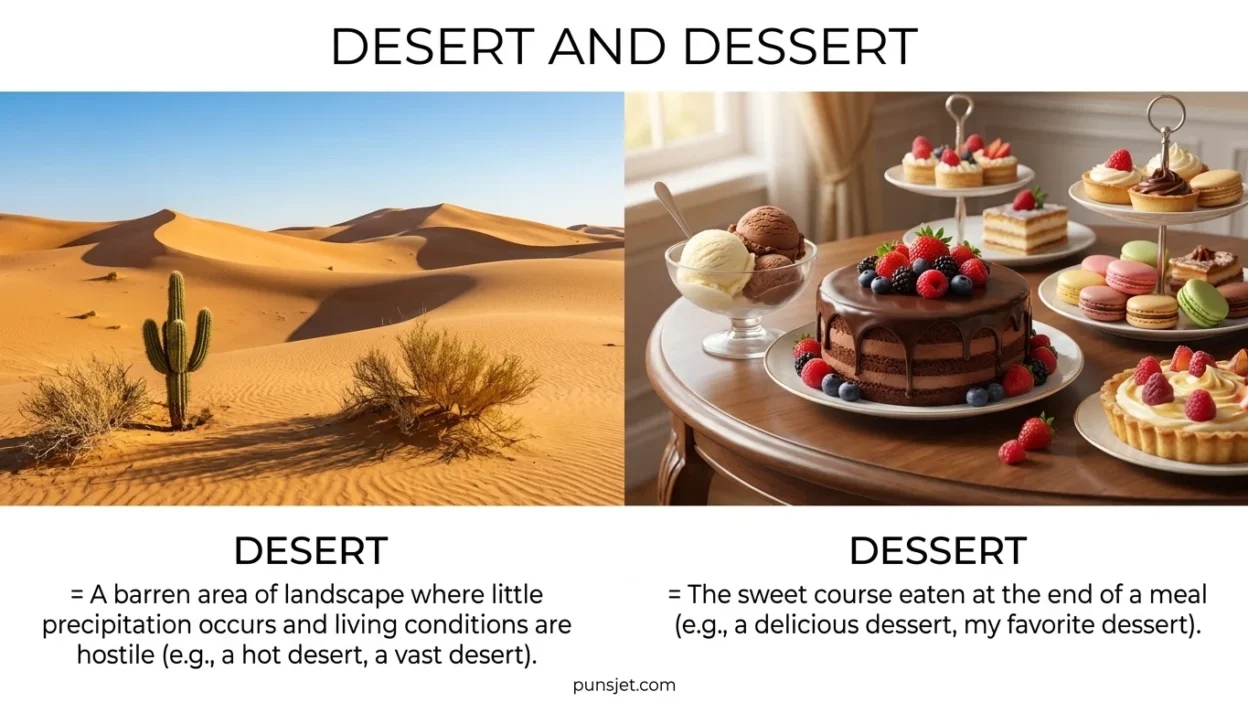
Desert and dessert are two English words that look and sound very similar. This is why many students, English learners, and even native speakers sometimes mix them up.
The good news is that their meanings are completely different.
A desert is a dry area of land that usually gets very little rain. A dessert is a sweet food that people usually eat after a meal.
There is also a simple pronunciation trick that can help you remember the difference. Desert has one main meaning when we talk about dry land, while dessert has an extra s and an extra syllable in its common pronunciation.
Once you learn the meaning, spelling, and pronunciation of each word, the difference becomes much easier to remember.
Quick Answer: Desert vs. Dessert
Here is the difference in a few simple points:
- Desert = a very dry area of land.
- Dessert = a sweet food eaten after a meal.
- Desert is usually pronounced like DEZ-ert when it means dry land.
- Dessert is usually pronounced like di-ZURT.
- Desert has one s.
- Dessert has two s’s.
- Example: The Sahara is a large desert.
- Example: We had chocolate cake for dessert.
Easy memory trick
Think:
Dessert has two S’s because you may want a SECOND serving.
So:
dessert = sweet food = two S’s
The word desert, with one S, refers to dry land.
What Does “Desert” Mean?
The word desert most commonly means a large, dry area of land.
Deserts receive very little rainfall. Some deserts are extremely hot, while others can be very cold. They can contain sand, rocks, mountains, dry soil, and plants that can survive with little water.
For example:
- The Sahara is a famous desert.
- Camels can survive in desert environments.
- The desert can become very cold at night.
- Many desert plants need very little water.
Desert as a verb
Desert can also be used as a verb. In this use, it means to leave someone or something when you should stay.
For example:
The soldiers were told not to desert their posts.
Another example:
He felt that his friends had deserted him.
The pronunciation of this verb is different from the noun desert meaning dry land. As a verb, it is usually pronounced with the stress on the second part: di-ZURT.
This second meaning can sometimes cause additional confusion.
What Does “Dessert” Mean?
Dessert means a sweet food or dish that is usually eaten at the end of a meal.
Common desserts include:
- Cake
- Ice cream
- Pudding
- Pie
- Cookies
- Brownies
- Fruit salad
- Cheesecake
- Custard
For example:
We ordered ice cream for dessert.
Or:
My favorite dessert is chocolate cake.
Dessert is often served after lunch or dinner, although people can enjoy sweet foods at other times too.
Simple Origin and Background
The two words have different histories, even though their spellings are very similar today.
Desert, meaning a dry and empty area of land, comes from an old word connected with the idea of something being abandoned or left empty. Over time, it became associated with land that seemed empty, dry, and uninhabited.
Dessert comes from a French word related to the idea of clearing the table after a meal. It later became the English word for the sweet food served at the end of a meal.
The words therefore developed from different sources and have different meanings.
Their similar spelling is simply one reason English learners often confuse them.
Desert and Dessert: The Main Difference
The easiest way to understand the difference is to focus on what each word describes.
Desert = dry land
A desert is a place.
It is usually a dry region with very little rainfall.
Example:
The travelers crossed the desert.
Here, desert describes the dry area they traveled through.
Dessert = sweet food
A dessert is food.
It is usually sweet and is commonly served after a meal.
Example:
We ate ice cream for dessert.
Here, dessert means the sweet food eaten after the meal.
Comparison Table
| Word | Meaning | Part of Speech | Example |
|---|---|---|---|
| Desert | A dry area of land | Noun | The desert is very dry. |
| Desert | To leave someone or something | Verb | He did not desert his team. |
| Dessert | Sweet food eaten after a meal | Noun | We had cake for dessert. |
Spelling difference
Look carefully:
Desert → one s
Dessert → two s’s
That extra s is important because it changes the word and its meaning.
Pronunciation: Desert vs. Dessert
Pronunciation is another useful way to tell these words apart.
Desert meaning dry land
When desert means a dry area of land, it is commonly pronounced:
DEZ-ert
The stress is on the first part.
Example:
The camel walked across the DEZ-ert.
Dessert
Dessert is commonly pronounced:
di-ZURT
The stress is on the second part.
Example:
We had cake for di-ZURT.
Desert as a verb
When desert means to leave someone or something, it is also commonly pronounced:
di-ZURT
So pronunciation can help distinguish the noun desert from the verb desert.
Which One Should You Use and When?
The easiest way is to ask yourself a simple question:
Are you talking about a dry place?
Use desert.
They traveled through the desert.
The desert receives very little rain.
Many animals live in the desert.
Are you talking about sweet food?
Use dessert.
We had fruit for dessert.
She made a delicious dessert.
What would you like for dessert?
Are you talking about leaving someone or something?
Use desert as a verb.
He would never desert his family.
The soldiers refused to desert their posts.
Common Mistakes People Make
Mistake 1: Using “desert” for sweet food
Incorrect:
We had cake for desert.
Correct:
We had cake for dessert.
Remember: dessert has two S’s.
Mistake 2: Using “dessert” for a dry place
Incorrect:
The camel lives in the dessert.
Correct:
The camel lives in the desert.
A camel may visit a dessert in a story, but it normally lives in a desert.
Mistake 3: Forgetting the second S
This is probably the most common spelling mistake.
People often write:
chocolate desert
when they mean:
chocolate dessert
The second spelling is correct because chocolate cake, ice cream, and similar foods are desserts.
Mistake 4: Confusing the verb “desert”
The word desert can also mean to leave someone.
For example:
He deserted his friends.
This does not mean that he gave his friends a sweet dish. It means he left them.
Everyday Real-Life Examples
You may see these words in many different situations.
In emails
Please let us know if you would like dessert after dinner.
Here, dessert means sweet food.
Another example:
The team should not desert its responsibilities.
Here, desert is a verb meaning to leave or abandon.
In news
Heavy rain reached parts of the desert.
Here, desert means a dry region.
You might also see:
The restaurant introduced three new desserts.
Here, desserts means sweet foods.
On social media
Someone might post:
“This chocolate cake is the best dessert ever!”
Another person might post:
“The desert sunset was beautiful.”
The first sentence is about food. The second is about a dry landscape.
In daily conversation
You might say:
What are we having for dessert?
This means you are asking about sweet food.
You could also say:
I want to visit the desert someday.
This means you want to visit a dry region.
A Simple Learning Trick for Students
If you often confuse desert and dessert, remember this sentence:
“Dessert has two S’s because I want a second serving.”
The two S’s can remind you that dessert is something delicious that you may want more of.
Another useful trick is to connect the words with pictures in your mind:
Desert → sand, heat, dry land
Dessert → cake, ice cream, sweet food
When you see the word desert, imagine sand.
When you see dessert, imagine a piece of cake.
This simple mental connection can make the difference easier to remember.
Quick practice
Choose the correct word:
- The Sahara is a large ______.
- We ate ice cream for ______.
- Many plants in the ______ can survive with little water.
- Chocolate cake is my favorite ______.
- He refused to ______ his friends.
Answers:
- desert
- dessert
- desert
- dessert
- desert
FAQs:
1. What is the difference between desert and dessert?
Desert usually means a dry area of land. Dessert means a sweet food usually eaten after a meal.
2. How do I remember the spelling of dessert?
Remember that dessert has two S’s. You can think, “I want a second serving of dessert.”
3. Is the desert always hot?
No. Some deserts are very hot, but some deserts can be extremely cold. The main feature of a desert is that it receives very little precipitation.
4. Is dessert always sweet?
In normal English use, dessert refers to a sweet course or food served after a meal. Common examples include cake, ice cream, pie, and pudding.
5. Can “desert” be a verb?
Yes. Desert can be a verb meaning to leave someone or something, especially when you are expected to stay.
Example:
He deserted his team.
6. Are desert and dessert pronounced differently?
Usually, yes. The dry-land noun desert is commonly pronounced DEZ-ert, while dessert is commonly pronounced di-ZURT. The verb desert has the same common stress pattern as dessert.
7. Why are desert and dessert so easy to confuse?
They have very similar spellings and sounds, but their meanings are completely different. The extra s in dessert is an important clue.
8. What is an easy sentence to remember the difference?
Try this:
The desert is dry, but dessert is sweet.
This short sentence gives you the basic difference in one line.
Conclusion
Desert and dessert may look almost the same, but they have very different meanings.
A desert is usually a dry area of land with very little rainfall. A dessert is a sweet food that is commonly eaten at the end of a meal.
The spelling gives you a helpful clue:
- Desert → one S → dry land
- Dessert → two S’s → sweet food
You can also remember the pronunciation. The dry-land desert is commonly pronounced DEZ-ert, while dessert is commonly pronounced di-ZURT.
The easiest memory trick is:“Dessert has two S’s because you may want a second serving.”
Once you connect desert with dry land and dessert with sweet food, these two commonly confused words become much easier to use correctly.

Emily Margaret is a writer and humor enthusiast at PunsJet.com. She enjoys creating clever puns and lighthearted content that entertains readers and adds a spark of humor to everyday life. With a love for wordplay and creativity, Emily aims to share fun, relatable jokes that make people smile and laugh.