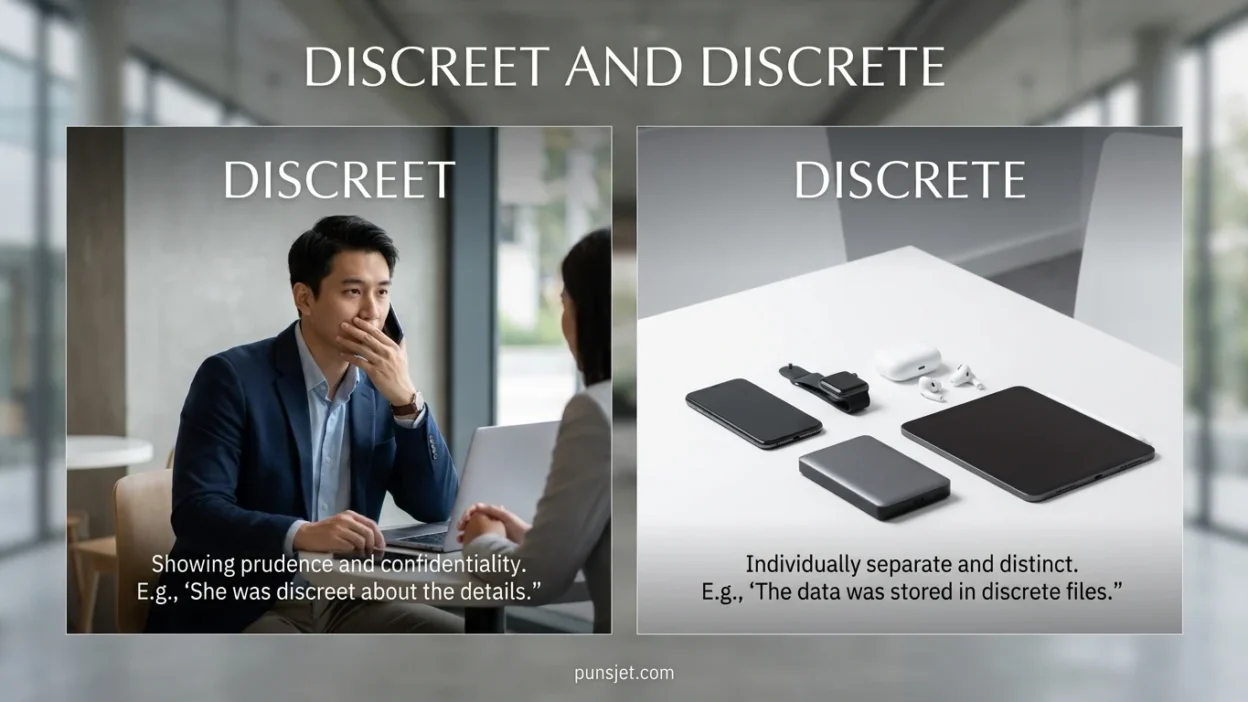
Discreet and discrete are two English words that look and sound almost the same. Because of this, many students and English learners mix them up when writing or speaking.
The two words have completely different meanings.
- Discreet means careful about keeping something private or avoiding attention.
- Discrete means separate, distinct, or clearly different from other things.
A simple way to remember them is:
Discreet = careful and private
Discrete = separate and different
Once you understand this small difference, these words become much easier to use correctly.
Quick Answer: Discreet vs. Discrete
Here is the difference in the simplest form:
- Discreet is an adjective that describes someone or something that is careful, private, or not likely to attract attention.
- Discrete is an adjective that describes something that is separate or clearly different from other things.
- A discreet person knows how to keep private information private.
- Discrete parts are separate parts of something.
- If you want to talk about being quiet or careful with private information, use discreet.
- If you want to talk about separate items, groups, or parts, use discrete.
Easy examples
- Please be discreet about my personal problem.
- The machine has several discrete parts.
In the first sentence, the person should be careful and private.
In the second sentence, the parts are separate from one another.
What Does “Discreet” Mean?
Discreet means being careful about what you say or do, especially when something should remain private.
A discreet person does not attract unnecessary attention. They also know when it is better not to share information.
Examples
- Please be discreet when discussing her salary.
- He was discreet about the family problem.
- The receptionist gave the visitor a discreet smile.
- She asked me to be discreet about the surprise party.
In all these examples, the idea is care, privacy, or avoiding attention.
Discreet in everyday life
Imagine your friend tells you something personal and asks you not to tell anyone.
You do not repeat the information to other people. You keep the matter private.
You are being discreet.
Another example is someone who needs to ask a sensitive question in a crowded room. They may speak quietly or wait until they are alone with the other person.
That is also discreet behavior.
What Does “Discrete” Mean?
Discrete means separate, individual, or clearly different.
When things are discrete, you can see them as separate items or groups rather than as one continuous thing.
Examples
- The course is divided into discrete units.
- The report contains five discrete sections.
- The boxes are stored in discrete groups.
- The machine has several discrete components.
Here, discrete has nothing to do with privacy or secrecy.
It simply means that things are separate from each other.
An easy way to understand it
Imagine five boxes sitting on a table.
Each box is separate from the others. You can identify one box, then another, and so on.
The boxes are discrete objects.
Discreet and Discrete: A Simple Background
Both words come from older forms of English and French, and their histories are closely related. This is one reason they look so similar today.
Over time, however, their meanings developed in different directions.
Discreet became connected with careful behavior, good judgment, privacy, and avoiding unwanted attention.
Discrete developed the meaning of being separate or distinct.
So, although the words look almost identical, they now serve different purposes in modern English.
Their similar spelling is the main reason learners often confuse them.
The Main Difference Between Discreet and Discrete
The easiest way to separate these words is to focus on their main ideas.
Discreet = careful and private
Use discreet when talking about:
- keeping information private
- avoiding attention
- behaving carefully
- handling a sensitive situation quietly
- not making something obvious
Example:
The manager was discreet when discussing the employee’s personal issue.
The manager handled the matter carefully and privately.
Discrete = separate and distinct
Use discrete when talking about:
- separate parts
- individual groups
- distinct items
- clearly different units
- things that can be treated separately
Example:
The project has four discrete stages.
The four stages are separate parts of the project.
Discreet vs. Discrete Comparison Table
| Feature | Discreet | Discrete |
|---|---|---|
| Meaning | Careful, private, or not attracting attention | Separate or distinct |
| Main idea | Privacy and careful behavior | Separation |
| Word type | Adjective | Adjective |
| Used for | People, actions, behavior, information | Parts, groups, items, stages |
| Example | She was discreet about the matter. | The system has discrete sections. |
| Memory clue | Think private | Think separate |
The key difference
If you can replace the word with private or careful, you probably need discreet.
If you can replace it with separate or distinct, you probably need discrete.
Which One Should You Use and When?
Choosing between these words becomes easy if you ask yourself one question:
Are you talking about privacy or separation?
If the answer is privacy, use discreet.
Please be discreet about the news.
The person should not share the news carelessly.
If the answer is separation, use discrete.
The program has three discrete sections.
The sections are separate from one another.
More examples
Use discreet:
- a discreet conversation
- a discreet question
- a discreet employee
- a discreet way of asking
- discreet behavior
Use discrete:
- discrete units
- discrete groups
- discrete stages
- discrete categories
- discrete parts
Common Mistakes People Make
Mistake 1: Using “discrete” for privacy
Incorrect:
Please be discrete about my personal information.
Correct:
Please be discreet about my personal information.
Why? The sentence is about keeping information private.
Mistake 2: Using “discreet” for separate things
Incorrect:
The experiment has four discreet stages.
Correct:
The experiment has four discrete stages.
Why? The stages are separate parts.
Mistake 3: Thinking the two words have the same meaning
They do not.
Their spelling is similar, and they sound very similar, but their meanings are different.
Remember:
Discreet → private and careful
Discrete → separate and distinct
Mistake 4: Forgetting the spelling difference
There is only one extra e in discreet.
- discreet → ee
- discrete → e…e
A useful memory trick is to connect the two e’s in discreet with being extra careful.
Everyday Real-Life Examples
Understanding these words in everyday situations can make them much easier to remember.
In emails
Please be discreet when forwarding this email.
This means you should be careful because the information may be private.
Another example:
The report is divided into three discrete sections.
Here, the sections are separate.
In the news
You may read:
Officials were asked to be discreet about the sensitive information.
The meaning is careful and private.
You might also see:
The study examined several discrete groups.
The groups are separate from one another.
On social media
Imagine someone sends you a private message and asks you not to share it.
You should be discreet.
For example:
Please be discreet about what I told you.
But if someone talks about separate categories of posts, they could use discrete:
The posts were divided into several discrete categories.
In daily conversation
You might say:
Can you be discreet about my surprise?
This means: Please do not reveal the surprise.
You might also say:
The teacher divided the lesson into discrete activities.
This means the activities were separate.
A Simple Learning Trick for Students
The easiest trick is to remember two short phrases:
Discreet = “Keep it quiet.”
Think about privacy, careful behavior, and avoiding attention.
Be discreet about the secret.
Discrete = “Keep it separate.”
Think about individual things, groups, or parts.
The project has discrete stages.
One-letter memory trick
Look at these words:
discreet
discrete
The spelling is almost the same.
You can remember:
Discreet has “ee” — think carefully and quietly.
For discrete, think:
Discrete = separate pieces.
Do not worry if you need a little practice. Seeing the words in different sentences will make the difference natural over time.
Discreet and Discrete in Short Sentences
Here are some quick examples to practice:
- Please be discreet about the meeting.
- The building has several discrete areas.
- She gave me a discreet warning.
- The lesson contains five discrete activities.
- He was discreet when discussing the private matter.
- The data was divided into discrete groups.
- They found a discreet place to talk.
- The machine is made of several discrete components.
Notice the pattern: discreet relates to careful or private behavior, while discrete relates to separate things.
FAQs:
1. What is the difference between discreet and discrete?
Discreet means careful, private, or not attracting attention. Discrete means separate, individual, or clearly different.
2. Is “discreet” about privacy?
Yes. Discreet is often used when someone handles private or sensitive information carefully.
She was discreet about the family matter.
3. Does “discrete” mean separate?
Yes. Discrete commonly means separate or clearly different.
The project has four discrete parts.
4. Are discreet and discrete pronounced the same?
In many varieties of English, they are pronounced very similarly, which is one reason they are easy to confuse. Their meanings and spellings are different.
5. Is it “be discreet” or “be discrete”?
When you mean be careful and private, the correct expression is:
Be discreet.
For example:
Please be discreet about the conversation.
6. How can I remember discreet and discrete?
Use this simple rule:
Discreet = private
Discrete = separate
Repeat these two meanings when you are learning the words.
7. Can discrete describe people?
It can be used when talking about people or groups as separate individuals or units in suitable contexts, but discreet is the word normally used to describe someone who is careful or private.
8. Why are these words so easy to confuse?
They have almost identical spelling and very similar pronunciation. Their meanings are also related historically, but modern English uses them in different ways.
Conclusion
Discreet and discrete may look almost the same, but they have different meanings.
Use discreet when you mean careful, private, or not attracting attention.
Please be discreet about the information.
Use discrete when you mean separate, individual, or distinct.
The report has several discrete sections.
The easiest rule to remember is:
Discreet = keep it private.
Discrete = keep it separate.
Once you connect discreet with privacy and discrete with separation, you will be much less likely to confuse them in your writing or conversation.