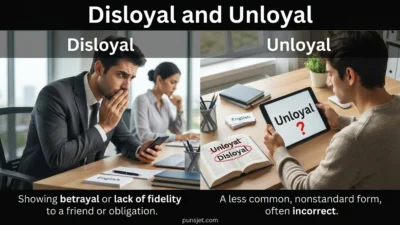
Disloyal and unloyal look almost the same, so it is easy to wonder whether they mean different things. Both words are connected with the idea of not being loyal. However, they are not equally common or natural in modern English.
The main word you should use is disloyal. It is the standard and widely accepted word for someone who does not stay faithful, supportive, or trustworthy toward a person, group, country, or cause.
Unloyal is much less common. It can be understood because the prefix un- often means “not,” but native English speakers normally choose disloyal instead.Learning this small difference can help you write more naturally in schoolwork, emails, conversations, and everyday English.
Quick Answer
- Disloyal means not loyal, faithful, or supportive.
- Disloyal is the normal and widely used word in modern English.
- Unloyal can mean “not loyal,” but it is uncommon and usually sounds less natural.
- Use disloyal when you want to describe someone who breaks their loyalty or does not remain faithful.
- Disloyal can describe a person, action, behavior, or relationship.
- In most situations, choosing disloyal is the safest and clearest option.
Easy example:
She was disloyal to her friend.
This means she did not remain faithful or trustworthy toward her friend.
What Does “Disloyal” Mean?
Disloyal is an adjective. It describes someone or something that does not show loyalty.
The word loyal means faithful, supportive, and dependable. When we add dis-, the meaning changes to the opposite.
So:
loyal → disloyal
For example:
Tom remained loyal to his team.
Tom supported his team.
But:
Tom was disloyal to his team.
Tom did not remain faithful or supportive.
Disloyalty can happen in many situations. A person can be disloyal to a friend, family member, employer, team, country, organization, or partner.
Examples
- He was disloyal to his best friend.
- The employee was accused of being disloyal to the company.
- She felt that her partner had been disloyal.
- The player was called disloyal after leaving the team.
- Sharing private information can be seen as disloyal behavior.
What Does “Unloyal” Mean?
Unloyal is formed from un- + loyal.
The prefix un- often means “not,” so unloyal can be understood as meaning “not loyal.”
However, unloyal is uncommon in modern standard English. Most speakers and writers prefer disloyal.
You may occasionally see or hear unloyal, especially in older writing or informal language. It is not usually the best choice when you want your English to sound natural and standard.
For example:
He was unloyal to his friends.
The meaning can be understood, but:
He was disloyal to his friends.
sounds much more natural.
Disloyal vs. Unloyal: The Main Difference
The biggest difference is usage and naturalness, rather than meaning.
Both words can communicate the idea of someone who is not loyal. But disloyal is the normal word used by modern English speakers and writers.
Think of it this way:
Disloyal = standard and common
Unloyal = uncommon and usually avoided
This does not mean that people can never understand unloyal. The meaning is fairly clear because of the word structure. The problem is that it is not the usual choice.
A Simple Memory Trick
When you want to say that someone is not loyal, remember:
Loyal → Disloyal
Just as you learn honest → dishonest, you can remember loyal → disloyal.
Comparison Table
| Word | Meaning | Common in modern English? | Example |
|---|---|---|---|
| Disloyal | Not loyal or faithful | Yes | He was disloyal to his friend. |
| Unloyal | Not loyal | Uncommon | The word may be understood, but disloyal is preferred. |
| Loyal | Faithful and supportive | Yes | She is loyal to her family. |
| Disloyalty | Lack of loyalty | Yes | His disloyalty hurt his team. |
Which One Should You Use?
In almost every normal situation, use disloyal.
Choose disloyal when:
- You are writing an essay.
- You are answering a school question.
- You are writing an email.
- You are speaking in everyday English.
- You are describing someone who broke someone’s trust.
- You are talking about a person who stopped supporting a group.
- You want your writing to sound natural.
Examples
Instead of:
He was unloyal to his employer.
Write:
He was disloyal to his employer.
Instead of:
She became unloyal to her friends.
Write:
She became disloyal to her friends.
Instead of:
His unloyal actions caused problems.
Write:
His disloyal actions caused problems.
Common Mistakes
Mistake 1: Thinking “unloyal” is always the better opposite of “loyal”
English does not always form opposites by simply adding un-.
For example:
- happy → unhappy
- kind → unkind
- clear → unclear
But some words normally use dis- instead:
- loyal → disloyal
- honest → dishonest
- agree → disagree
So, even though unloyal seems logical, disloyal is the normal choice.
Mistake 2: Using “unloyal” in formal writing
Because unloyal is uncommon, it may make your writing sound unusual.
If you are writing a school assignment, application, report, or professional message, disloyal is the safer choice.
Mistake 3: Confusing “disloyal” with “disliked”
These words have completely different meanings.
Disloyal means not faithful or supportive.
Disliked means not liked.
For example:
The employee was disloyal to the company.
The employee was not faithful or supportive.
But:
The employee was disliked by his coworkers.
The coworkers did not like him.
Mistake 4: Thinking disloyal always means dishonest
Disloyal behavior can involve dishonesty, but the two words are not exactly the same.
A person can be disloyal by leaving a group, breaking a promise of support, revealing private information, or turning against someone.
The exact meaning depends on the situation.
Everyday Real-Life Examples
In a Friendship
Imagine two close friends. One friend promises to keep a private matter secret but tells other people.
You could say:
His behavior was disloyal.
The problem is that he did not respect the trust between the friends.
At Work
An employee may be described as disloyal if they deliberately act against the interests of their employer after promising to support the company.
For example:
The manager believed the employee had been disloyal.
In a Relationship
People may use disloyal when they believe a partner has not remained faithful or supportive.
For example:
She felt that her partner had been disloyal.
The exact reason for the feeling depends on the situation.
In Sports
Sports fans sometimes describe a player as disloyal when the player leaves a team or appears to stop supporting it.
For example:
Some fans called the player disloyal after he left the club.
This describes the fans’ view of the player’s actions.
In Social Media
People may use the word when discussing friendships or groups online.
For example:
Posting someone’s private messages without permission can seem disloyal.
Again, the important idea is a lack of trust or support.
In an Email
You might write:
I was disappointed by what happened because I felt that your actions were disloyal.
This sounds more natural than using unloyal.
A Short Learning Guide for Students
If you are learning English, you do not need to spend too much time worrying about unloyal.
The most useful thing to remember is:
Loyal
Someone who is faithful, supportive, and dependable.
Maria is loyal to her friends.
Disloyal
Someone who is not faithful or supportive.
Maria was disloyal to her friends.
Disloyalty
The noun form describing a lack of loyalty.
Her disloyalty surprised everyone.
Unloyal
A less common form that can be understood as “not loyal,” but disloyal is normally preferred.
A simple sentence pattern to remember is:
Someone is disloyal to someone.
Examples:
- He was disloyal to his friend.
- She was disloyal to her employer.
- They were disloyal to their team.
Remember the preposition to. We normally say disloyal to, not “disloyal with.”
FAQs:
1. Is “disloyal” a correct word?
Yes. Disloyal is a standard English word. It means not loyal, faithful, or supportive.
2. Is “unloyal” a correct word?
Unloyal can be understood and has been used, but it is uncommon. In modern English, disloyal is normally preferred.
3. Which is more common: disloyal or unloyal?
Disloyal is much more common and natural in modern English.
4. Can I use “unloyal” in an essay?
It is better to use disloyal. This is especially true for school, university, work, and other formal writing.
5. What is the opposite of loyal?
The usual opposite is disloyal.
For example:
loyal friend → disloyal friend
6. What is the noun form of disloyal?
The noun is disloyalty.
For example:
His disloyalty hurt his friend.
7. Does disloyal mean dishonest?
Not exactly. Disloyal means lacking loyalty or faithfulness. Dishonest means not truthful or fair. The two ideas can sometimes appear together, but they are different.
8. Should I ever use “unloyal”?
You may encounter it, but if you want natural modern English, disloyal is the better choice.
Conclusion
Disloyal and unloyal both relate to the idea of not being loyal, but there is an important difference in normal usage.
Disloyal is the standard, common, and natural word. It can describe someone who is not faithful, supportive, or trustworthy toward another person, group, or organization.Unloyal is much less common. Although its meaning can be understood, it is usually better to avoid it and choose disloyal instead.
The easiest rule is:
Use “disloyal” when you mean “not loyal.”
Once you remember loyal → disloyal, this confusing pair becomes much easier to use correctly in everyday English, school writing, emails, and conversations.

Donald Andrew is the creative mind behind PunsJet.com, where he shares clever wordplay and humorous puns for readers around the world. With a passion for language and comedy, Donald enjoys crafting witty jokes that bring smiles to everyday conversations. His goal is to make humor simple, fun, and easy to share.