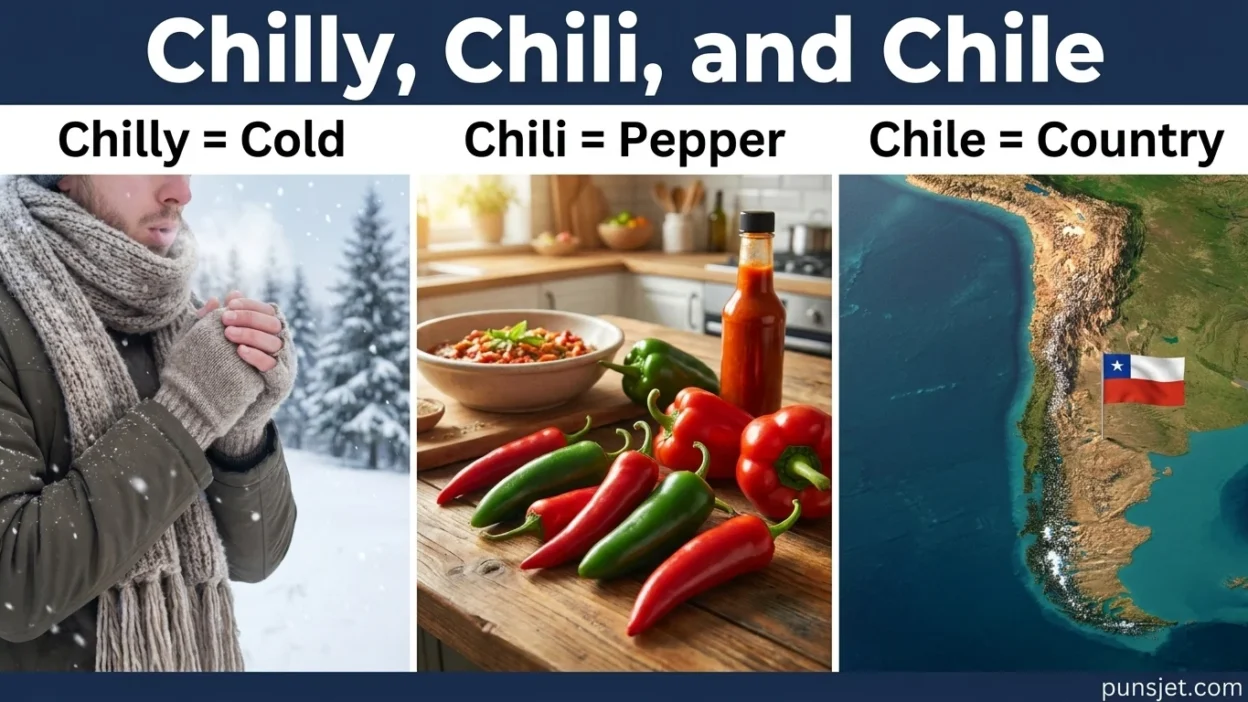
English has many words that look and sound almost the same but have completely different meanings. Chilly, chili, and chile are a good example.
These three words are easy to mix up because they are pronounced very similarly. However, they are not used in the same way. One describes cold weather, while the other two are connected with spicy peppers and food.
For students, English learners, and beginners, the spelling can make this even more confusing. You may see chili pepper, chile pepper, or chilli pepper, and all of them can refer to the spicy fruit of a pepper plant. At the same time, chilly has nothing to do with spicy food.
The easiest way to remember them is:
- Chilly = a little cold.
- Chili = a hot pepper or a spicy dish.
- Chile = another spelling for a hot pepper, especially in American and Spanish-influenced usage.
Let’s look at each word carefully so you can use them correctly.
Quick Answer: Chilly vs. Chili vs. Chile
Here is the simple difference:
- Chilly is an adjective that means slightly cold or uncomfortably cool.
- It is chilly outside today.
- The room feels chilly.
- Chili can mean a hot or spicy pepper.
- Add one chili to the sauce.
- Chili can also mean a spicy dish, often made with beans, meat, tomatoes, and chili peppers.
- We had chili for dinner.
- Chile is another spelling for the hot pepper.
- She added fresh green chile to the soup.
- Chile can also refer to the country of Chile when it is written with a capital letter.
- They traveled to Chile last summer.
So, if you are talking about temperature, use chilly. If you are talking about a spicy pepper or spicy food, use chili or chile, depending on the style and context.
A Simple Background of These Words
The words chili and chile have a very different history from chilly.
The word chili comes through Spanish chile from Nahuatl, an Indigenous language of Mexico. The original word referred to the hot pepper. Modern dictionaries still connect chili and chile with this history.
Over time, English developed different spellings for the pepper. Chili is especially common in North American English, while chile is also widely used, particularly in American contexts influenced by Spanish and Mexican usage. British English commonly uses chilli with two l’s.
The word chilly, however, comes from the word chill, which is connected with coldness. It describes something that makes you feel cold or slightly uncomfortable because of low temperature.
This means that chilly and chili are not related simply because they look similar. Their meanings and histories are different.
What Does “Chilly” Mean?
Chilly is an adjective.
It means slightly cold or cold enough to make you feel uncomfortable.
It is often used for weather, rooms, air, mornings, evenings, or other situations involving temperature.
Examples of “chilly”
- The morning was chilly.
- It feels chilly in this room.
- I wore a jacket because the weather was chilly.
- The chilly wind made everyone close the windows.
Think about chilly as being between comfortable and very cold.
For example:
Cool: The room feels a little cool.
Chilly: The room feels cold enough that you want a jacket.
Very cold: The temperature is extremely low.
So, chilly is about coldness, not food.
Chilly can also describe a feeling
Sometimes chilly can be used in a less literal way to describe someone’s behavior or attitude.
For example:
- She gave me a chilly response.
This means her response felt unfriendly or not very warm.
However, for beginners, the easiest meaning to remember is:
Chilly = slightly cold.
What Does “Chili” Mean?
Chili has two common meanings.
1. Chili means a hot pepper
A chili is a type of pepper used to add heat and flavor to food.
Examples include:
- jalapeño
- serrano
- habanero
- cayenne
- many other types of hot peppers
For example:
- I added a little chili to the curry.
- This chili is very hot.
- He chopped a red chili for the sauce.
Cambridge Dictionary defines chili pepper as a type of pepper used to make food spicy.
2. Chili means a spicy dish
In American English, chili can also mean a thick, spicy dish. It often contains beans, tomatoes, meat, and chili peppers, although recipes can be different.
Examples:
- We made chili for dinner.
- She served a bowl of hot chili.
- My favorite chili has beans and vegetables.
This second meaning is important because chili does not always mean the pepper itself.
The sentence helps you understand the meaning:
“I bought three chilies.”
Here, the word probably means peppers.
“I ate a bowl of chili.”
Here, it means the cooked dish.
What Does “Chile” Mean?
Chile can also mean a hot pepper.
For example:
- Add a green chile to the soup.
- The recipe uses dried chile.
- She bought fresh red chiles.
Cambridge lists chile as a word for the small red or green fruit of certain pepper plants used to make food spicy.
In American English, chile is especially common in names and descriptions of certain Mexican and Southwestern foods.
For example:
- chile sauce
- green chile
- red chile
- chile relleno
- chile con queso
Chile can also mean a country
There is another important difference.
Chile, with a capital C, is also the name of a country in South America.
For example:
- Chile is located along the western side of South America.
- She wants to visit Chile.
- Santiago is the capital of Chile.
This meaning is completely different from chile, the pepper.
The capital letter helps you recognize the country:
chile = pepper
Chile = country
Chilly, Chili, and Chile: Comparison Table
| Word | Main meaning | Part of speech | Example |
|---|---|---|---|
| chilly | slightly cold | Adjective | It is chilly outside. |
| chili | a hot pepper | Noun | Add one chili to the sauce. |
| chili | a spicy dish | Noun | We had chili for dinner. |
| chile | a hot pepper | Noun | She chopped a green chile. |
| Chile | a country in South America | Proper noun | They traveled to Chile. |
The key difference is very simple:
Chilly = cold
Chili = spicy pepper or spicy dish
Chile = spicy pepper or the country, depending on capitalization
Which One Should You Use and When?
Choosing the correct word becomes easy when you first ask yourself what you are talking about.
Use “chilly” when talking about cold
Use chilly for weather, air, rooms, mornings, evenings, or other things that feel slightly cold.
Correct:
- It is chilly today.
- The office is chilly.
- The chilly wind was uncomfortable.
Incorrect:
- I added chilly to my soup.
If you mean a spicy pepper, you need chili or chile.
Use “chili” for a pepper or spicy dish
Use chili when referring to a hot pepper or the spicy dish.
Examples:
- The chili made the food very spicy.
- I bought fresh chilies.
- We cooked chili for dinner.
Use “chile” for the pepper
Chile is another accepted spelling for the pepper.
Examples:
- The recipe needs two green chiles.
- He dried the red chiles.
- She added chile powder to the dish.
Use “Chile” for the country
When you mean the South American country, use a capital C:
- Chile has a long Pacific coastline.
- My friend lives in Chile.
Common Mistakes People Make
Mistake 1: Writing “chilly” for a pepper
Incorrect:
Add two chilly peppers.
Correct:
Add two chili peppers.
or
Add two chile peppers.
Chilly describes coldness.
Mistake 2: Using “chili” for cold weather
Incorrect:
The weather is chili today.
Correct:
The weather is chilly today.
Remember:
Chilly has two l’s because it comes from “chill.”
Mistake 3: Thinking chili and Chile are completely different foods
In many situations, chili and chile are simply different spellings for the hot pepper.
The preferred spelling can depend on region, style, and context.
Mistake 4: Forgetting the capital letter in “Chile”
When talking about the country, write:
Chile
not:
chile
Compare:
- I added chile to my meal.
- I traveled to Chile.
The first is a pepper. The second is a country.
Mistake 5: Confusing “chili” the pepper with “chili” the dish
Context is important.
I chopped the chili.
This probably means a pepper.
I ate the chili.
This probably means the cooked dish.
Everyday Real-Life Examples
These words appear in everyday writing and conversation.
In daily conversation
Weather:
“Take a jacket. It is chilly outside.”
Cooking:
“Please add one chili to the sauce.”
Food:
“We’re having chili for dinner.”
Travel:
“My brother is visiting Chile.”
In a message or email
You might write:
“The meeting room is a little chilly, so please bring a sweater.”
Or:
“Could you buy some fresh chilies from the market?”
On social media
Someone might post:
“This weather is so chilly today!”
A food lover might write:
“Made homemade chili tonight!”
A traveler might write:
“Enjoying my vacation in Chile!”
The meaning becomes clear from the surrounding words.
A Short Learning Trick for Students
Here is an easy way to remember the three words.
Remember “chilly” with “chill”
Chill → chilly → cold
If you can connect chilly with chill, you will remember that it has something to do with cold weather.
Chilly = cold
Remember “chili” with food
Think about a red or green hot pepper.
Chili = pepper or spicy dish
Remember “Chile” with the country
Look at the capital letter:
Chile = country
You can also remember:
Chilly → cold
Chili → food
Chile → pepper or country
This three-word trick is enough for most everyday situations.
FAQ:
1. What is the difference between chilly and chili?
Chilly means slightly cold. Chili usually means a hot pepper or a spicy dish.
Example:
- The weather is chilly.
- The chili is spicy.
2. Is chili the same as chile?
When talking about a hot pepper, chili and chile can mean the same thing. The spelling can vary by region and style.
3. Is “chilly” a food word?
No. Chilly normally describes something that is slightly cold.
Example:
The room is chilly.
4. Is chili always a pepper?
No. Chili can mean either a hot pepper or a spicy cooked dish.
The meaning depends on the sentence.
5. How do you spell the pepper: chili or chile?
Both chili and chile are used for hot peppers. British English commonly uses chilli with two l’s.
6. How do you remember chilly?
Connect it with chill.
Chill → chilly → cold
This is an easy memory trick for students.
7. Is Chile the same as chili?
Not always. Chile can mean a hot pepper, but Chile with a capital C is also the name of a South American country.
8. Why do chili and chile have different spellings?
English uses more than one spelling for the pepper. The word came into English through Spanish from Nahuatl, and different English-speaking regions developed different spelling preferences.
Conclusion
Chilly, chili, and chile may look and sound similar, but their meanings are easy to separate once you know the basic rule.
Use chilly when you are talking about something slightly cold:Use chili when you mean a hot pepper or a spicy dish:
Add some chili to the soup.
Use chile when referring to a hot pepper, especially in contexts where that spelling is preferred:And remember that Chile, with a capital letter, is also a country:
She is traveling to Chile.
The simplest memory guide is:
Chilly = cold
Chili = spicy food or pepper
Chile = pepper or country
Once you connect each spelling with its meaning, these commonly confused words become much easier to use correctly.