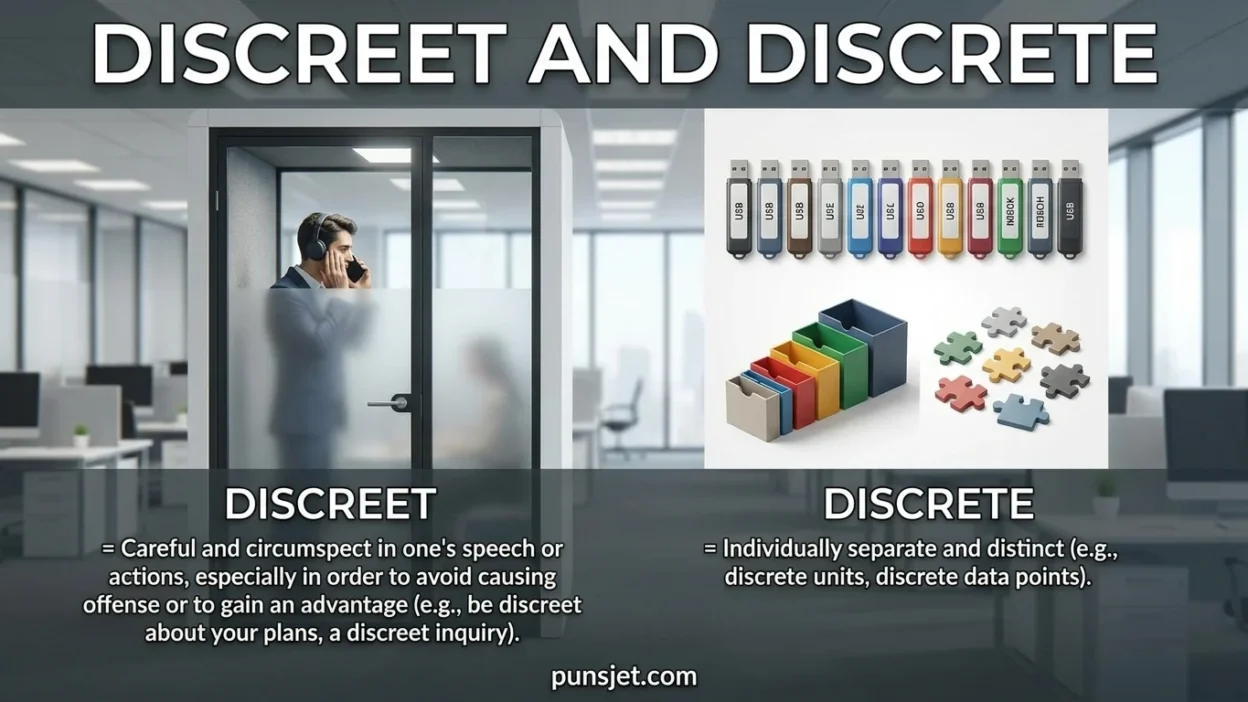
Discreet and discrete are two English words that look and sound almost the same. They are easy to mix up, especially when you hear them in conversation. However, their meanings are completely different.
Discreet usually describes someone or something that is careful, quiet, and not likely to attract attention. For example, a person may be discreet when they keep private information secret.
Discrete, on the other hand, means separate, individual, or clearly different from other things. It is often used when talking about separate parts, items, groups, or values.
The good news is that there is a simple way to remember the difference. Once you connect each spelling with its meaning, these two words become much easier to use correctly.
Quick Answer: Discreet vs. Discrete
Here is the difference in the simplest way:
- Discreet = careful about keeping something private or avoiding attention.
- Discrete = separate, individual, or distinct.
- Discreet is often used for people, actions, or behavior.
- Discrete is often used for separate objects, parts, groups, or things.
- Discreet is connected with privacy and careful behavior.
- Discrete is connected with separation and individuality.
Easy memory trick
Think of the two e’s in discreet as a reminder to keep things secret.
Think of discrete as meaning separate or different.
For example:
The assistant was discreet about the customer’s private information.
The survey contains five discrete questions.
A Simple Background of the Two Words
Although discreet and discrete look very similar, they developed from different words.
Discreet came through French from a word related to being careful, sensible, or able to make good judgments. Over time, its meaning became connected with behaving carefully, especially when dealing with private or sensitive matters.
Discrete comes from a Latin word meaning separate or divided. Its meaning has stayed closely connected to the idea of things being apart or clearly different from one another.
The similar spelling is one reason these words are often confused. They also have very similar pronunciations in many varieties of English.
So, when you are writing, do not choose the spelling simply because it sounds right. Think about the meaning you want.
What Does “Discreet” Mean?
Discreet is an adjective that describes someone who behaves carefully and avoids drawing unnecessary attention.
It can also describe an action or arrangement that is designed to remain private or unnoticed.
Examples
- She was discreet when asking about his personal problem.
- The manager made a discreet inquiry.
- Please be discreet about the information I shared with you.
- The security guard stayed discreet while watching the entrance.
- They wanted a discreet way to discuss the matter.
In all these examples, the idea is carefulness, privacy, or avoiding attention.
Discreet does not always mean secret
Something can be discreet without being completely secret.
For example:
She gave him a discreet signal.
The signal may be visible to some people, but it is small and not meant to attract attention.
What Does “Discrete” Mean?
Discrete is an adjective that means separate, individual, or clearly different.
It is used when things can be considered as separate units rather than one continuous thing.
Examples
- The course has three discrete sections.
- The machine has several discrete parts.
- The teacher divided the lesson into discrete topics.
- These are discrete groups with different goals.
- The report contains several discrete categories.
In each example, the word focuses on things being separate from one another.
A simple way to understand discrete
Imagine five boxes sitting next to each other:
Box 1 | Box 2 | Box 3 | Box 4 | Box 5
Each box is separate. They are discrete boxes.
Discreet vs. Discrete: Comparison Table
| Word | Meaning | Common idea | Example |
|---|---|---|---|
| Discreet | Careful, private, or not attracting attention | Privacy | She was discreet about the conversation. |
| Discrete | Separate or individual | Separation | The study contains four discrete groups. |
| Discreet | Quiet and careful behavior | Avoiding attention | He made a discreet request. |
| Discrete | Clearly separate from other things | Individual units | The program has several discrete steps. |
| Discreet | Often describes people or actions | Carefulness | Please be discreet. |
| Discrete | Often describes things, parts, or groups | Separate units | The machine has discrete components. |
Which One Should You Use and When?
The easiest way to choose the correct word is to ask yourself one question:
Am I talking about privacy or separation?
If you mean privacy, careful behavior, or avoiding attention, use discreet.
Please be discreet about this conversation.
If you mean separate, individual, or clearly different, use discrete.
The project is divided into four discrete stages.
Use “discreet” for:
- private conversations
- careful behavior
- quiet actions
- avoiding attention
- sensitive information
- subtle signals
- confidential situations
Use “discrete” for:
- separate groups
- individual items
- distinct categories
- separate parts
- individual steps
- separate values
- clearly divided units
Common Mistakes People Make
1. Using “discrete” when they mean private
Incorrect:
Please be discrete about my personal information.
If you mean “please keep it private,” the correct word is:
Please be discreet about my personal information.
2. Using “discreet” when you mean separate
Incorrect:
The project has three discreet sections.
If you mean that the sections are separate from one another, use:
The project has three discrete sections.
3. Thinking the two words have the same meaning
They do not.
They are different words with different meanings, even though they look and sound similar.
Remember:
Discreet = careful and private
Discrete = separate and individual
4. Choosing based only on pronunciation
In many accents, the words sound almost identical. This makes listening difficult.
When writing, stop and ask what you mean before choosing the spelling.
Everyday Real-Life Examples
In Emails
Imagine you are writing to a coworker about private information:
Please be discreet when discussing this matter with the team.
Here, discreet is correct because the writer wants the coworker to behave carefully.
Now imagine an email about a project:
The report is divided into four discrete sections.
Here, discrete is correct because the sections are separate.
In News
A news report might say:
The official asked staff to be discreet when handling the sensitive information.
This means staff should act carefully and avoid unnecessary attention.
Another report might say:
The research examined three discrete groups.
This means the groups were separate.
On Social Media
Someone might write:
I tried to be discreet when asking about the surprise party.
The person did not want to attract attention.
But you could also see:
The app allows users to create discrete categories for different types of content.
Here, the categories are separate.
In Daily Conversation
You might say:
Can you be discreet about what I just told you?
This means, “Please do not draw attention to this or share it carelessly.”
You might say:
We divided the work into five discrete tasks.
This means there are five separate tasks.
A Simple Learning Trick for Students
If you are a student, try remembering these two short sentences:
Discreet = Don’t attract attention.
She was discreet about the secret.
Discrete = Different and separate.
The teacher gave us three discrete assignments.
You can also remember the spelling:
Discreet has ee near the end.
Think:
discreet → secret
Both are connected with keeping something private.
For discrete, think:
discrete → separate
This small memory trick can help you choose the correct spelling quickly.
More Examples to Practice
Discreet
- The doctor was discreet when discussing the patient’s information.
- She gave me a discreet smile.
- He made a discreet phone call.
- Please be discreet about the surprise.
- The employee handled the complaint in a discreet manner.
Discrete
- The teacher divided the class into discrete groups.
- The machine has several discrete parts.
- The form contains five discrete sections.
- Each item belongs to a discrete category.
- The experiment involved two discrete stages.
FAQs:
1. What is the difference between discreet and discrete?
Discreet means careful, private, or unlikely to attract attention. Discrete means separate, individual, or clearly different.
2. How do I remember discreet?
Think of discreet as being connected with privacy. If someone needs to be careful about information or attention, use discreet.
3. How do I remember discrete?
Think of discrete as meaning separate. If things are individual or divided into clear units, use discrete.
4. Is “discreet” about keeping secrets?
It can be. Discreet often describes careful behavior involving private or sensitive information. However, it can also mean avoiding unnecessary attention.
5. Does “discrete” mean different?
Yes. Discrete can mean clearly separate or distinct from other things.
6. Are discreet and discrete pronounced the same?
In many varieties of English, they are pronounced the same or very similarly. This is one reason they are easy to confuse.
7. Can I use discreet for separate things?
Usually, no. If you mean that things are separate or individual, discrete is normally the correct word.
8. What is the easiest way to remember the difference?
Remember:
Discreet = privacy and careful behavior.
Discrete = separate and individual.
Final Conclusion
Discreet and discrete are commonly confused because they look and sound almost the same. However, their meanings are easy to separate once you learn the main idea behind each word.
Use discreet when you are talking about being careful, private, quiet, or not attracting attention.Use discrete when you are talking about things that are separate, individual, or clearly different.
The simplest memory rule is:
Discreet = careful and private.
Discrete = separate and individual.
When you see one of these words in your writing, think about its meaning first. If the idea is privacy or careful behavior, choose discreet. If the idea is separation or individual parts, choose discrete. With a little practice, this commonly confused pair will become much easier to use correctly.