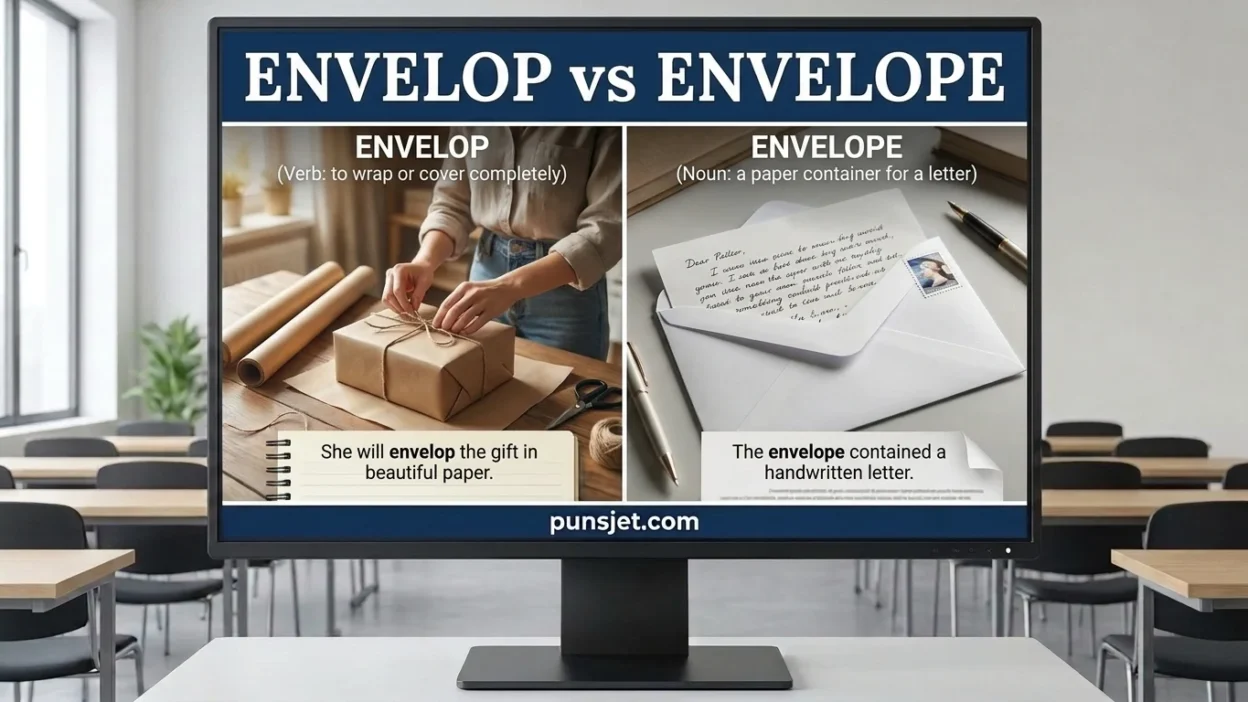
Envelop and envelope look almost the same, but they are different words with different meanings. The only visible difference is the final e, yet that small letter changes the word completely.
This pair can be confusing because both words are related to the idea of covering or surrounding something. However, one is mainly a verb, while the other is usually a noun.
If you are writing an email, school assignment, letter, or message, knowing the difference will help you choose the correct word.
The easiest way to remember them is:
- Envelop = to surround or cover something.
- Envelope = a paper container used for a letter or document.
Let’s look at the difference in a simple way.
Quick Answer: Envelop vs. Envelope
- Envelop is a verb.
- It means to completely surround, cover, or wrap something.
- Envelope is usually a noun.
- It means a flat paper container used to hold a letter or document.
- Envelop sounds like “en-VEL-up.”
- Envelope is commonly pronounced “EN-vuh-lohp.”
- Example: Dark clouds began to envelop the town.
- Example: She put the letter inside an envelope.
Simple memory trick
Think:
Envelop = surround
Envelope = letter holder
The final e in envelope helps you remember the physical object used for letters.
What Does “Envelop” Mean?
Envelop is a verb. It describes an action.
When something envelops another thing, it surrounds or covers it completely or almost completely.
For example:
Thick fog began to envelop the city.
This means the fog spread around the city and covered it.
Another example is:
The warm blanket enveloped the child.
Here, the blanket surrounded and covered the child.
The word can be used for physical things, such as fog, smoke, darkness, water, or flames. It can also be used for feelings or ideas.
For example:
A feeling of sadness enveloped him.
This does not mean sadness physically covered him. It means the feeling became very strong and seemed to surround him.
Common uses of “envelop”
You may see envelop used with:
- fog
- smoke
- darkness
- clouds
- flames
- water
- warmth
- silence
- fear
- sadness
Examples
- Smoke enveloped the building.
- Darkness enveloped the village.
- The mist enveloped the mountain.
- A warm blanket enveloped the baby.
- Silence enveloped the room.
In each sentence, envelop means to surround or cover.
What Does “Envelope” Mean?
Envelope is most commonly a noun. It is the paper container that holds a letter, card, bill, or other document.
For example:
I put the birthday card in an envelope.
The envelope is the paper item around the card.
You may use an envelope when:
- sending a letter
- mailing a card
- sending a document
- giving someone an invitation
- keeping papers together
Examples
- Please write your address on the envelope.
- She opened the envelope carefully.
- I put the check inside an envelope.
- He mailed the envelope yesterday.
- The invitation arrived in a white envelope.
In these examples, envelope refers to a physical container.
Simple Origin and Background
The two words are closely related because both come from an older French word connected with the idea of wrapping or surrounding something.
Over time, English developed two forms with different uses.
Envelop became a verb meaning to surround or cover something.
Envelope became a noun for something that surrounds or covers another thing, including the paper container used to hold a letter.
This connection can make the words easier to understand. An envelope literally envelops the letter inside it.
So, although the two words have different meanings today, they are connected by the basic idea of surrounding or covering.
The Clear Difference Between Envelop and Envelope
The main difference is their part of speech and meaning.
Envelop
Envelop is a verb.
It tells us what something does.
Fog enveloped the road.
The fog surrounded or covered the road.
Envelope
Envelope is a noun.
It names a thing.
The letter was inside an envelope.
The envelope is the paper container holding the letter.
A useful question can help:
Is it an action of surrounding something?
Use envelop.
Is it the paper container for a letter?
Use envelope.
Envelop vs. Envelope: Comparison Table
| Feature | Envelop | Envelope |
| Part of speech | Verb | Noun |
| Basic meaning | To surround or cover | A paper container |
| Main use | Describes an action | Names an object |
| Example | Fog enveloped the town. | Put the letter in the envelope. |
| Connected idea | Surrounding | Something that surrounds |
| Common situation | Fog, smoke, darkness, feelings | Letters, cards, documents |
Which One Should You Use and When?
Choosing the correct word is simple once you focus on the meaning.
Use “envelop” when something surrounds or covers
Use envelop when you are describing an action.
For example:
Thick smoke began to envelop the room.
The smoke is spreading around the room.
Darkness enveloped the street.
Darkness surrounded the street.
A sense of calm enveloped her.
The feeling seemed to surround her.
Use “envelope” for the paper container
Use envelope when talking about something that holds a letter, card, or document.
For example:
I need an envelope for this letter.
The invitation came in a beautiful envelope.
Please seal the envelope before mailing it.
Remember:
Action = envelop
Paper container = envelope
Common Mistakes People Make
Mistake 1: Using “envelope” as a verb
Some people write:
The fog enveloped the town.
This sentence is correct because enveloped is the past form of envelop.
The mistake would be using envelope when the intended meaning is “surround.”
Incorrect:
The fog enveloped the town.
This is actually correct. Notice the spelling: enveloped, not enveloped with an extra “e” from envelope.
The base verb is envelop.
Mistake 2: Confusing the spelling
People sometimes forget the final e in envelope.
If you are talking about a letter holder, write:
Put the letter in the envelope.
Not:
Put the letter in the envelop.
Mistake 3: Thinking they are interchangeable
They are not interchangeable.
Compare:
The clouds enveloped the mountain.
Here, enveloped means surrounded.
The letter was inside an envelope.
Here, envelope is an object.
The spelling is similar, but the grammar and meaning are different.
Mistake 4: Forgetting the verb form
Because envelop is a verb, it can change depending on the sentence:
- envelop
- envelops
- enveloped
- enveloping
Examples:
Fog envelops the valley.
Fog enveloped the valley.
Fog is enveloping the valley.
Everyday Real-Life Examples
Understanding real examples makes the difference much easier to remember.
In emails
The word envelope may appear when discussing physical mail:
Please send the signed document in an envelope.
For digital messages, however, people normally talk about an email, not an envelope.
In news
News reports may use envelop when describing weather or events:
Heavy smoke enveloped the area.
Thick fog enveloped the highway.
Here, envelop describes something spreading around an area.
On social media
You might see a sentence such as:
A beautiful sunset enveloped the city in golden light.
The word enveloped means the light surrounded or covered the city.
If someone posts a picture of a handwritten letter, they might write:
I found an old letter inside an envelope.
Here, envelope is the physical item.
In daily life
You can use envelope when:
- mailing a letter
- sending a birthday card
- giving someone an invitation
- storing a document
You can use envelop when:
- fog surrounds a road
- smoke covers a building
- darkness covers a place
- warmth surrounds someone
- a strong feeling seems to surround a person
A Simple Learning Trick for Students
Here is an easy way to remember the difference:
Think of a letter
A letter goes inside an envelope.
So:
Envelope = the thing that holds the letter.
Now think about what the envelope does to the letter.
It surrounds the letter.
So:
Envelop = surround or cover.
You can also remember this sentence:
The envelope envelops the letter.
In this sentence:
- envelope = the paper container
- envelops = surrounds
This one sentence can help you remember both words at the same time.
Quick practice
Choose the correct word:
- The fog began to ______ the village.
- Please put the letter in the ______.
- Darkness ______ the street.
- She opened the ______ carefully.
Answers:
- envelop
- envelope
- enveloped
- envelope
FAQs:
1. What is the difference between envelop and envelope?
Envelop is a verb meaning to surround or cover. Envelope is usually a noun meaning a paper container for a letter or document.
2. Is “envelop” a verb?
Yes. Envelop is a verb.
Example:
Clouds enveloped the mountain.
3. Is “envelope” a noun?
Yes. Envelope is most commonly a noun.
Example:
The letter is in the envelope.
4. Can “envelope” be used as a verb?
Yes. Envelope can also be used as a verb in some contexts, especially when referring to covering or enclosing something. However, envelop is the common spelling for the verb meaning “surround.”
For everyday writing, use envelop when you mean “surround.”
5. How do I remember “envelop”?
Think of envelop as an action: something surrounds something else.
Example:
Smoke enveloped the building.
6. How do I remember “envelope”?
Think of envelope as the paper holder for a letter.
Example:
Put the card in the envelope.
7. Is “enveloped” the past tense of “envelop”?
Yes.
The fog enveloped the town.
It means the fog surrounded or covered the town.
8. Are envelop and envelope pronounced the same?
No. They are pronounced differently.
Envelop is commonly pronounced like en-VEL-up.
Envelope, when it means the paper container, is commonly pronounced like EN-vuh-lohp.
Conclusion
Envelop and envelope are easy to confuse because they look and sound similar, but their common uses are different.
Envelop is a verb that means to surround, cover, or wrap around something.
The fog enveloped the city.Envelope is a noun that usually means a paper container for a letter, card, or document.She put the letter in an envelope.
The simplest rule is:
Envelop = surround or cover.
Envelope = paper container for a letter.Once you connect envelope with letters and envelop with surrounding, the difference becomes much easier to remember and use correctly.