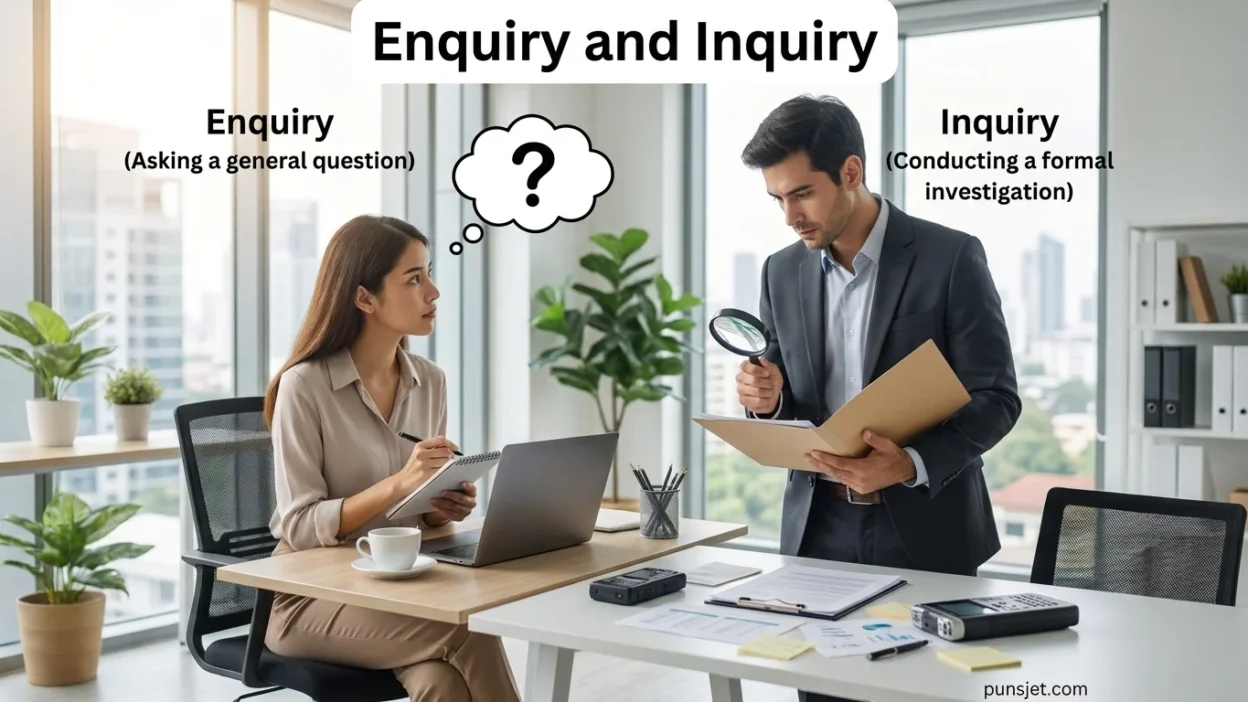
Enquiry and inquiry are two words that often confuse English learners. They look almost the same, sound similar, and both relate to asking for information. In many situations, they can even be used in the same way.
The main difference is connected to British English and American English, but there is also a small difference in meaning in some uses. Understanding this difference can help you choose the right word when writing an email, asking a question, reading the news, or communicating at work or school.
The good news is that the difference is not difficult. Once you understand the basic idea, you will know when to use enquiry and when to use inquiry.
Quick Answer: Enquiry vs. Inquiry
Here is the simple answer:
- Enquiry usually means a request for information, especially in British English.
- Inquiry is the more common spelling in American English.
- Inquiry can also mean an official investigation or detailed examination.
- In British English, enquiry is often used for an ordinary question, while inquiry may be used for a formal investigation.
- American English generally uses inquiry for both meanings.
- Both words come from the same language history and are closely related.
- If you are writing for an American audience, inquiry is usually the safer choice.
- If you are writing British English, enquiry is common for a simple request for information.
Easy memory tip
Think of it this way:
Enquiry = a question for information
Inquiry = a question or a formal investigation
However, this is not a strict rule everywhere. Usage can vary by country, organization, and context.
A Simple Background of the Two Words
Both enquiry and inquiry are connected to the idea of asking, seeking information, or investigating something.
They have a long history in English and are related to the same older word family. Over time, English speakers developed two common spellings: enquiry and inquiry.
The spelling with en- became especially common in British English for ordinary requests for information. The spelling with in- became standard in American English and is also widely used in British English, especially for formal investigations.
This is why you may see both spellings in books, newspapers, websites, schools, and offices.
For example, a British company might write:
“Thank you for your enquiry.”
An American company might write:
“Thank you for your inquiry.”
The basic message is the same: someone has asked for information.
What Does “Enquiry” Mean?
Enquiry means a request for information.
It is especially common in British English.
When you want to know something and ask another person or organization for information, you can describe your question as an enquiry.
Examples
- I sent an enquiry about the price of the course.
- We received an enquiry from a new customer.
- She made an enquiry about the train schedule.
- Thank you for your enquiry.
- The school received several enquiries from parents.
In these examples, nobody is conducting a serious investigation. They simply want information.
Enquiry in everyday communication
You might make an enquiry when you want to know:
- the price of something
- opening hours
- course information
- delivery details
- travel information
- available services
- appointment times
For example:
“I am writing to make an enquiry about your English course.”
This simply means:
“I am writing because I want some information about your English course.”
What Does “Inquiry” Mean?
Inquiry has two common uses.
1. A request for information
Like enquiry, inquiry can mean a question or request for information.
This use is particularly common in American English.
For example:
- I sent an inquiry about the product.
- We received an inquiry from a customer.
- Please contact us if you have any inquiries.
- She made an inquiry about the application process.
Here, inquiry simply means a request for information.
2. A formal investigation
Inquiry can also mean a formal investigation into a problem, event, or situation.
For example:
- The government opened an inquiry into the incident.
- An official inquiry was launched after the accident.
- The committee conducted an inquiry into the matter.
- The investigation will be discussed during the public inquiry.
In this sense, the word suggests something more serious and organized.
People may collect information, examine evidence, ask questions, and produce a report.
Enquiry vs. Inquiry: The Main Difference
The easiest way to understand the difference is to look at English variety and context.
| Word | Common Use | Typical English | Example |
| Enquiry | Request for information | British English | I made an enquiry about the course. |
| Inquiry | Request for information | American English | I made an inquiry about the course. |
| Inquiry | Formal investigation | British and American English | An inquiry was opened into the incident. |
So, if someone asks for information about a hotel, course, product, or service, enquiry and inquiry may both work depending on the variety of English.
But when you mean an official investigation, inquiry is the usual choice.
Which One Should You Use?
The best choice depends mainly on your audience.
Use “enquiry” when:
You are writing in British English and talking about a normal request for information.
For example:
- “I have an enquiry about your services.”
- “We received an enquiry from a customer.”
- “Please send your enquiry to our office.”
This spelling is common in the UK and other places where British English is widely used.
Use “inquiry” when:
You are writing in American English.
For example:
- “I have an inquiry about your services.”
- “We received an inquiry from a customer.”
- “Please send your inquiry by email.”
You should also use inquiry when referring to a formal investigation, regardless of whether you are writing British or American English.
Simple rule
If you are unsure:
British English + ordinary question → enquiry is common.
American English + question → inquiry is common.
Formal investigation → inquiry.
Common Mistakes People Make
Mistake 1: Thinking the two words always have completely different meanings
They do not.
Both can describe a request for information.
For example:
- “I made an enquiry about the job.”
- “I made an inquiry about the job.”
Both can mean that the person asked for information about the job.
The preferred spelling depends on the type of English being used.
Mistake 2: Using “enquiry” for a formal investigation
When you mean an official investigation, inquiry is normally the better choice.
For example:
Correct:
“The committee began an inquiry into the incident.”
Less suitable:
“The committee began an enquiry into the incident.”
In British English, the distinction between the two can be useful because enquiry often refers to a simple request, while inquiry can refer to a formal investigation.
Mistake 3: Mixing English varieties without a reason
It is not wrong to know both spellings, but consistent writing looks clearer.
If your document uses British spelling such as colour, centre, and organise, then enquiry may fit naturally when you mean a simple request for information.
If you are writing American English with spellings such as color, center, and organize, inquiry is usually the natural choice.
Everyday Real-Life Examples
Understanding the words becomes easier when you see them in normal situations.
In an email
British English
“I am writing to make an enquiry about the available courses.”
This means the writer wants information about the courses.
American English
“I am writing to make an inquiry about the available courses.”
The meaning is essentially the same.
In customer service
A company might receive this message:
“I would like to make an enquiry about your delivery options.”
The customer simply wants information.
An American customer might write:
“I would like to make an inquiry about your delivery options.”
Again, the meaning is similar.
In the news
When newspapers report an official investigation, inquiry is commonly used.
For example:
“An inquiry was launched after the accident.”
This suggests that officials or an organized group are examining what happened.
It is more than simply asking someone a question.
In school
A student may ask:
“I have an enquiry about the homework.”
In British English, this can mean the student wants clarification.
In American English, the student would normally say:
“I have an inquiry about the homework.”
However, in everyday American speech, people may simply say:
“I have a question about the homework.”
On social media
A business might post:
“For enquiries, please send us a message.”
This is common in British English.
An American business might write:
“For inquiries, please send us a message.”
Both tell people that they can contact the business for information.
Enquiry and Inquiry: Easy Examples to Remember
Here are some simple pairs:
| Situation | British English | American English |
| Asking about a course | I made an enquiry. | I made an inquiry. |
| Asking about a product | Send your enquiry. | Send your inquiry. |
| Asking about prices | We received an enquiry. | We received an inquiry. |
| Formal investigation | An inquiry was opened. | An inquiry was opened. |
| Official examination | A public inquiry began. | A public inquiry began. |
The most important point is that inquiry works in both ordinary and formal contexts, while enquiry is especially associated with ordinary requests for information in British English.
A Simple Learning Trick for Students
If you are a beginner, do not try to memorize many complicated rules.
Remember these three points:
1. Enquiry = asking for information
Think:
“I want to know something.”
Example:
“I made an enquiry about the course.”
2. Inquiry = asking for information
Especially remember this spelling when using American English.
Example:
“I made an inquiry about the course.”
3. Inquiry = formal investigation
Think:
“Officials are looking carefully into something.”
Example:
“The committee started an inquiry.”
One-line memory rule
Enquiry is commonly a British spelling for a question; inquiry is widely used for questions and formal investigations.
FAQs:
1. Is “enquiry” correct English?
Yes. Enquiry is a correct English word and is commonly used in British English for a request for information.
2. Is “inquiry” correct English?
Yes. Inquiry is also correct. It is the standard spelling in American English and is widely used in British English too.
3. Are enquiry and inquiry the same?
They can have the same meaning when they refer to a request for information. The main difference is often related to regional spelling and context.
4. Which is American: enquiry or inquiry?
Inquiry is the standard American spelling.
5. Which is British: enquiry or inquiry?
Both are used in British English. Enquiry is commonly used for an ordinary request for information, while inquiry is often used for a formal investigation.
6. Should I use “enquiry” in a business email?
If you are writing British English and simply asking for information, enquiry is perfectly suitable.
For example:
“I am writing to make an enquiry about your services.”
7. Should I use “inquiry” for an official investigation?
Yes. Inquiry is the usual word for a formal investigation.
For example:
“The committee launched an inquiry into the matter.”
8. Is “enquiry” more polite than “inquiry”?
No. Neither word is automatically more polite. The choice mainly depends on English variety and context. You can make either word polite by using respectful language around it.
Conclusion
Enquiry and inquiry are very similar words, so it is easy to understand why people confuse them. Both can describe someone asking for information.
The biggest difference is often regional usage. Enquiry is especially common in British English when someone is simply requesting information. Inquiry is the standard American spelling and is also widely used in British English. It is also the usual word for a formal investigation.
The easiest rule to remember is:Enquiry = a request for information, especially in British English.Inquiry = a request for information, especially in American English, or a formal investigation.Once you remember these simple points, choosing between enquiry and inquiry becomes much easier.

Joshua Paul is a creative writer and contributor at PunsJet.com who enjoys crafting witty puns and clever wordplay. With a strong sense of humor and a love for language, he creates entertaining content that readers can easily share and enjoy. Joshua’s goal is to spread laughter through fun and memorable jokes.