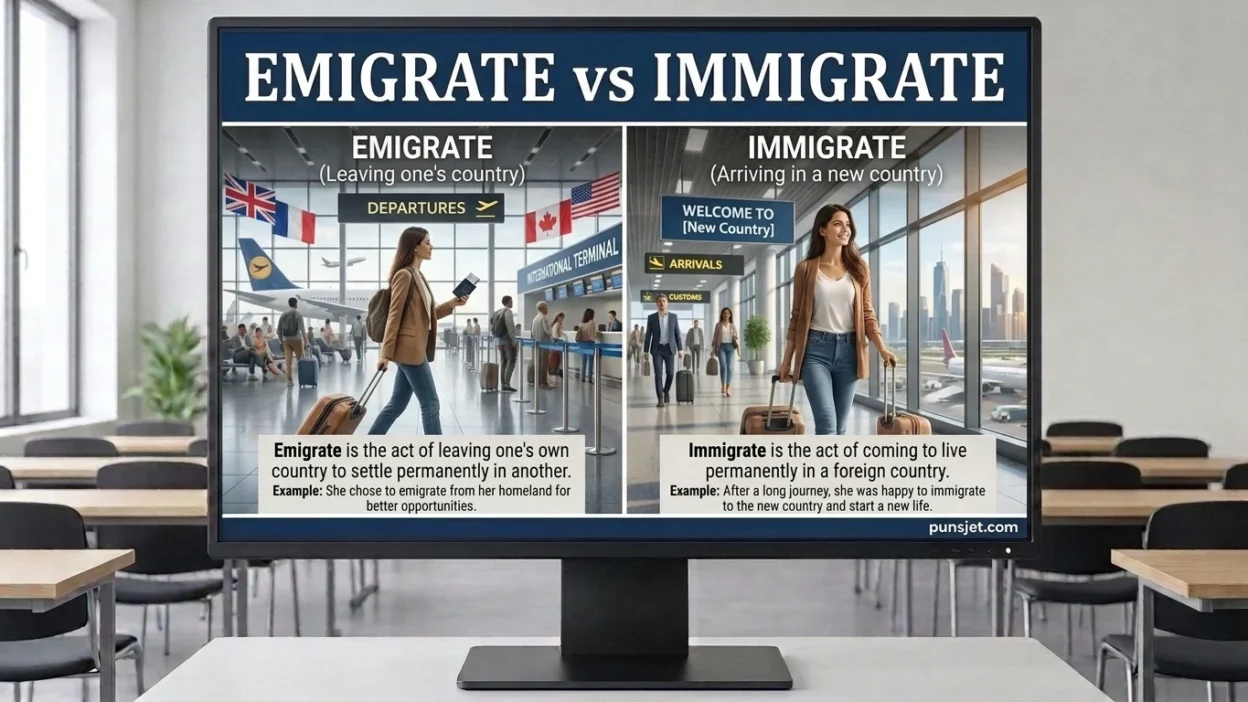
Emigrate and immigrate are two words about moving from one country to another. They are closely connected, so it is easy to mix them up.
The good news is that the difference is simple when you focus on where a person is going and where a person is leaving.
Imagine that Sara leaves Pakistan and moves to Canada permanently.
- From Pakistan’s point of view, Sara emigrates from Pakistan.
- From Canada’s point of view, Sara immigrates to Canada.
The same person can therefore emigrate from one country and immigrate to another.
This guide explains the difference in simple English, with examples that make these words easy to remember and use correctly.
Quick Answer
- Emigrate means to leave your own country and move to another country.
- Immigrate means to come into another country and live there.
- Emigrate = leave
- Immigrate = enter
- You emigrate from a country.
- You immigrate to a country.
- A person can emigrate from Pakistan and immigrate to Canada.
- Both words usually describe moving to another country with the intention of living there, rather than simply taking a short trip.
An easy memory trick
Think of E in emigrate as exit.
Emigrate = Exit your country
Think of I in immigrate as in.
Immigrate = Move in to another country
This simple trick can help you remember the difference quickly.
The Simple Background of the Words
Both words are related to the idea of moving from one place to another.
The word emigrate is connected with leaving a place. When someone emigrates, the focus is on the country they are leaving.
The word immigrate focuses on entering and settling in a new country. When someone immigrates, the focus is on the country they are moving into.
The two words describe different sides of the same international move.
For example:
Ahmed moved from Egypt to Germany.
If we are talking about Egypt:
Ahmed emigrated from Egypt.
If we are talking about Germany:
Ahmed immigrated to Germany.
So, the action is not necessarily two different moves. It is one move described from two different viewpoints.
Emigrate vs. Immigrate: The Main Difference
The easiest way to understand these words is to look at the prepositions that usually follow them.
Emigrate from
Emigrate is normally followed by from when you name the country someone leaves.
Maria emigrated from Brazil.
This means Maria left Brazil to live somewhere else.
Immigrate to
Immigrate is normally followed by to when you name the country someone enters and settles in.
Maria immigrated to Australia.
This means Maria moved to Australia to live there.
One person, two words
Consider this example:
Daniel left Mexico and moved to Spain.
You could say:
Daniel emigrated from Mexico.
And:
Daniel immigrated to Spain.
Both sentences can be correct because they focus on different parts of Daniel’s move.
Easy Comparison Table
| Word | Simple Meaning | Focus | Common Preposition | Example |
| Emigrate | Leave your country to live somewhere else | The country you leave | from | She emigrated from India. |
| Immigrate | Move into another country to live there | The country you enter | to | She immigrated to Canada. |
| Emigration | The act of leaving a country | Leaving | from | His emigration from Italy was difficult. |
| Immigration | The act of moving into another country | Entering | to/into | Immigration to Australia increased. |
| Emigrant | A person who leaves their country | Leaving | from | He became an emigrant from Spain. |
| Immigrant | A person who moves into another country | Entering | to | She is an immigrant to the United States. |
The most important pair to remember is:
Emigrate from → leave
Immigrate to → enter
Which One Should You Use and When?
Use emigrate when your sentence focuses on the country a person is leaving.
Use “emigrate” for leaving
- She emigrated from Pakistan.
- His family emigrated from Ireland.
- Many people emigrated from the country.
- They decided to emigrate from their homeland.
The main idea is departure.
Use “immigrate” for entering
Use immigrate when your sentence focuses on the country where a person starts a new life.
- She immigrated to Canada.
- His parents immigrated to Australia.
- They immigrated to the United States.
- Her family immigrated to Germany.
The main idea is arrival and settlement.
What if you mention both countries?
You can use both words in the same explanation:
He emigrated from China and immigrated to France.
This sentence clearly shows both sides of his move.
Common Mistakes People Make
1. Using “immigrate from”
One common mistake is saying:
❌ She immigrated from Canada.
If you mean that she left Canada, emigrated from Canada is usually the better choice.
✅ She emigrated from Canada.
The word immigrate normally focuses on the country someone moves to.
2. Using “emigrate to”
Another common mistake is:
❌ He emigrated to Australia.
In standard usage, immigrated to Australia is the clearer choice when you are focusing on Australia as the destination.
✅ He immigrated to Australia.
You can remember:
Emigrate from
Immigrate to
3. Thinking they describe completely different actions
They actually describe two sides of the same international move.
For example:
Fatima emigrated from Morocco and immigrated to France.
She did not make two separate moves. The two words simply describe her move from different viewpoints.
4. Confusing immigration with travel
A person does not normally immigrate just because they visit another country for a few days.
For example:
Ahmed traveled to Italy for a two-week holiday.
We would not normally say:
❌ Ahmed immigrated to Italy for a two-week holiday.
Immigrate is associated with moving to another country to live there.
Everyday Real-Life Examples
These words appear in many kinds of writing and conversation.
In emails
My parents emigrated from Turkey many years ago.
My sister recently immigrated to Canada for work.
These sentences clearly show the country being left and the country being entered.
In news
A news report might discuss people who:
emigrated from their home country
or people who:
immigrated to a new country
The exact word depends on which side of the move the writer wants to describe.
In social media
Someone might write:
“My grandparents emigrated from Italy in the 1960s.”
Another person might say:
“My family immigrated to the United States when I was young.”
Both sentences can describe the same family history from different perspectives.
In everyday conversation
You might hear:
“Where did your family emigrate from?”
Or:
“When did your family immigrate to Canada?”
Both questions are about international migration, but they focus on different places.
A Simple Way for Students to Remember
If these words still seem confusing, use this three-step method.
Step 1: Find the starting country
Ask:
Where did the person leave?
Use:
emigrate from
Example:
He emigrated from Pakistan.
Step 2: Find the destination country
Ask:
Where did the person move to live?
Use:
immigrate to
Example:
He immigrated to Canada.
Step 3: Put them together
He emigrated from Pakistan and immigrated to Canada.
That’s the whole difference.
Easy memory sentence
Emigrate = Exit
Immigrate = In
If you remember E = Exit and I = In, these words become much easier.
Emigrate, Immigrate, and Migrate
There is another related word that learners often see: migrate.
Migrate is a broader word. It means to move from one place to another. It can be used for people and animals and does not always focus specifically on international settlement.
For example:
Many birds migrate to warmer areas.
For people, you might see:
Thousands of people migrated to another region.
So the three words can be understood like this:
- Migrate = move from one place to another
- Emigrate = leave your country to live elsewhere
- Immigrate = move into another country to live there
This distinction helps you understand why emigrate and immigrate are more specific.
FAQs:
1. What is the difference between emigrate and immigrate?
Emigrate means leaving a country to live somewhere else. Immigrate means moving into another country to live there.
2. Is it emigrate from or emigrate to?
The usual pattern is emigrate from.
She emigrated from India.
3. Is it immigrate from or immigrate to?
The usual pattern is immigrate to.
She immigrated to Canada.
4. Can someone emigrate and immigrate at the same time?
Yes. A person can emigrate from one country and immigrate to another as part of the same move.
For example:
He emigrated from Brazil and immigrated to Portugal.
5. Does immigrate mean taking a holiday?
No. Immigrate usually refers to moving to another country with the intention of living there. A short vacation is normally described as traveling or visiting.
6. What is an immigrant?
An immigrant is a person who has moved to another country to live there.
For example:
She is an immigrant who moved to Canada.
7. What is an emigrant?
An emigrant is a person viewed as someone who has left their country to live somewhere else.
For example:
He was an emigrant from Ireland.
8. What is the easiest way to remember the difference?
Remember:
Emigrate = Exit
Immigrate = In
Then remember the common patterns:
Emigrate from
Immigrate to
Conclusion
The difference between emigrate and immigrate is simple once you know which direction each word describes.Emigrate focuses on leaving a country.Immigrate focuses on entering a new country to live there.For example:Sara emigrated from Pakistan.This focuses on Pakistan, the country she left.
Sara immigrated to Canada.This focuses on Canada, the country where she moved to live.So, whenever you are unsure, ask yourself one simple question:Am I talking about the country the person left, or the country they entered?If you mean left, use emigrate.If you mean entered and settled, use immigrate.The easiest rule to keep in your mind is:
Emigrate from. Immigrate to.Once you remember that small pattern, these two commonly confused words become much easier to use correctly.

Emily Margaret is a writer and humor enthusiast at PunsJet.com. She enjoys creating clever puns and lighthearted content that entertains readers and adds a spark of humor to everyday life. With a love for wordplay and creativity, Emily aims to share fun, relatable jokes that make people smile and laugh.