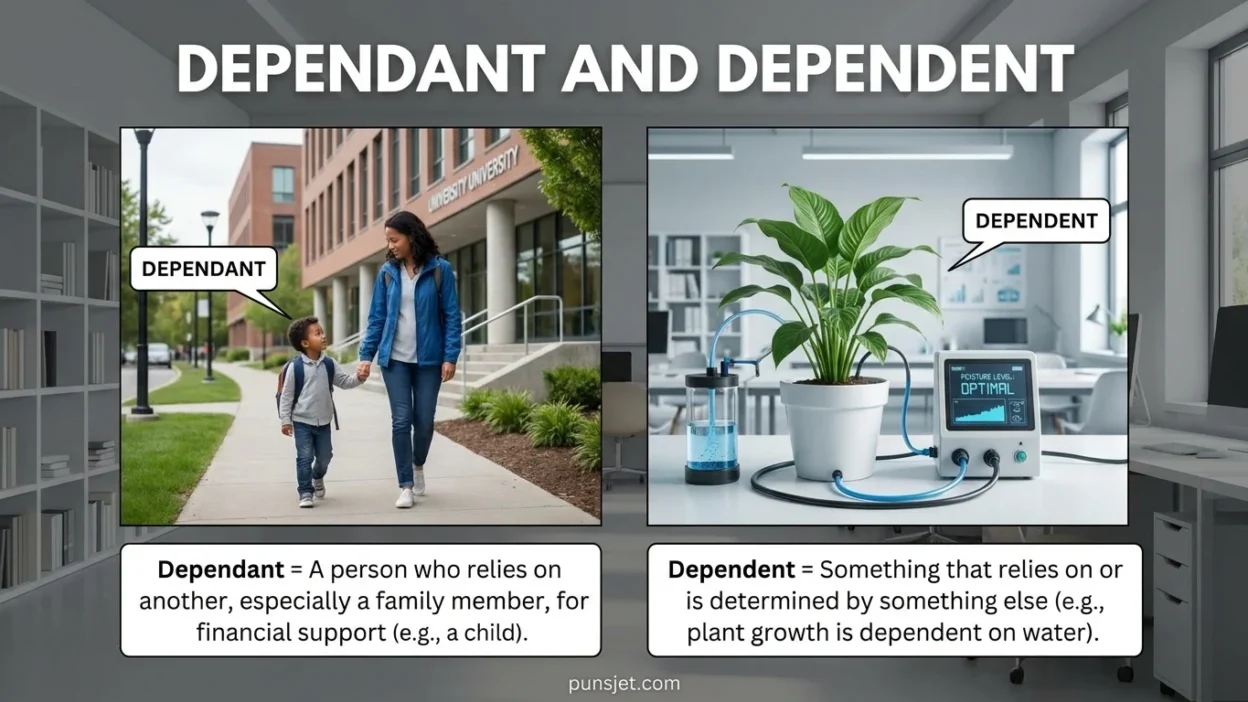
Dependant and dependent look almost the same, and they have the same basic meaning. Both words describe a person who relies on someone or something else for support.
The main difference is where the word is used and which form of English you are following.
In British English, dependant is commonly used as a noun for a person who relies on another person for money or support. Dependent is usually used as an adjective.
In American English, dependent is normally used for both the noun and the adjective.
This small spelling difference can be confusing, especially for students and ESL learners. The good news is that the rule is simple once you know it.
Quick Answer
- Dependant is mainly a noun in British English.
- Dependent is an adjective meaning relying on someone or something.
- In American English, dependent is normally used as both a noun and an adjective.
- A dependant is a person who depends on someone else for support.
- Dependent can describe a person, thing, or situation that relies on something else.
- If you are writing for an international audience, dependent is often the safer spelling because it is widely understood.
- The word dependent is also used in phrases such as “financially dependent” and “dependent on.”
A Simple Background
Both dependant and dependent come from the same word family as depend.
The verb depend means to need or rely on someone or something.
For example:
Children depend on their parents for food and care.
From this idea, English developed words describing people and situations that rely on others.
Over time, English developed slightly different spelling habits in different places. British English commonly kept dependant as a noun, while American English generally uses dependent for both the noun and adjective.
This is similar to several other British and American spelling differences. The important thing is not to think of one spelling as completely wrong. The correct choice can depend on the type of English you are using and the job the word is doing in the sentence.
Dependant vs. Dependent: The Main Difference
The easiest way to understand these words is to look at their grammar role.
Dependant as a Noun
Dependant is mainly used as a noun in British English.
It means a person who depends on another person for financial support or care.
For example:
- His wife is his dependant.
- The employee listed two dependants on the form.
- She supports three dependants.
- The company provides insurance for employees and their dependants.
Here, dependant refers to a person.
Easy memory trick
Think:
Dependant = a person who depends.
If you are talking about someone who receives support from another person, dependant can be used in British English.
Dependent as an Adjective
Dependent is commonly used as an adjective.
It describes someone or something that relies on another person or thing.
For example:
- The child is dependent on her parents.
- The plant is dependent on sunlight.
- He is financially dependent on his family.
- The result is dependent on several factors.
In these examples, dependent describes a person, plant, or situation.
A very common pattern is:
dependent on
For example:
Success is dependent on careful planning.
Young children are dependent on adults for care.
Dependent as a Noun
In American English, dependent can also be used as a noun.
It can mean a person who relies on another person for financial support.
For example:
- He added his children as dependents.
- She has two dependents.
- The form asks whether you have any dependents.
So, in American English:
dependent = noun + adjective
In British English:
dependant = noun
dependent = adjective
This is the key difference to remember.
Comparison Table
| Word | Common use | Meaning | Example |
|---|---|---|---|
| Dependant | Noun, mainly British English | A person who relies on another person for support | She has two dependants. |
| Dependent | Adjective | Relying on someone or something | The child is dependent on his parents. |
| Dependent | Noun, especially American English | A person who relies on another person for support | He has two dependents. |
The easiest rule
If you are describing something that relies on something else, use:
dependent
If you mean a person who receives support, British English may use:
dependant
American English usually uses:
dependent
Which One Should You Use and When?
The answer depends on the sentence and the type of English you are writing.
Use “dependant” in British English when:
You are using the word as a noun for a person who relies on another person.
Examples:
- She has three dependants.
- His children are listed as dependants.
- The employee receives benefits for his dependants.
Use “dependent” when:
You are using it as an adjective.
Examples:
- The child is dependent on her mother.
- The company is dependent on foreign supplies.
- He became financially dependent on his parents.
Use “dependent” as a noun in American English
Examples:
- She has two dependents.
- You may claim your children as dependents.
- The form asks for information about your dependents.
A useful writing tip
If you are writing for a British audience, dependant may be expected when the word is a noun.
If you are writing for an American audience, dependent is normally used for both noun and adjective.
Common Mistakes
1. Using “dependant” as an adjective
Incorrect:
The child is dependant on his parents.
In standard modern English, the usual form is:
The child is dependent on his parents.
Remember: dependent is the adjective.
2. Thinking “dependant” is always wrong
It is not.
In British English, dependant is a standard noun for someone who relies on another person for support.
Example:
The employee has two dependants.
So the spelling is not simply a mistake.
3. Mixing British and American styles
A writer may use dependant in one sentence and dependent as a noun in another without knowing why.
It is better to choose one English style and stay consistent.
For British English:
She has two dependants.
For American English:
She has two dependents.
4. Forgetting “dependent on”
A common mistake is leaving out on.
Incorrect:
He is dependent his parents.
Correct:
He is dependent on his parents.
The normal phrase is:
dependent on someone/something
Everyday Real-Life Examples
In Emails
Imagine an employee writing to a company:
I would like to add my daughter as a dependant to my benefits plan.
This spelling fits British English.
In American English, the same sentence would normally use:
I would like to add my daughter as a dependent to my benefits plan.
In News
You may read:
The number of dependants supported by working adults has increased.
Here, dependants is a noun referring to people who receive support.
You may also see:
Many older people are financially dependent on their families.
Here, dependent is an adjective.
On Forms
Official forms may ask about dependants or dependents, depending on the country and organization.
For example:
Number of dependants: 2
This is common in British English.
An American form may say:
Number of dependents: 2
The meaning is basically the same.
In Daily Conversation
You might say:
My younger brother is still dependent on our parents.
Here, dependent describes your brother.
You might also say:
She has two dependants.
Here, dependants is a noun in British English.
A Simple Learning Trick
For students and beginners, remember this three-part rule:
1. Person + British noun = dependant
He supports three dependants.
2. Describing reliance = dependent
The child is dependent on her parents.
3. American noun = dependent
She has two dependents.
You can also remember:
Dependent on = adjective
Whenever you see dependent on, the spelling is almost always dependent.
For example:
- dependent on money
- dependent on parents
- dependent on technology
- dependent on the weather
- dependent on the result
More Examples
Here are some simple examples to make the difference clearer:
Dependant
His wife is listed as his dependant.
The worker receives benefits for his dependants.
She supports two dependants.
Dependent
The baby is completely dependent on its parents.
Our plans are dependent on the weather.
The business is dependent on regular customers.
Dependent as an American noun
He has three dependents.
The insurance covers the employee and her dependents.
FAQs:
1. Is “dependant” correct English?
Yes. Dependant is a standard noun, especially in British English. It refers to a person who depends on another person for support.
2. Is “dependent” correct English?
Yes. Dependent is the normal adjective in both British and American English. It is also commonly used as a noun in American English.
3. What is the difference between dependant and dependent?
The main difference is grammar and regional usage. Dependant is mainly a British English noun, while dependent is the adjective and is also the usual noun form in American English.
4. Is “dependent on” correct?
Yes. Dependent on is the standard expression.
For example:
The project is dependent on funding.
5. Which is correct: “dependant” or “dependent”?
Both can be correct. If you mean a person who receives support and are using British English, dependant is common. If you are using American English, dependent is normally used.
6. Do British people use “dependent”?
Yes. British English uses dependent as an adjective.
For example:
The child is dependent on his parents.
The noun can be dependant.
7. Do Americans use “dependant”?
American English generally uses dependent instead of dependant for the noun.
For example:
She has two dependents.
8. How can I remember the difference?
Remember this simple pattern:
Dependant = person, mainly British noun
Dependent = describing reliance + American noun
Final Conclusion
Dependant and dependent have the same basic idea: both are connected to the idea of relying on someone or something.The main difference is how they are used.
In British English, dependant is commonly a noun meaning a person who relies on another person for support. Dependent is the adjective used to describe someone or something that relies on another person or thing.In American English, dependent is normally used for both the noun and adjective.
The easiest examples to remember are:
She has two dependants. — British English noun
She is dependent on her parents. — adjective
She has two dependents. — American English noun
Once you remember dependant = British noun and dependent = adjective, the difference becomes much easier.

Donald Andrew is the creative mind behind PunsJet.com, where he shares clever wordplay and humorous puns for readers around the world. With a passion for language and comedy, Donald enjoys crafting witty jokes that bring smiles to everyday conversations. His goal is to make humor simple, fun, and easy to share.