
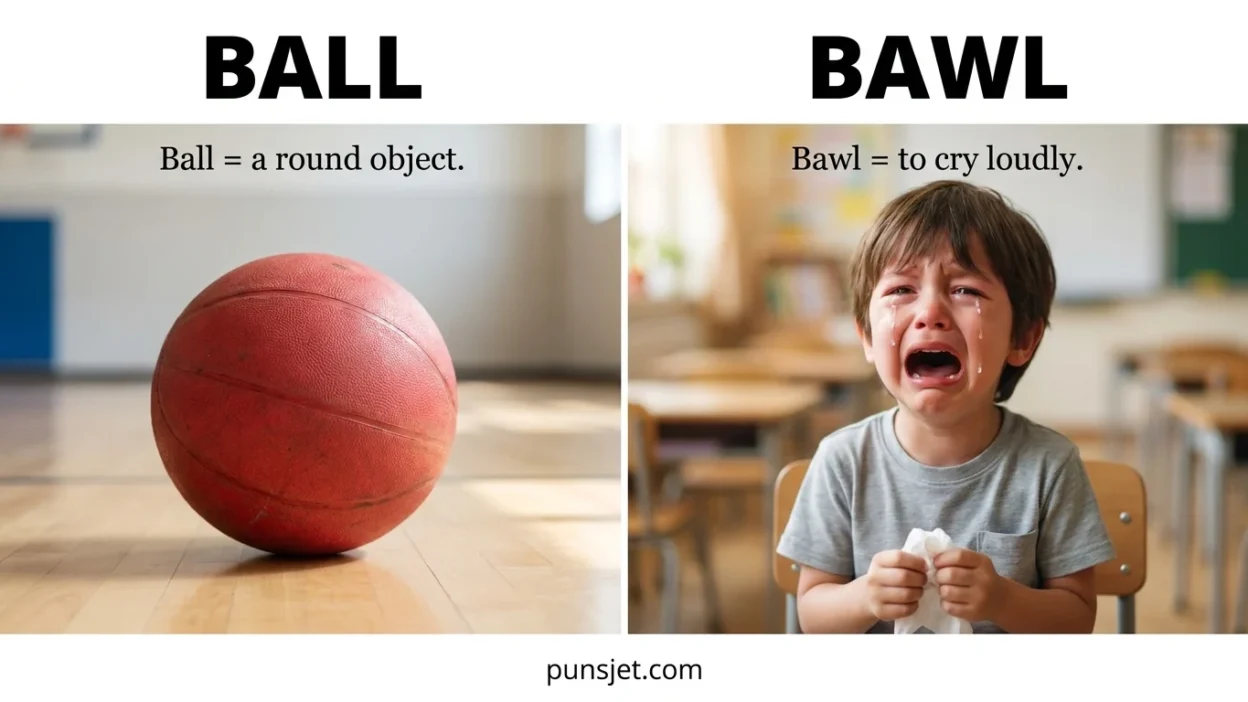
Many English words sound the same but have completely different meanings. Ball and bawl are two such words. They are pronounced the same in most forms of English, but they are not used in the same way.
This can be confusing, especially for students and English learners. When you hear someone say “ball” or “bawl,” you cannot always know which word they mean just from the sound. You need to understand the meaning and the context.
The good news is that the difference is quite easy to remember. Ball usually refers to a round object used for playing, while bawl means to cry or shout loudly.
In this guide, we will look at their meanings, uses, examples, common mistakes, and an easy way to remember the difference.
Quick Answer: Ball vs. Bawl
Here is the easiest way to understand them:
- Ball = a round object used for playing, sports, or other activities.
- Ball can also mean to dance or have fun at a party.
- Bawl = to cry or shout loudly.
- Ball and bawl usually sound the same.
- Ball is a noun and can also be a verb.
- Bawl is mainly used as a verb.
- If you are talking about a soccer ball, basketball, or toy ball, use ball.
- If you are talking about loud crying, use bawl.
Easy memory trick
Think:
Ball = something you can throw.
Bawl = something you do when you cry loudly.
What Does “Ball” Mean?
The word ball has several meanings, but the most common meaning is a round object.
A ball can be made from many different materials, such as rubber, leather, plastic, or cloth. People use balls for sports, games, exercise, and play.
Examples
- I kicked the ball across the field.
- The children are playing with a ball.
- She threw the ball to her brother.
- The soccer ball went over the fence.
- He caught the ball with one hand.
In these examples, ball refers to a physical object.
Ball as a Verb
Ball can also be used as a verb in some situations.
For example, in informal English, ball can mean to have a good time or enjoy yourself.
- We went out and balled all night.
However, this use is informal and is much less common for beginners. Students should focus first on the common meaning of ball as a round object.
Ball as a Social Event
A ball can also mean a formal dance or large social event.
For example:
- The students attended a school ball.
- She wore a beautiful dress to the ball.
- The royal ball was held in a large hall.
Here, ball does not mean a round object. It means a formal event where people dance and socialize.
What Does “Bawl” Mean?
Bawl means to cry or shout very loudly.
It is often used when someone cries in a loud, uncontrolled way. It can describe children, adults, or anyone who is making a very loud cry.
Examples
- The baby began to bawl.
- The child bawled after falling down.
- She bawled when she heard the sad news.
- He started to bawl during the argument.
- The little boy was bawling loudly.
Bawl can also mean to shout or call out loudly.
For example:
- The coach bawled instructions from the side of the field.
- He bawled for help when he got lost.
So, bawl is connected with loud crying or loud shouting.
Where Do “Ball” and “Bawl” Come From?
The two words have different histories even though they sound alike.
Ball has a very old history. The word has been used for a round object for many centuries. It developed through older forms of English and other European languages.
Bawl also comes from an old English word connected with loud crying, shouting, or making a loud sound.
Over time, the pronunciation of these words became very similar in English. Today, in most common varieties of English, ball and bawl are homophones.
A homophone is a word that sounds the same as another word but has a different meaning and spelling.
Other examples of homophones include:
- bare and bear
- flower and flour
- right and write
- sea and see
Just like these pairs, ball and bawl must be understood from their meaning and context.
Ball vs. Bawl: The Main Difference
The biggest difference is simple:
Ball is usually a thing. Bawl is an action.
When you see the word ball, think about something round that can be thrown, kicked, caught, or used in a game.
When you see bawl, think about someone crying or shouting loudly.
Compare these sentences:
The boy kicked the ball.
Here, ball is the object that the boy kicked.
The boy began to bawl.
Here, bawl describes what the boy did. He cried loudly.
The pronunciation may be the same, but the meaning is completely different.
Ball and Bawl Comparison Table
| Word | Meaning | Word Type | Example |
|---|---|---|---|
| Ball | A round object used in games or sports | Noun | I threw the ball. |
| Ball | A formal dance or event | Noun | They attended the school ball. |
| Bawl | To cry loudly | Verb | The child began to bawl. |
| Bawl | To shout loudly | Verb | He bawled for help. |
Pronunciation
In most common English accents:
- Ball → sounds like “bawl”
- Bawl → sounds like “ball”
This is why listening alone can sometimes cause confusion.
Which One Should You Use and When?
The easiest way to choose the correct word is to ask yourself what you are talking about.
Use “ball” when talking about a round object
Use ball for things such as:
- soccer balls
- basketballs
- tennis balls
- baseballs
- toy balls
- rubber balls
Example:
Please pass me the ball.
Use “bawl” when talking about loud crying
Use bawl when someone is crying loudly.
Example:
The baby began to bawl when her mother left the room.
Use “ball” for a formal dance
Example:
They attended a charity ball.
Remember that this meaning of ball is different from the sports meaning.
Common Mistakes with Ball and Bawl
Because these words sound alike, learners often confuse their spelling.
Mistake 1: Using “bawl” for a sports object
Incorrect:
He kicked the bawl into the goal.
Correct:
He kicked the ball into the goal.
A sports object is a ball.
Mistake 2: Using “ball” for loud crying
Incorrect:
The baby started to ball.
Correct:
The baby started to bawl.
When someone cries loudly, use bawl.
Mistake 3: Thinking “bawl” means any kind of crying
Bawl usually suggests loud or strong crying. It is stronger than simply saying “cry.”
For example:
The child cried quietly.
This does not necessarily mean the child bawled.
But:
The child bawled loudly after losing his toy.
This clearly describes loud crying.
Mistake 4: Forgetting that “ball” has more than one meaning
A ball is not always a sports object.
It can also mean a formal dance.
For example:
The school held a winter ball.
Here, the word means a social event.
Ball and Bawl in Everyday Life
Understanding these words is useful because both can appear in ordinary conversations and writing.
In Sports
You will often see ball in sports conversations.
- The player passed the ball.
- The goalkeeper caught the ball.
- She hit the ball over the net.
- The ball rolled under the chair.
In Family Conversations
You might hear bawl when someone talks about a crying child.
- The baby was bawling all morning.
- The little boy bawled after falling.
- She started to bawl when she heard the news.
In News Reports
The word ball may appear in reports about sports or events.
The player scored after receiving the ball.
The word bawl may appear when describing an emotional situation.
Witnesses said the child was bawling after the accident.
In Social Media
People may use ball when talking about sports:
What a great ball!
Or they may use bawl when describing an emotional moment:
I wanted to bawl after watching that movie.
Simple Learning Tips for Students
If you often confuse ball and bawl, try these easy tricks.
Trick 1: Remember the object
Ball = round object
Imagine a football or basketball whenever you see the word ball.
Trick 2: Remember the emotion
Bawl = loud crying
Imagine a baby crying loudly whenever you see bawl.
Trick 3: Look at the sentence
Ask:
Is it a thing?
If yes, it may be ball.
I threw the ball.
Ask:
Is it an action involving loud crying or shouting?
If yes, it may be bawl.
She began to bawl.
Trick 4: Learn the spelling, not just the sound
When listening, these words can be difficult because they sound alike. When writing, remember their different spellings.
Ball → round object
Bawl → cry loudly
Practice: Choose Ball or Bawl
Try filling in the blanks.
- The children kicked the ______ across the playground.
- The baby began to ______ after waking up.
- He threw the ______ to his friend.
- She started to ______ when she heard the news.
- The player caught the ______.
- The little boy was ______ loudly.
Answers
- ball
- bawl
- ball
- bawl
- ball
- bawling
If you got them all right, you understand the basic difference.
FAQs:
1. Are ball and bawl pronounced the same?
Yes, in most common English accents, ball and bawl are pronounced the same or very similarly. Their spelling and meanings are different.
2. What does ball mean?
Ball usually means a round object used for sports, games, or play. It can also mean a formal dance or social event.
3. What does bawl mean?
Bawl means to cry or shout very loudly.
4. Is bawl a noun or a verb?
Bawl is mainly used as a verb. For example:
The child began to bawl.
5. Is ball a noun or a verb?
Ball can be a noun and, in some uses, a verb. The most common use is as a noun for a round object.
6. Can I use bawl for normal crying?
You can, but bawl usually suggests loud or strong crying. For ordinary crying, cry is more common.
7. Why do ball and bawl confuse English learners?
They confuse learners because they usually have the same pronunciation but different spellings and meanings.
8. What is the easiest way to remember them?
Remember:
Ball = a round thing.
Bawl = cry loudly.
Final Conclusion
The difference between ball and bawl is simple once you connect each word with its meaning.
Ball usually refers to a round object used for sports, games, or play. It can also describe a formal dance or event.
Bawl means to cry or shout loudly.
Although the two words usually sound the same, their spelling and meanings are different. This makes them homophones, just like bare and bear or right and write.
Whenever you are unsure, use this quick memory rule:
With a little practice, you will be able to choose the correct word easily in conversations, schoolwork, emails, social media posts, and everyday writing.

Emily Margaret is a writer and humor enthusiast at PunsJet.com. She enjoys creating clever puns and lighthearted content that entertains readers and adds a spark of humor to everyday life. With a love for wordplay and creativity, Emily aims to share fun, relatable jokes that make people smile and laugh.