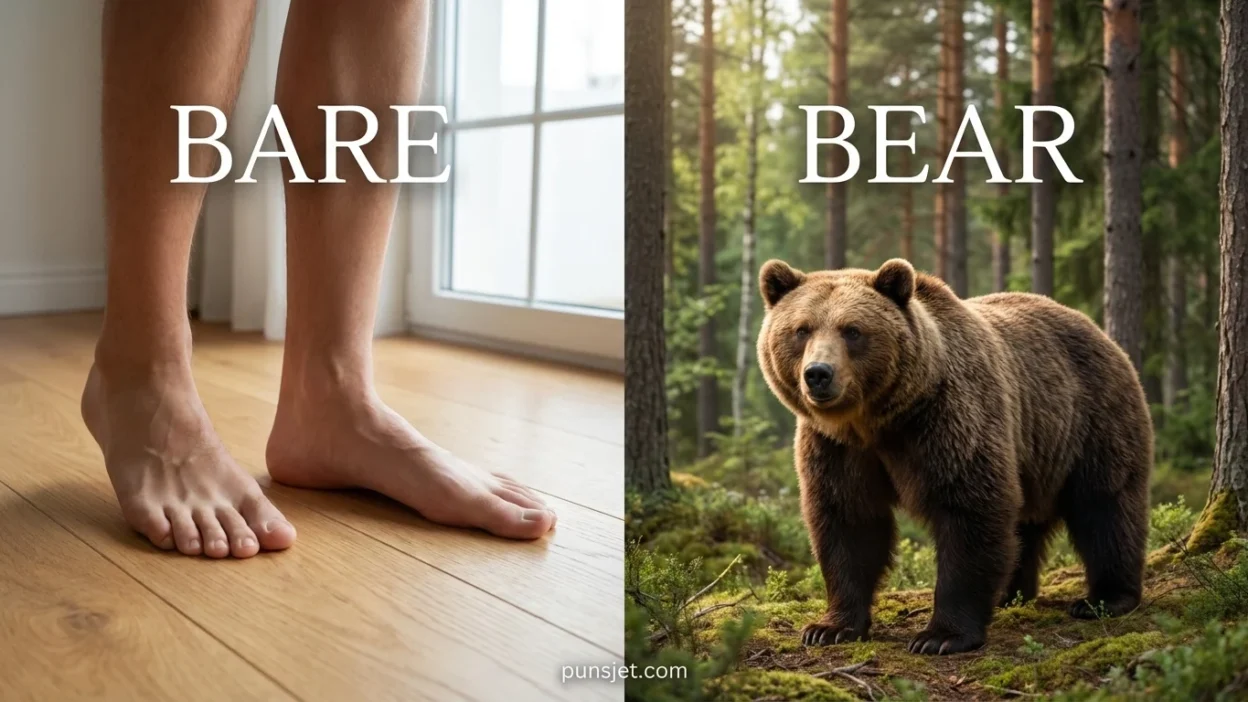
Bare and bear are two English words that sound exactly the same, but they have completely different meanings. Because they have the same pronunciation, students and English learners often mix them up when writing.
The good news is that the difference is easy to understand once you learn what each word means.
Bare usually means uncovered, empty, or without something.
Bear can mean to carry, support, or tolerate something, and it can also refer to the large animal that lives in forests and other places.
For example:
- The room had bare walls.
- I cannot bear this pain.
- We saw a bear in the forest.
In this guide, we will look at the meanings, uses, common mistakes, and everyday examples of bare and bear so you can use them correctly.
Quick Answer: Bare vs. Bear
Here is the easiest way to remember the difference:
- Bare = uncovered, exposed, or without the usual covering.
- Bear = to carry, support, tolerate, or endure something.
- Bear = also a large wild animal.
- Bare is usually connected with the idea of nothing covering something.
- Bear is often connected with carrying or dealing with something.
- Both words are pronounced the same in standard English, but their spellings and meanings are different.
Simple examples
Bare:
She walked on the bare floor.
Bear:
I cannot bear the noise anymore.
Bear:
The bear was walking through the forest.
A simple memory trick is:
Where Do “Bare” and “Bear” Come From?
Both bare and bear are old English words. They have been used for hundreds of years, but they developed different meanings and spellings.
The word bare has long been connected with the idea of being uncovered or having nothing on the surface.
For example, when we say bare feet, we mean feet without shoes or socks.
The word bear has several meanings. One meaning is connected to carrying or supporting something. Another meaning refers to the animal called a bear.
Over time, these words kept their different spellings and meanings even though their pronunciation became the same.
This is why bare and bear are called homophones. Homophones are words that sound alike but have different meanings and often different spellings.
What Does “Bare” Mean?
Bare usually means not covered, not decorated, or without something that is normally present.
It can describe a person, body part, surface, room, tree, or other thing.
1. Bare means uncovered
When something has no covering, we can use bare.
Examples:
- He walked with bare feet.
- The tree had bare branches.
- She touched the bare wall.
- The children sat on the bare floor.
In these examples, bare describes something that is not covered.
2. Bare can mean empty or simple
Bare can also describe something that has very little on it.
For example:
- The room had bare walls.
- The house had only the bare essentials.
- The table was bare after dinner.
Here, the word does not simply mean “uncovered.” It can also suggest that something has very little decoration, furniture, or extra material.
3. Bare can mean the minimum
The expression bare minimum is very common.
It means the smallest amount that is necessary.
Example:
He did the bare minimum to finish the assignment.
This means he did only what was necessary and nothing extra.
What Does “Bear” Mean?
Bear has several meanings, so it can sometimes seem more confusing than bare.
1. Bear means an animal
The most familiar meaning of bear is the large animal.
There are different types of bears, including brown bears, polar bears, and black bears.
Examples:
- We saw a bear at the zoo.
- The bear was looking for food.
- A mother bear was walking with her cub.
When you are talking about the animal, the spelling is always bear.
2. Bear means to carry or support
Bear can also mean to carry, hold, or support something.
For example:
- The bridge must bear a lot of weight.
- This shelf can bear heavy books.
- The tree bears many apples.
In these sentences, bear is a verb.
The meaning changes slightly depending on the sentence, but the basic idea is connected with carrying or supporting something.
3. Bear means to tolerate or endure
Another very common meaning of bear is to tolerate or deal with something difficult.
For example:
- I cannot bear the noise.
- She could not bear the pain.
- He could hardly bear the waiting.
When someone says:
“I can’t bear it.”
they mean:
“I cannot tolerate it.”
This use is very common in everyday English.
Bare vs. Bear: Comparison Table
| Word | Main Meaning | Word Type | Example |
|---|---|---|---|
| Bare | Uncovered or exposed | Adjective/Verb | He walked with bare feet. |
| Bare | Without extra things | Adjective | The room had bare walls. |
| Bear | A large animal | Noun | We saw a bear in the forest. |
| Bear | Carry or support | Verb | The bridge can bear the weight. |
| Bear | Tolerate or endure | Verb | I cannot bear the noise. |
The easiest difference is:
Bare = uncovered or without something.
Bear = animal, carry, support, or tolerate.
Which One Should You Use?
Choosing between bare and bear becomes much easier if you look at the meaning of the sentence.
Use “bare” when you mean:
- uncovered
- exposed
- empty
- simple
- without something
- the minimum amount
Examples:
- bare feet
- bare hands
- bare walls
- bare branches
- bare minimum
Use “bear” when you mean:
- the animal
- carry
- support
- tolerate
- endure
Examples:
- a bear in the forest
- bear the weight
- bear the responsibility
- bear the pain
- cannot bear the noise
Common Mistakes With Bare and Bear
Because these words sound the same, spelling mistakes are very common.
Mistake 1: “I can’t bare it.”
❌ I can’t bare the pain.
This is incorrect when you mean “tolerate.”
✅ I can’t bear the pain.
Remember: bear = tolerate.
Mistake 2: “He walked on bear feet.”
❌ He walked on bear feet.
This sounds like his feet belong to a bear!
✅ He walked on bare feet.
Here, bare means without shoes or socks.
Mistake 3: “We saw a bare in the forest.”
❌ We saw a bare in the forest.
The animal is spelled bear.
✅ We saw a bear in the forest.
Mistake 4: “The shelf cannot bare the weight.”
❌ The shelf cannot bare the weight.
When you mean “support,” use bear.
✅ The shelf cannot bear the weight.
Bare and Bear in Everyday English
These words appear in normal conversations, schoolwork, emails, books, news stories, and social media.
In daily conversation
“I can’t bear this heat.”
Here, bear means tolerate.
At school
“The walls were bare after the classroom decorations were removed.”
Here, bare means empty or without decoration.
In a message
“I can’t bear to see you upset.”
Here, bear means tolerate or handle emotionally.
In a news report
“A bear was spotted near the town.”
Here, bear means the animal.
In a social media post
“Walking around with bare feet on the beach.”
Here, bare means uncovered.
Easy Examples to Remember
Here are some simple sentences that show the difference clearly:
- She walked with bare feet.
- I cannot bear this headache.
- The forest is home to many bears.
- The walls were bare.
- Can this box bear the weight?
- He could not bear the cold.
- The child was walking with bare hands.
- We saw a large bear near the river.
- They had only the bare necessities.
- She could hardly bear the waiting.
Notice how the meaning tells you which spelling to choose.
A Simple Memory Trick
If you often confuse these two words, try this trick.
Think of “bare” as “nothing there.”
Bare feet → no shoes or socks.
Bare walls → no decorations.
Bare hands → no gloves or covering.
Think of “bear” as “carry or tolerate.”
Bear the weight → carry/support the weight.
Bear the responsibility → carry the responsibility.
Bear the pain → tolerate the pain.
And remember:
A bear is an animal.
So:
Bare and Bear Practice
Try choosing the correct word in each sentence.
1. I cannot ___ this noise anymore.
Answer: bear
2. He walked with ___ feet.
Answer: bare
3. We saw a ___ in the mountains.
Answer: bear
4. The room had ___ walls.
Answer: bare
5. Can this bridge ___ the weight?
Answer: bear
6. She could not ___ the pain.
Answer: bear
These examples can help you build a natural understanding of the two words.
Bare and Bear for Students and Beginners
If you are learning English, do not try to memorize every meaning at once.
Start with these three ideas:
Bare
Think:
Bare = uncovered
- bare feet
- bare hands
- bare walls
- bare floor
Bear
Think:
Bear = animal
- brown bear
- polar bear
- bear cub
Then learn:
Bear = tolerate or carry
- bear the pain
- bear the responsibility
- bear the weight
This small set of examples is enough to help you recognize the correct word in many everyday sentences.
Another useful tip is to look at the words around the blank. If the sentence talks about shoes, clothes, gloves, walls, or covering, bare may be correct. If it talks about pain, pressure, weight, responsibility, or an animal, bear is more likely.
FAQs:
1. What is the difference between bare and bear?
Bare usually means uncovered, exposed, empty, or without something. Bear can mean a large animal, to carry or support something, or to tolerate something.
2. Are bare and bear pronounced the same?
Yes. In standard English, bare and bear are homophones, which means they have the same pronunciation but different meanings and spellings.
3. Is it “bare feet” or “bear feet”?
The correct phrase is bare feet when you mean feet without shoes or socks.
Example:
She walked across the grass with bare feet.
4. Is it “I can’t bare it” or “I can’t bear it”?
The correct phrase is “I can’t bear it.”
Here, bear means “tolerate” or “deal with.”
5. Which spelling is used for the animal?
The animal is spelled bear.
Example:
The bear was sleeping in the cave.
6. What does “bare minimum” mean?
Bare minimum means the smallest amount that is necessary.
Example:
He did the bare minimum required to pass.
7. Can bear be used as a verb?
Yes. Bear can be a verb meaning to carry, support, tolerate, or endure.
Example:
I cannot bear the pain.
8. What is the easiest way to remember bare and bear?
Remember:
Bare = uncovered.
Bear = animal, carry, or tolerate.
Conclusion
Bare and bear sound the same, but their meanings are very different.
Use bare when you are talking about something that is uncovered, exposed, empty, simple, or without something. Examples include bare feet, bare hands, and bare walls.
Use bear when you are talking about the animal, or when you mean carry, support, tolerate, or endure. Examples include a bear in the forest, bear the weight, and bear the pain.
The easiest rule to remember is:
Once you connect each spelling with its main meaning, choosing between bare and bear becomes much easier. With a little practice, you will be able to use both words correctly in your writing and everyday English.