English has many words that sound exactly the same but have completely different meanings. Awe, or, oar, and ore are a good example. When you hear them in conversation, it can be difficult to know which word someone means because their pronunciation is very similar.
This can be especially confusing for students, ESL learners, and beginners. You may know what you want to say, but choosing the correct spelling can still be a challenge.
The good news is that each word has a simple meaning. Once you learn what each word means and see it in everyday sentences, the difference becomes much easier to remember.
In this guide, we will explain awe, or, oar, and ore in simple English, compare them in a table, show common mistakes, and give you practical examples.
Quick Answer: Awe, Or, Oar, and Ore
Here is the easiest way to remember the four words:
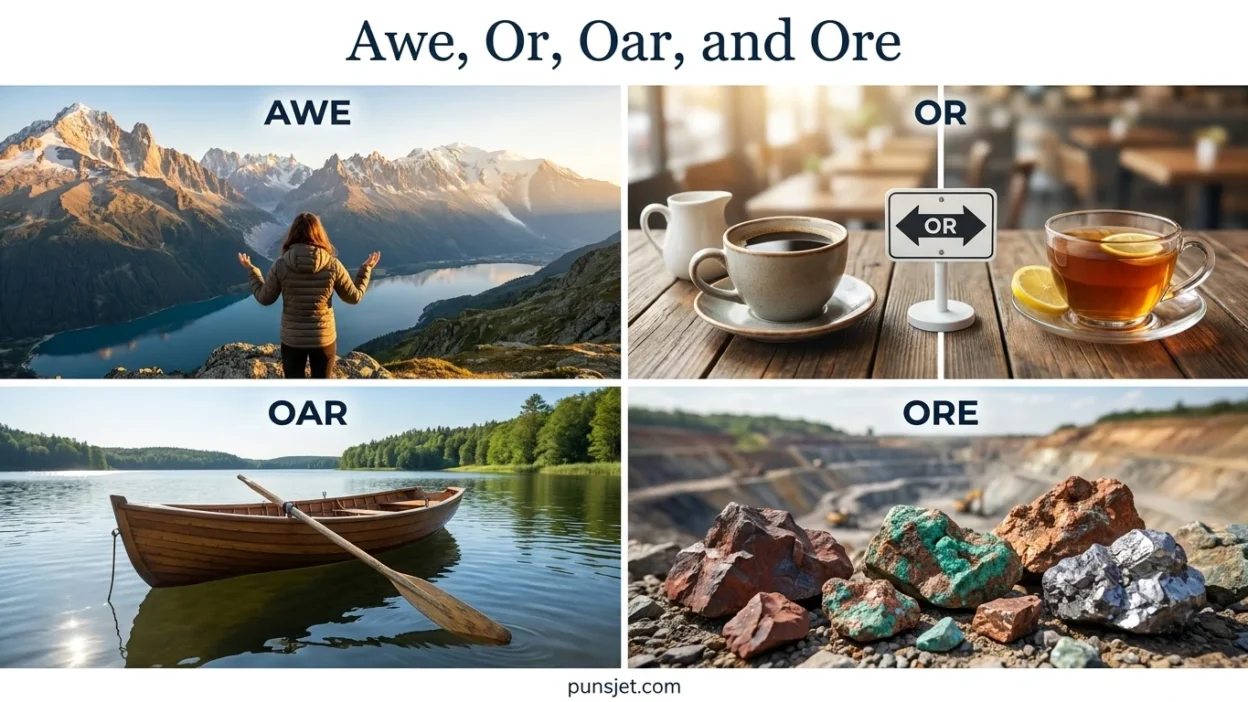
- Awe — a strong feeling of wonder, respect, or amazement.
- Or — a word used to show a choice between two or more things.
- Oar — a long pole with a flat blade used to move or steer a boat.
- Ore — rock or material from which useful metals can be taken.
Quick examples
- The beautiful view filled me with awe.
- Would you like tea or coffee?
- He used an oar to move the boat.
- The miners found iron ore.
The words awe, or, oar, and ore have different meanings even though they can sound very similar.
A Simple Background of These Words
These words come from different histories and have developed different meanings over time.
Awe is connected with an old word referring to feelings of fear, wonder, or deep respect. Today, it usually describes a powerful feeling caused by something impressive or beautiful.
Or is a very common English conjunction. It is used to connect choices or possibilities. For example, you can choose one thing or another.
Oar has been used for a long time to describe a tool used for moving boats through water. An oar usually has a long handle and a wide, flat part that pushes against the water.
Ore is connected with mining. It refers to natural rock or material that contains valuable minerals or metals that can be removed and used.
Although these words may sound alike, their meanings and uses are completely different.
What Does “Awe” Mean?
Awe means a powerful feeling of wonder, admiration, or respect.
You may feel awe when you see something extremely beautiful, huge, impressive, or unusual.
Examples
- We stood in awe of the huge waterfall.
- The children looked at the fireworks with awe.
- The beauty of the mountains filled her with awe.
- He watched the performer in awe.
Awe as a noun
Most commonly, awe is used as a noun.
For example:
The visitors looked at the ancient building with awe.
Here, awe describes the feeling the visitors experienced.
Related word: “awesome”
The word awesome comes from awe. In everyday English, awesome often means “very good” or “excellent.”
For example:
That was an awesome movie!
However, awe itself usually refers to a feeling of deep wonder or admiration.
What Does “Or” Mean?
Or is used when talking about a choice or possibility.
It often appears between two alternatives.
Examples
- Do you want rice or bread?
- Should I call you or send a message?
- Is your bag black or blue?
- You can walk or take the bus.
In each sentence, or connects choices.
“Or” can also show another possibility
For example:
We may go to the park, or we may stay home.
This means there are two possible plans.
Because or is a grammar word, it appears extremely often in everyday English.
What Does “Oar” Mean?
An oar is a long tool used to move or control a boat.
An oar usually has a long handle and a flat blade at one end. A person pushes the blade through the water to help move the boat.
Examples
- The man picked up an oar.
- She used an oar to steer the small boat.
- One oar fell into the water.
- The boat moved slowly as they pulled the oars through the water.
Oar vs. paddle
An oar and a paddle are related but are not always used in exactly the same way.
An oar is commonly used with a boat in which the oar is placed against the boat or held in a rowing position. A paddle is generally held directly by the person using it.
For basic vocabulary, remember:
Oar = a tool for moving a boat through water.
What Does “Ore” Mean?
Ore is a natural rock or material that contains a valuable mineral or metal.
People can process certain ores to obtain materials such as iron, copper, or other useful metals.
Examples
- The mine contains iron ore.
- Workers removed the ore from the ground.
- The company processes copper ore.
- The miners discovered a large amount of ore.
A simple way to remember it
Think about mining.
If something is dug out of the ground because it contains a useful metal or mineral, it may be called ore.
Awe, Or, Oar, and Ore: Comparison Table
| Word | Meaning | Part of Speech | Example |
|---|---|---|---|
| Awe | A strong feeling of wonder or admiration | Noun | The view filled us with awe. |
| Or | Shows a choice or possibility | Conjunction | Do you want tea or coffee? |
| Oar | A tool used to move or steer a boat | Noun | He grabbed an oar. |
| Ore | Rock containing useful minerals or metals | Noun | The mine produces iron ore. |
This table gives you the main difference at a glance.
Awe vs. Or
These two words are very different in meaning.
Awe describes a feeling.
Or connects choices or possibilities.
Compare:
The enormous building filled me with awe.
Here, awe is a feeling.
Would you like the red shirt or the blue one?
Here, or shows a choice.
Easy memory tip
Awe = feeling
Or = choice
Oar vs. Ore
These two words can be especially confusing because both are connected to physical things.
Oar is connected to boats and water.
Ore is connected to mining and rocks.
Compare:
The sailor lifted the oar.
The person is using a tool to move a boat.
The miners found iron ore.
The workers found material in the ground that contains iron.
Easy memory tip
Think:
Oar → Ocean
Both begin with the letter O, and an oar can be used on the water.
For ore, think:
Ore → Rock → Metal
Which One Should You Use and When?
Choosing the correct word becomes easy when you first identify what you are talking about.
Use “awe” when talking about a feeling
Use awe when something makes you feel amazed, deeply impressed, or full of wonder.
The young student looked at the giant telescope in awe.
Use “or” when giving a choice
Use or when someone can choose between possibilities.
Would you like to study English or science?
Use “oar” when talking about a boat
Use oar when referring to the tool used to move or steer a boat.
We need another oar for the boat.
Use “ore” when talking about mined material
Use ore when discussing rock or natural material that contains useful minerals or metals.
The mine produces copper ore.
Common Mistakes People Make
1. Using “ore” when you mean “oar”
Incorrect:
He picked up an ore and started rowing.
Correct:
He picked up an oar and started rowing.
The tool used for rowing is an oar.
2. Using “oar” when you mean “ore”
Incorrect:
The workers found iron oar.
Correct:
The workers found iron ore.
Iron ore is the material found in the ground.
3. Using “or” instead of “awe”
Incorrect:
The beautiful sunset filled me with or.
Correct:
The beautiful sunset filled me with awe.
The word awe describes the feeling.
4. Confusing “awe” with “awesome”
Awe and awesome are related, but they are not interchangeable.
The view filled me with awe.
The view was awesome.
The first sentence describes a feeling. The second describes something as extremely impressive or excellent.
Everyday Real-Life Examples
You can see these words in many different situations.
In school
We learned how ore is processed to obtain metals.
The students watched the science demonstration in awe.
In travel
We used an oar to move the small boat.
The view from the mountain filled us with awe.
In conversation
Would you like pizza or pasta?
In news or documentaries
The mine contains large amounts of iron ore.
On social media
Someone might write:
“I saw this incredible waterfall today. I was completely in awe!”
Another person might post:
“Should I wear the black dress or the white one?”
These examples show how different the words are despite their similar sound.
A Simple Learning Trick for Students
If you are learning English, do not try to memorize all four words as one group. Instead, connect each word with one simple idea.
Remember these four connections:
- Awe → Feeling
- Or → Choice
- Oar → Boat
- Ore → Mine
You can also create a short sentence for each:
I felt awe at the beautiful view.
Tea or coffee?
I need an oar for the boat.
The mine contains ore.
Practice saying these sentences aloud. Then make your own examples.
Mini Practice Quiz
Choose the correct word: awe, or, oar, ore.
- Would you like tea ___ coffee?
- The giant waterfall filled us with ___.
- The fisherman lost his ___ in the water.
- The workers discovered iron ___.
- We watched the fireworks in ___.
- Should we walk ___ take the bus?
Answers
- or
- awe
- oar
- ore
- awe
- or
If you can answer these correctly, you already understand the main difference.
FAQs:
1. Are awe, or, oar, and ore pronounced the same?
In many varieties of English, awe, oar, and ore can have very similar or identical pronunciations. Or may also sound similar, especially in connected speech. Pronunciation can vary by accent.
2. What does awe mean?
Awe means a strong feeling of wonder, admiration, or respect caused by something impressive.
3. What does or mean?
Or is used to connect choices or different possibilities.
4. What is an oar?
An oar is a long tool with a blade used to move or steer a boat.
5. What is ore?
Ore is rock or natural material that contains useful minerals or metals that can be extracted.
6. How can I remember oar and ore?
Remember oar = boat and ore = mine. An oar moves a boat, while ore comes from the ground.
7. Is awe a noun?
Yes. Awe is commonly used as a noun to describe a powerful feeling of wonder or admiration.
8. Why are these words confusing?
They are confusing mainly because their pronunciations can be very similar, while their spellings and meanings are completely different.
Conclusion
Awe, or, oar, and ore may sound alike or very similar, but they have four completely different meanings.
The easiest way to remember them is:
- Awe = a powerful feeling of wonder
- Or = a choice or possibility
- Oar = a tool used with a boat
- Ore = rock containing useful minerals or metals
Whenever you are unsure which spelling to use, think about the meaning first. Are you talking about a feeling, a choice, a boat, or mining material? Once you identify the meaning, the correct word becomes much easier to choose.
With a little practice, these commonly confused words will become simple and natural to use.

Joshua Paul is a creative writer and contributor at PunsJet.com who enjoys crafting witty puns and clever wordplay. With a strong sense of humor and a love for language, he creates entertaining content that readers can easily share and enjoy. Joshua’s goal is to spread laughter through fun and memorable jokes.