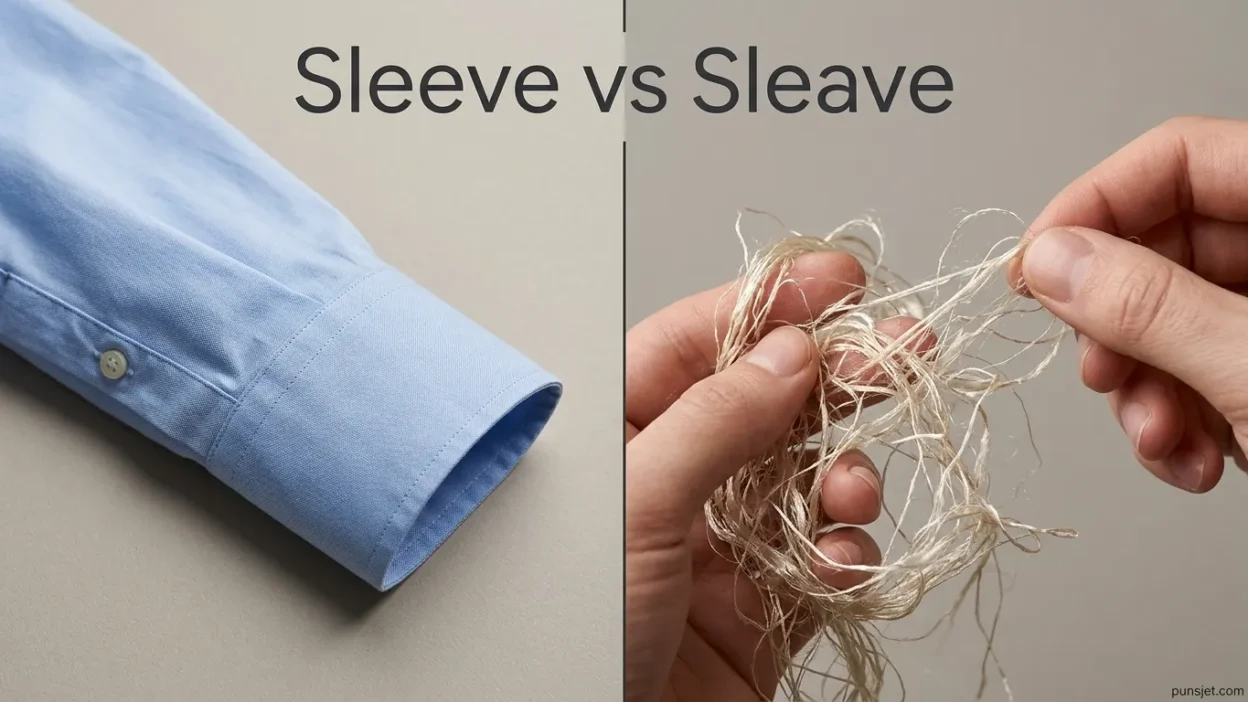
Have you ever wondered if the correct spelling is sleeve or sleave? These two words look similar, so it is easy to mix them up when writing or learning English. However, only one is the standard spelling of the word used for the part of a shirt, jacket, or other garment that covers your arm.
The correct word is sleeve. It refers to the part of a piece of clothing that covers all or part of your arm. For example, you might wear a shirt with long sleeves or a dress with short sleeves. The spelling sleave is not the standard spelling for this meaning. People may write it by mistake because its pronunciation is similar to that of sleeve. Learning the difference is simple once you remember the correct letters. In this guide, you will learn what each spelling means, see everyday examples, discover common mistakes, and find an easy way to remember the correct word.
Quick Answer: Sleeve vs Sleave
Sleeve is the correct and standard spelling for the part of a shirt, coat, or other garment that covers the arm. Sleave is generally a misspelling when used with this meaning. Write long sleeves, shirt sleeve, and sleeveless dress correctly by remembering the spelling s-l-e-e-v-e.
Why Do People Confuse Sleeve and Sleave?
People confuse sleeve and sleave because the two spellings contain nearly the same letters. They also look and sound similar when spoken quickly.
The main difference is the order of the letters. The correct spelling has two e letters together after the initial l: s-l-e-e-v-e.
The incorrect spelling sleave replaces the second letter e in the middle with a. This mistake can happen when people write from memory instead of checking the spelling.
Another reason for the confusion is that English spelling does not always follow simple pronunciation rules. When two words sound alike or look alike, learners may accidentally choose the wrong spelling.
What Does Sleeve Mean?
Sleeve is a noun that describes the part of a garment that covers the arm. It can cover the entire arm or only part of it, depending on the clothing design.
Examples of Sleeve in Everyday English
- Long sleeve: A sleeve that extends down much of the arm, often to the wrist.
- Short sleeve: A sleeve that usually ends above the elbow.
- Sleeveless: Describes clothing that has no sleeves.
- Shirt sleeve: The part of a shirt that covers the arm.
- Sleeve length: The measurement of a sleeve from one point to another.
The word can also be used in other contexts. For example, a protective sleeve may cover a document, a laptop, or another object. A record sleeve is the cover that holds a vinyl record.
Example Sentences With Sleeve
- My new shirt has a blue sleeve.
- She rolled up her sleeves before washing the dishes.
- He bought a jacket with long sleeves.
- The dress has short sleeves and a round neckline.
- I need to repair the sleeve of my coat.
In each sentence, sleeve is the correct spelling.
What Does Sleave Mean?
Sleave is not the standard spelling of the clothing word. If you want to describe the part of a shirt or jacket that covers the arm, you should write sleeve, not sleave.
However, sleave is not entirely absent from English. It is a rare, old-fashioned word associated with loosely twisted or untwisted silk thread. Most people will not encounter this use in everyday conversation.
For ordinary writing, clothing descriptions, school assignments, and general communication, the important distinction is straightforward: use sleeve for the part of a garment that covers the arm.
Examples of the Correct Usage
- Correct: The sleeve of my shirt is too long.
- Incorrect: The sleave of my shirt is too long.
- Correct: She rolled up her sleeves.
- Incorrect: She rolled up her sleaves.
The incorrect examples use a spelling that does not fit the intended clothing meaning.
Sleeve vs Sleave: Comparison Table
| Feature | Sleeve | Sleave |
|---|---|---|
| Standard spelling for clothing | Yes | No |
| Main everyday meaning | Part of clothing that covers the arm | Not used for this clothing meaning |
| Part of speech | Noun | Rarely a noun or verb in specialized historical usage |
| Common in daily English | Yes | No |
| Example | The sleeve is torn. | Incorrect if referring to a shirt sleeve |
| Best choice for ordinary writing | Yes | No, unless using its rare historical meaning |
When Should You Use Sleeve or Sleave?
Knowing when to use each spelling helps you avoid mistakes in everyday writing.
When to Use Sleeve
Use sleeve when talking about clothing or a covering designed to protect or hold something.
Examples:
- When describing a shirt: “The shirt has a white sleeve.”
- When discussing clothing sizes: “Please check the sleeve length.”
- When talking about a jacket: “The sleeve is torn.”
- When discussing a protective covering: “I put my laptop in a padded sleeve.”
- When talking about a record: “The album cover is printed on the record sleeve.”
When to Use Sleave
Use sleave only when you specifically mean the rare historical term related to loosely twisted or untwisted silk thread, or when discussing the word itself.
For example:
- The old textile description used the word sleave for a type of silk thread.
This use is uncommon and may require explanation for modern readers.
If you are writing about shirts, dresses, coats, or jackets, choose sleeve.
12 Examples of Sleeve vs Sleave in Sentences
Here are practical examples to help you recognize the correct spelling.
- Correct: My shirt has a long sleeve.
Incorrect: My shirt has a long sleave. - Correct: She rolled up her sleeves while cooking.
Incorrect: She rolled up her sleaves while cooking. - Correct: The sleeve of his jacket is wet.
Incorrect: The sleave of his jacket is wet. - Correct: I bought a dress with short sleeves.
Incorrect: I bought a dress with short sleaves. - Correct: The tailor shortened the sleeve of my coat.
Incorrect: The tailor shortened the sleave of my coat. - Correct: This shirt has a loose sleeve.
Incorrect: This shirt has a loose sleave. - Correct: He spilled coffee on his sleeve.
Incorrect: He spilled coffee on his sleave. - Correct: The sweater has sleeves that cover his hands.
Incorrect: The sweater has sleaves that cover his hands. - Correct: I placed my tablet inside a protective sleeve.
Incorrect: I placed my tablet inside a protective sleave. - Correct: The sleeve of the uniform needs a new button.
Incorrect: The sleave of the uniform needs a new button. - Correct: She prefers a sleeveless top in summer.
Incorrect: She prefers a sleaveless top in summer. - Correct in a historical textile context: The description refers to sleave, a rare term associated with silk thread.
Incorrect for clothing: The tailor repaired the sleave of the shirt.
These examples show that sleeve is the spelling you need in almost every ordinary situation involving clothing or protective coverings.
Common Mistakes With Sleeve and Sleave
Even simple words can cause spelling problems. Here are some mistakes to avoid.
1. Writing Sleave Instead of Sleeve
Incorrect: My sleeve is too short.
The sentence above is correct as written. The mistake would be writing, “My sleave is too short.”
Correct: My sleeve is too short.
2. Adding an A to the Plural
Incorrect: The jacket has two sleaves.
Correct: The jacket has two sleeves.
The plural of sleeve is sleeves, not sleaves.
3. Misspelling Sleeveless
Incorrect: She wore a sleaveless shirt.
Correct: She wore a sleeveless shirt.
The word sleeveless comes from sleeve plus -less. Keeping the correct base spelling helps you spell the longer word correctly.
4. Trusting Pronunciation Alone
A word may sound familiar without its spelling being obvious. Do not rely only on how the word sounds. Remember the standard spelling or check a dictionary when uncertain.
5. Assuming Every Similar-Looking Word Is Common
Although sleave has a rare historical use, it is not interchangeable with sleeve. A word’s existence does not mean it is appropriate in every sentence.
Memory Trick: How to Remember Sleeve
Here is an easy way to remember the correct spelling.
Think of the double E in sleeve.
The correct spelling is:
S-L-E-E-V-E
Remember the two e letters in the middle. If you are describing a shirt or jacket, use sleeve.
You can also connect the word with familiar clothing phrases:
- Long sleeves
- Short sleeves
- Roll up your sleeves
- Sleeveless shirt
Practicing these phrases will help you recognize the correct spelling naturally.
American vs British English: Sleeve or Sleave?
There is no standard American-versus-British spelling difference for this word. Both American English and British English use sleeve when referring to the part of clothing that covers the arm.
| Variety of English | Correct spelling | Example |
|---|---|---|
| American English | Sleeve | The shirt has short sleeves. |
| British English | Sleeve | The shirt has short sleeves. |
Unlike words such as color and colour, the spelling of sleeve does not change between these two varieties of English.
Whether you are writing for an American, British, Canadian, or Australian audience, sleeve is the standard choice for clothing.
Similar Words to Sleeve and Sleave
Several English words can cause similar spelling confusion. Learning their correct forms can improve your writing.
- Believe vs. Beleive: Believe is correct. Beleive is a common misspelling.
- Receive vs. Recieve: Receive is correct. Recieve is incorrect.
- Friend vs. Freind: Friend is correct. Freind is a misspelling.
- Separate vs. Seperate: Separate is correct. Seperate is a common error.
- Sleeve vs. Sleave: Sleeve is correct for the part of clothing that covers the arm.
These examples show why checking letter order matters. English words sometimes contain familiar letter combinations that are easy to mix up.
FAQs:
1. Is it sleeve or sleave?
Sleeve is correct when referring to the part of clothing that covers the arm. Sleave is not the standard spelling for this meaning.
2. Is sleave a real word?
Yes. Sleave has a rare, historical use related to loosely twisted or untwisted silk thread. However, it is not interchangeable with sleeve when discussing clothing.
3. What is the plural of sleeve?
The plural of sleeve is sleeves. For example, “My jacket has long sleeves.” Do not write sleaves when referring to more than one clothing sleeve.
4. Why do people spell sleeve as sleave?
People may confuse the words because they look and sound similar. The mistake usually comes from choosing the wrong vowel in the middle of the word.
5. Is sleeve spelled the same in American and British English?
Yes. Both American and British English use sleeve. There is no standard spelling difference between these varieties.
6. What does sleeve mean in clothing?
A sleeve is the part of a shirt, coat, dress, or other garment that covers some or all of the arm. Sleeves can be long, short, tight, loose, or designed in many other ways.
7. How can I remember the correct spelling of sleeve?
Remember the two e letters in the middle: s-l-e-e-v-e. You can also practice common phrases such as long sleeves, short sleeves, and roll up your sleeves.
Remember This
- Sleeve is the correct spelling for the part of clothing that covers the arm.
- Sleave is not correct for this everyday meaning.
- The plural of sleeve is sleeves.
- American and British English both use sleeve.
- Remember the two e letters in the middle of the word.
Conclusion
The difference between sleeve and sleave is easy to understand once you know their meanings. Sleeve is the standard spelling for the part of a shirt, jacket, or dress that covers the arm. It is also used for protective coverings, such as laptop sleeves and record sleeves. Sleave has a rare historical meaning related to silk thread, but it is not used as the ordinary clothing term.
When writing emails, school assignments, social media posts, or everyday messages, choose sleeve whenever you are talking about clothing. Remember the two e letters in its spelling, and you will be less likely to make this common mistake. A little practice with examples such as long sleeves and sleeveless shirt can help you use the correct word with confidence.

Joshua Paul is a creative writer and contributor at PunsJet.com who enjoys crafting witty puns and clever wordplay. With a strong sense of humor and a love for language, he creates entertaining content that readers can easily share and enjoy. Joshua’s goal is to spread laughter through fun and memorable jokes.