
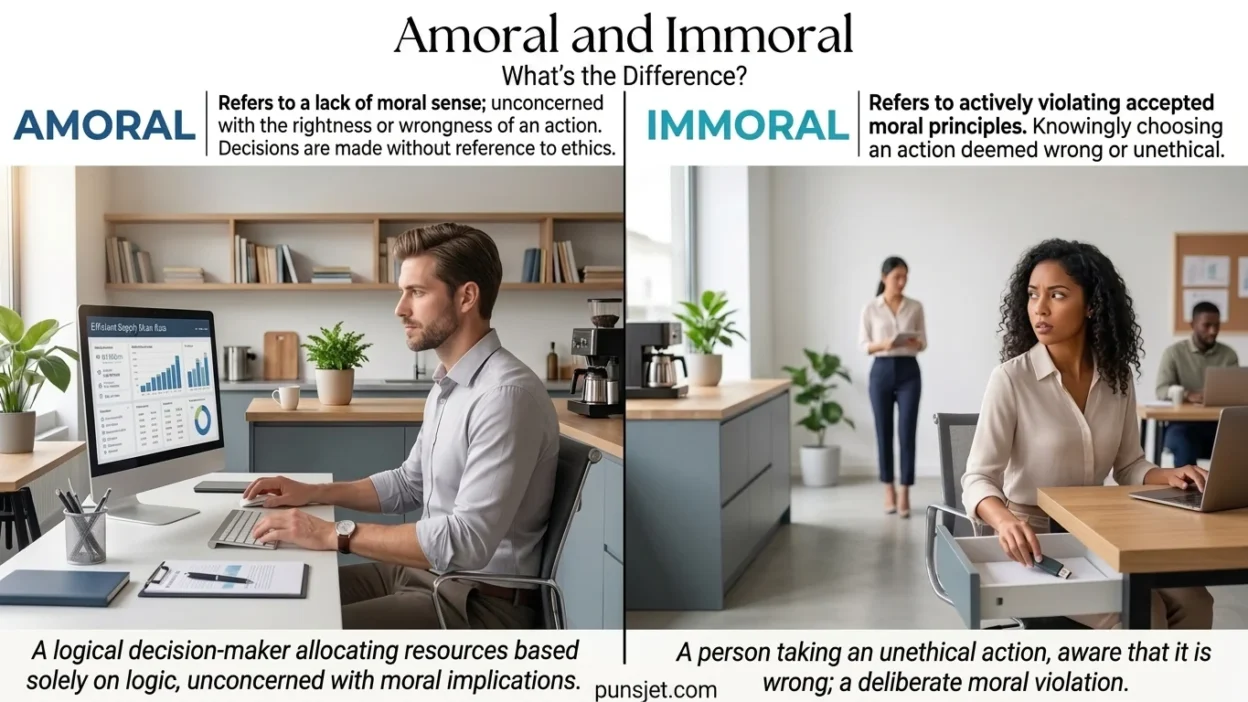
Amoral and immoral look and sound very similar, so it is easy to mix them up. Both words are connected with morality, which means ideas about what is right and wrong. However, they do not mean the same thing.
The main difference is simple:
- Amoral means not concerned with right or wrong.
- Immoral means wrong or against accepted moral standards.
For example, a small child may not understand that lying is wrong. We might describe the child as amoral about the situation because the child does not yet understand the moral idea. But if an adult knows that lying is wrong and chooses to lie to hurt someone, the action can be called immoral.
Learning this difference can help you choose the correct word when writing essays, emails, conversations, or social media posts.
Quick Answer: Amoral vs. Immoral
Here is the easiest way to remember the difference:
- Amoral = has no concern about morality.
- Immoral = violates moral rules or is considered wrong.
- Amoral does not necessarily mean bad.
- Immoral usually carries a negative meaning.
- A person, action, decision, system, or behavior can be described as immoral.
- Amoral is often used when morality is simply not part of the situation.
- Immoral suggests that someone has crossed a moral line.
- The prefix a- often means “without” or “not,” while im- in immoral means “not.”
A quick memory trick
Think of the words this way:
Amoral = without moral concern
Immoral = against morality
That one difference will help you use both words correctly.
What Do These Words Mean?
Before looking at the difference, it helps to understand the word moral.
What does “moral” mean?
Moral describes ideas or actions connected with right and wrong behavior.
For example:
- Helping someone in need can be a moral action.
- Keeping a promise is usually considered moral.
- Deliberately hurting an innocent person is generally considered immoral.
The words amoral and immoral are formed by adding different prefixes to the word moral.
What does “amoral” mean?
Amoral means not thinking about morality or not being concerned with whether something is right or wrong.
It does not automatically mean that something is bad.
For example:
“The machine is amoral.”
A machine does not have feelings or moral beliefs. It does not decide whether something is right or wrong. It simply performs the task it was designed to perform.
What does “immoral” mean?
Immoral means morally wrong or against accepted ideas of right and wrong.
For example:
“Stealing from someone is immoral.”
The sentence says that stealing is considered wrong.
The Simple Difference Between Amoral and Immoral
The easiest way to understand these words is to focus on awareness and judgment.
Amoral: No moral judgment
Something that is amoral is outside moral thinking or does not consider moral questions.
Imagine a calculator.
A calculator can tell you that 10 + 10 = 20. It does not ask whether the calculation is morally good or bad. Mathematics itself is not normally concerned with morality.
You could say:
“The calculator is amoral.”
This does not mean the calculator is evil. It simply has no moral beliefs.
The word can also describe a person who does not consider moral questions when making decisions.
Immoral: A wrong moral choice
Something that is immoral is considered morally wrong.
For example:
“Cheating on an important exam is immoral.”
The person understands that there are rules and deliberately breaks them for personal benefit.
So the key difference is:
Amoral = no moral concern
Immoral = morally wrong
Amoral vs. Immoral: Comparison Table
| Word | Meaning | Main Idea | Example |
|---|---|---|---|
| Amoral | Not concerned with right or wrong | No moral judgment | “The machine is amoral.” |
| Immoral | Morally wrong | Against accepted moral standards | “Cheating is immoral.” |
| Moral | Morally right or good | Follows accepted moral standards | “Helping others is moral.” |
Another easy way to remember
Imagine three positions:
Moral → chooses what is right
Amoral → does not consider right or wrong
Immoral → chooses or does something considered wrong
This simple picture can make the difference much easier to remember.
Where Do “Amoral” and “Immoral” Come From?
The two words use different prefixes.
The prefix “a-”
In many English words, a- can mean without or not.
For example:
- amoral = without moral concern
- atypical = not typical
- asymmetrical = not symmetrical
So amoral can be understood as “without morality” or “not concerned with morality.”
The prefix “im-”
The im- in immoral expresses the idea of not.
For example:
- immoral = not moral
- impatient = not patient
- impossible = not possible
Therefore, immoral means something that is not morally acceptable.
The prefixes give us a useful clue, but remembering the actual meanings is still important.
When Should You Use “Amoral”?
Use amoral when you want to say that someone or something does not consider morality, rather than saying that it is morally bad.
Examples
“The business decision was completely amoral; the managers focused only on profit.”
“Animals are sometimes described as amoral because they do not follow human moral rules in the same way people do.”
“The computer program is amoral. It follows its instructions without making moral judgments.”
Be careful with the word when describing people. Calling someone amoral can suggest that the person lacks concern about right and wrong, which can be a strong statement depending on the context.
When Should You Use “Immoral”?
Use immoral when you mean that an action, behavior, or decision is morally wrong.
Examples
“It is immoral to deliberately deceive people for money.”
“The company was criticized for its immoral treatment of workers.”
“Many people believe that cheating is immoral.”
The word immoral clearly expresses moral disapproval.
Common Mistakes People Make
Mistake 1: Thinking “amoral” means “very bad”
This is one of the most common mistakes.
Amoral does not simply mean bad.
It means that morality is not being considered or does not apply.
Compare:
“The machine is amoral.”
This means the machine has no moral judgment.
But:
“The act was immoral.”
This means the act was morally wrong.
Mistake 2: Using “amoral” when you mean “immoral”
Someone might say:
“Stealing is amoral.”
If the intended meaning is “stealing is wrong,” then immoral is the better word.
Correct:
“Stealing is immoral.”
Mistake 3: Thinking “immoral” means “without morals”
Although immoral means “not moral,” it usually describes behavior or choices that go against moral standards.
If you want to emphasize a lack of concern about morality, amoral may be more appropriate.
Mistake 4: Assuming every amoral thing is bad
A thing can be amoral without being good or bad.
For example, a calculator, a rock, or a mathematical formula does not normally make moral decisions.
They are not “bad.” Morality simply does not apply to them in the ordinary sense.
Everyday Real-Life Examples
Understanding these words becomes easier when you see them in ordinary situations.
In an email
“The manager’s decision was considered immoral because it deliberately harmed employees.”
Here, immoral means the decision was viewed as morally wrong.
Another example:
“The software is amoral and simply follows the rules given to it.”
Here, amoral means the software does not make moral judgments.
In the news
You may see sentences such as:
“The politician was accused of immoral behavior.”
This means the behavior was considered morally wrong.
You might also read about an organization making decisions based only on money or efficiency. In that situation, an article might describe the approach as amoral if moral concerns were ignored.
On social media
Someone might write:
“Lying to your friends for personal gain is immoral.”
Another person might say:
“Technology itself is amoral; people decide how to use it.”
The second sentence does not say that technology is bad. It says technology itself does not have a moral position.
In daily conversation
You could say:
“Eating ice cream is not a moral issue.”
You would not normally call eating ice cream immoral or amoral in ordinary conversation. Sometimes the best choice is simply to say that something is not a moral issue.
Amoral vs. Immoral: More Examples
Here are some examples to make the difference even clearer:
Amoral
- “The robot does not understand human morality, so it is amoral.”
- “The machine makes decisions according to its programming, not moral beliefs.”
- “The scientific formula itself is amoral.”
- “The child was too young to understand the moral meaning of the action.”
Immoral
- “The man stole money from an elderly person, which was immoral.”
- “Many people consider deliberate cruelty to be immoral.”
- “The company was accused of immoral business practices.”
- “Cheating people for personal profit is widely viewed as immoral.”
Notice that amoral focuses on the absence of moral concern, while immoral focuses on moral wrongdoing.
A Simple Learning Trick for Students
If you are an ESL learner or beginner, use this short method.
Step 1: Ask, “Is the action wrong?”
If the answer is yes, immoral may be the correct word.
“Stealing is immoral.”
Step 2: Ask, “Is morality simply not being considered?”
If the answer is yes, amoral may be the correct word.
“The machine is amoral.”
Step 3: Remember the prefixes
A = without
Im = not
So:
Amoral → without moral concern
Immoral → not moral / morally wrong
Try this mini-test
Which word fits?
- “The robot has no understanding of right and wrong.”
Answer: amoral - “Cheating someone for money is morally wrong.”
Answer: immoral - “The computer follows instructions without judging them.”
Answer: amoral - “Hurting an innocent person for pleasure is morally wrong.”
Answer: immoral
If you can answer these, you already understand the basic difference.
FAQs:
1. Does amoral mean bad?
No. Amoral means not concerned with morality or not making a moral judgment. It does not automatically mean something is bad.
2. Does immoral mean wrong?
Yes. Immoral generally means morally wrong or against accepted moral standards.
3. Is a robot amoral?
A robot can be described as amoral because it does not have human moral beliefs in the usual sense. It follows its programming rather than making moral judgments like a person.
4. Is stealing amoral or immoral?
If you mean that stealing is morally wrong, the correct word is immoral.
“Stealing is immoral.”
5. Can a person be amoral?
Yes. Amoral can describe a person who does not consider moral questions or does not care about whether something is right or wrong. The exact meaning depends on the context.
6. Can an action be amoral?
Yes, when the action is viewed as outside moral judgment or done without moral consideration. However, amoral is not simply another word for “neutral” in every situation.
7. What is the easiest way to remember amoral and immoral?
Remember:
Amoral = no moral concern
Immoral = morally wrong
8. What is the opposite of immoral?
The most direct opposite is moral, meaning morally right or acceptable.
Final Conclusion
Amoral and immoral are similar-looking words, but their meanings are different.
Amoral means not concerned with morality or not making a judgment about right and wrong. It does not automatically mean something is bad.
Immoral means morally wrong or against accepted standards of right and wrong.The easiest memory trick is:
When you are unsure which word to use, ask yourself one simple question: “Am I talking about a lack of moral concern, or am I saying something is wrong?”
If you mean a lack of moral concern, choose amoral. If you mean that something is morally wrong, choose immoral.
Once you understand this small difference, these two confusing words become much easier to use correctly in everyday English.

Donald Andrew is the creative mind behind PunsJet.com, where he shares clever wordplay and humorous puns for readers around the world. With a passion for language and comedy, Donald enjoys crafting witty jokes that bring smiles to everyday conversations. His goal is to make humor simple, fun, and easy to share.