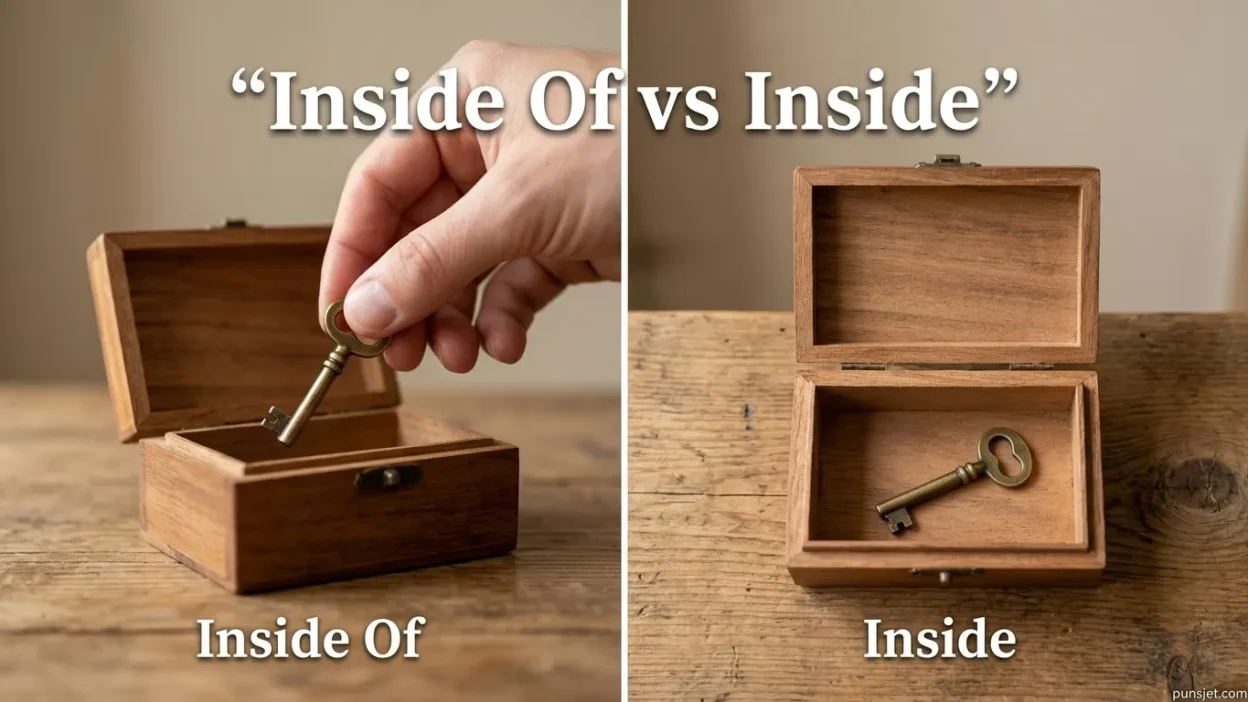
The phrases “inside of” and “inside” are both used in English to describe something that is within a place, object, or area. However, choosing between them can sometimes be confusing. Should you say “The keys are inside the drawer” or “The keys are inside of the drawer”? Both sentences are grammatically correct, but one is shorter and often sounds more natural.
Understanding the difference between inside and inside of can help you speak and write more clearly. Although these expressions often have the same meaning, their use can depend on the sentence, the situation, and the style of English you prefer. In everyday conversations, people commonly use both forms, while shorter wording is often preferred in formal writing.
In this guide, you will learn what inside and inside of mean, when to use each expression, and how they work in real sentences. You will also find practical examples, common mistakes, and simple tips to help you choose the right phrase with confidence.
Quick Answer: Inside Of vs Inside
“Inside” and “inside of” can both mean within something or in the interior of a place. For example, “The cat is inside the house” and “The cat is inside of the house” are both correct. Inside is generally shorter and more direct, while inside of is common in conversational American English. Choose the expression that sounds natural in your sentence.
Why Do People Confuse Inside Of and Inside?
People confuse these expressions because they often describe the same location. Both can tell us that someone or something is within a building, container, room, or enclosed space.
For example:
- The phone is inside the bag.
- The phone is inside of the bag.
Both sentences communicate the same basic idea. The difference is not usually about meaning but about wording and style.
Another reason for the confusion is that English uses prepositions in different ways. Sometimes, adding a word changes a sentence’s meaning. In this case, however, adding “of” usually does not change the meaning when inside and inside of describe a location.
1. What Does Inside Mean?
Inside means within the boundaries or interior of something. It can refer to a physical place, an enclosed object, or even a person’s thoughts and feelings.
Inside can function as a preposition, an adverb, an adjective, or a noun, depending on how it is used.
Inside as a Preposition
When inside is followed by a noun, it shows where someone or something is located.
Examples:
- The children are inside the classroom.
- I left my wallet inside the car.
- There is a letter inside the envelope.
- She waited inside the building.
In each sentence, inside tells us where something or someone is.
Inside as an Adverb
Inside can also stand alone without a noun immediately following it.
Examples:
- It is raining, so let’s go inside.
- The dog stayed inside all day.
- Please come inside.
Here, inside describes a direction or location without naming the place directly.
Inside as an Adjective or Noun
Inside can also describe an inner part or refer to the interior of something.
Examples:
- The inside pocket is empty.
- The inside of the box is clean.
- The inside walls need painting.
These examples show that inside is a flexible word that works in several grammatical roles.
2. What Does Inside Of Mean?
Inside of usually means within the boundaries or interior of something. In this expression, inside is followed by the preposition of and then a noun or noun phrase.
Examples:
- The keys are inside of the drawer.
- We stayed inside of the house during the storm.
- There is a small gift inside of the package.
- The children played inside of the room.
These sentences are grammatically acceptable. In many cases, you can remove of without changing the basic meaning.
Is Inside Of Informal?
Inside of is common in everyday American English, particularly in conversation. Some speakers naturally use the longer expression without giving it any special emphasis.
For example:
- Put the groceries inside of the refrigerator.
- I found my old photographs inside of a box.
However, inside the refrigerator and inside a box are shorter alternatives that work just as well.
In formal writing, the shorter form is often a good choice when it communicates the same meaning clearly. Still, inside of is not automatically incorrect or unsuitable in every formal context.
Can Inside Of Mean Something Else?
Yes. In some sentences, inside of can refer to a period of time or a limit.
For example:
- We should finish the work inside of two hours.
- You must submit the form inside of seven days.
These sentences use inside of to mean within a specified time limit. In many contexts, “within two hours” and “within seven days” are more concise and natural alternatives.
3. Inside Of vs Inside: Comparison Table
| Feature | Inside | Inside Of |
|---|---|---|
| Basic meaning | Within something | Within something |
| Grammar | Can be a preposition, adverb, adjective, or noun | Commonly a prepositional phrase |
| Example | The cat is inside the box. | The cat is inside of the box. |
| Length | Shorter | Longer |
| Everyday conversation | Very common | Common, especially in American English |
| Formal writing | Often preferred for directness | Sometimes appropriate, depending on context |
| Can stand alone? | Yes, as in “Come inside.” | Usually needs a following noun or phrase |
| Meaning difference | Usually none when describing location | Usually none when describing location |
The main point is that both expressions can be correct. The best choice depends on how the phrase functions in the sentence and which wording sounds clearest.
4. When Should You Use Each?
Knowing when to use inside and inside of is easier when you consider the type of sentence you are writing.
When to Use Inside
Use inside when you want a short, clear expression of location.
1. In everyday writing
- The book is inside the backpack.
- Your lunch is inside the refrigerator.
2. In formal or professional communication
- The documents are inside the folder.
- Please remain inside the designated area.
3. When the word stands alone
- Come inside before it gets dark.
- The children are already inside.
4. When describing an interior
- The inside wall is damaged.
- The inside of the building is quiet.
Inside is especially useful when you want to avoid unnecessary words.
When to Use Inside Of
Use inside of when it fits your natural speaking style or when you want to retain the wording of a conversational sentence.
1. In casual conversation
- I left my jacket inside of the car.
- The cat is hiding inside of the closet.
2. When speaking naturally
- We waited inside of the restaurant.
- There is something inside of this package.
3. When discussing a time limit
- The delivery should arrive inside of an hour.
In the last example, “within an hour” is generally a more concise alternative.
Remember that you do not need to add of simply because a noun follows inside. “Inside the house” is already correct.
5. Inside Of vs Inside: 12 Examples
The following examples show how both expressions work in everyday situations.
| No. | Using Inside | Using Inside Of |
|---|---|---|
| 1 | The dog is inside the house. | The dog is inside of the house. |
| 2 | I found money inside the drawer. | I found money inside of the drawer. |
| 3 | The food is inside the refrigerator. | The food is inside of the refrigerator. |
| 4 | She waited inside the office. | She waited inside of the office. |
| 5 | The keys are inside my bag. | The keys are inside of my bag. |
| 6 | There is a note inside the book. | There is a note inside of the book. |
| 7 | The children are playing inside the room. | The children are playing inside of the room. |
| 8 | We stayed inside the hotel. | We stayed inside of the hotel. |
| 9 | The gift is inside the box. | The gift is inside of the box. |
| 10 | He put the letter inside the envelope. | He put the letter inside of the envelope. |
| 11 | The cat sleeps inside the basket. | The cat sleeps inside of the basket. |
| 12 | I found my phone inside the car. | I found my phone inside of the car. |
Both columns contain acceptable sentences when the phrases describe location. In most of these examples, the meaning stays the same.
Examples in Different Situations
In an email:
“The signed contract is inside the attached folder.”
In everyday conversation:
“Your shoes are inside of the closet.”
In a classroom:
“Please keep your books inside your desk.”
In a news report:
“Rescue workers searched inside the damaged building.”
These examples demonstrate that inside is suitable for casual, academic, and professional communication.
6. Common Mistakes With Inside Of and Inside
Even though both expressions are straightforward, a few mistakes are worth avoiding.
Mistake 1: Thinking Inside Of Is Always Wrong
Incorrect assumption: “Inside of” is never grammatically correct.
Correction: Inside of is an established expression and is commonly used, especially in conversational American English.
Example:
“The wallet is inside of the bag.”
This sentence is acceptable, although “inside the bag” is shorter.
Mistake 2: Adding Of Every Time
Some learners assume that inside must always be followed by of before a noun.
Incorrect: “The children are inside of the classroom” is the only correct form.
Correct: “The children are inside the classroom” is also correct.
You can use inside directly before a noun to describe location.
Mistake 3: Using Inside Of Without a Clear Purpose
In concise writing, adding of can make a sentence longer without making its meaning clearer.
Wordy: “The documents are located inside of the cabinet.”
More concise: “The documents are inside the cabinet.”
Both are understandable, but the second version is more direct.
Mistake 4: Confusing Inside With Into
Inside and into do not always mean the same thing.
- The cat is inside the room. (Location)
- The cat ran into the room. (Movement)
Use inside to describe where something is. Use into when emphasizing movement from outside to within a place.
Mistake 5: Assuming Inside Of Always Refers to Location
Inside of can also express a time limit in certain contexts.
Example:
“We completed the task inside of three hours.”
However, “We completed the task within three hours” is often the clearer choice.
7. Memory Trick: How to Remember the Difference
Use this simple memory trick:
Inside = shorter wording. Inside of = inside + an extra word.
Both usually describe the same location, so you can often remove of without changing the meaning.
Try these examples:
- Inside the box → correct.
- Inside of the box → also correct.
- Come inside → correct.
- Come inside of → incomplete in ordinary usage when no following noun or phrase is supplied.
A useful question to ask yourself is: “Does adding of make my sentence clearer?”
If the answer is no, choose inside. This simple habit can make your writing more natural and concise.
8. American vs British English
Both inside and inside of are understood in American and British English. Neither expression belongs exclusively to one variety.
However, inside of is particularly familiar in conversational American English, while inside is a concise choice in both varieties.
Examples in American English:
- The kids are inside of the house.
- Put the groceries inside the fridge.
Examples in British English:
- The children are inside the house.
- Put the shopping inside the fridge.
These are tendencies, not strict regional rules. American and British speakers may use either expression depending on their personal speaking style and the context.
For formal writing in either variety, inside is often a straightforward choice when referring to a physical location.
9. Similar Words and Expressions
Several related words can help you describe locations, movement, or limits more accurately.
Within
Within means inside a boundary, area, or limit. It can also refer to a period of time.
Example: “Please respond within two days.”
Into
Into usually describes movement toward or across the boundary of something.
Example: “She walked into the room.”
Indoors
Indoors means inside a building or other enclosed place. It can stand alone.
Example: “We stayed indoors because of the rain.”
Interior
Interior refers to the inner part of a place or object. It is often used as a noun or adjective.
Example: “The interior of the car is clean.”
In
In is another common preposition that can describe location.
Example: “The keys are in the drawer.”
Inside Out
Inside out means with the inner surface facing outward, or it can describe knowing something very thoroughly.
Examples:
- He wore his shirt inside out.
- She knows the subject inside out.
Choosing the correct expression depends on whether you are describing location, movement, a boundary, or a different relationship.
10. Final Verdict: Inside Of or Inside?
Both inside and inside of are correct when they describe something located within a place or object.
Use inside when you want a short, clear, and direct sentence. It works well in everyday conversation, academic writing, business communication, and formal documents.
Use inside of when it fits your conversational style or when the longer expression sounds natural in context. It is especially common in American speech.
For example, “The keys are inside the drawer” and “The keys are inside of the drawer” both communicate the same location.
The easiest rule is to use inside by default. Add of when you prefer that expression, not because grammar requires it in every sentence.
FAQs:
1. Is inside of grammatically correct?
Yes. Inside of is grammatically correct in sentences such as “The cat is inside of the house.” In this usage, it usually means the same thing as inside the house.
2. Is inside or inside of better?
Inside is often the better choice when you want concise writing. Inside of is also acceptable and common in conversation. Neither is universally better in every context.
3. Can I use inside of in formal writing?
Yes, but consider whether the extra word is necessary. In many formal sentences, inside is shorter and equally clear. Choose the wording that best fits the sentence.
4. What is the difference between inside and inside of?
When describing location, there is usually no difference in meaning. Both indicate that someone or something is within a place or object. The main difference is wording and style.
5. Is inside of American English?
Inside of is widely used in American English, particularly in conversation. However, it is not exclusive to the United States. Speakers of British English also understand and may use it.
6. Should I say “inside the house” or “inside of the house”?
Both are correct. “Inside the house” is shorter and more direct, while “inside of the house” is also natural in many conversations.
7. Is “come inside of” correct?
Usually, you would say “come inside” when asking someone to enter a building or room. Inside of normally needs a following noun or phrase in this construction, such as “come inside of the building,” although that wording is less concise than “come inside the building.”
8. Is inside the same as into?
No. Inside usually describes a location, while into generally describes movement toward or within a place.
For example, “She is inside the room” describes her location. “She walked into the room” describes her movement.
Remember This
- Inside is shorter and direct.
- Inside of is also correct when describing location.
- Both expressions usually have the same meaning.
- Inside is often preferred for concise formal writing.
- Inside of is common in conversational American English.
- Use into when describing movement rather than simply location.
Conclusion
The difference between inside of and inside is mainly about style, not meaning. When you describe something located within a room, building, container, or other enclosed space, both expressions can be correct. For example, “The book is inside the bag” and “The book is inside of the bag” communicate the same basic information. Understanding this similarity makes it easier to choose the right expression without overthinking your grammar.
For most situations, inside is a simple and reliable choice because it keeps your sentences clear and concise. However, there is no need to avoid inside of when it sounds natural in conversation. Focus on the meaning of your sentence, the audience you are writing for, and the level of formality you need. With practice, you will be able to use both expressions confidently and naturally.

Joshua Paul is a creative writer and contributor at PunsJet.com who enjoys crafting witty puns and clever wordplay. With a strong sense of humor and a love for language, he creates entertaining content that readers can easily share and enjoy. Joshua’s goal is to spread laughter through fun and memorable jokes.