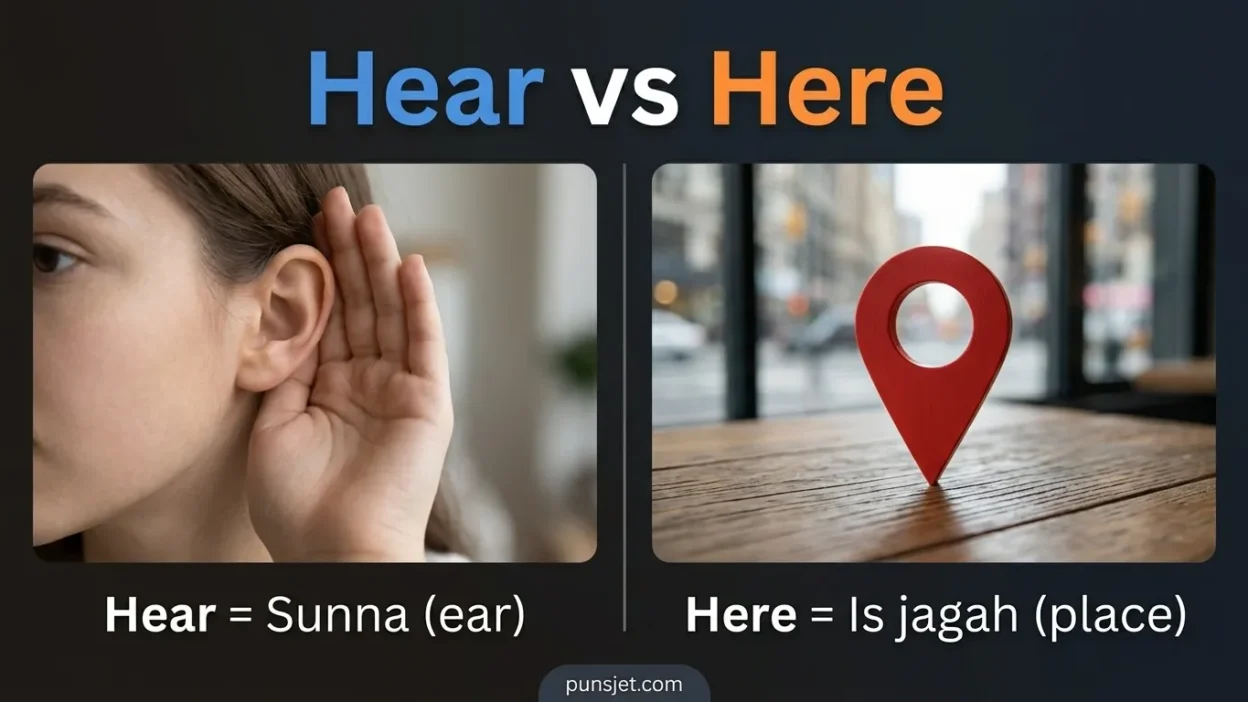
The words hear vs here can be confusing because they sound exactly the same but have completely different meanings. Both words are common in everyday English, schoolwork, conversations, emails, and social media posts. However, using the wrong word can change the meaning of your sentence or make your writing unclear.
The main difference is simple: hear is related to listening and sound, while here refers to a place or location. For example, “I can hear the birds” means you can notice the birds’ sounds. On the other hand, “Come here” means someone should come to your location. Once you understand this difference, choosing the correct word becomes much easier.
In this guide, you will learn the meanings of hear and here, their grammatical uses, common mistakes, and practical examples. You will also discover a simple memory trick to help you remember which word to use whenever you write or speak English.
Quick Answer: What Is the Difference Between Hear and Here?
Hear means to notice or receive a sound with your ears. Here means in, at, or to this place. These words are homophones because they have the same pronunciation but different meanings and spellings. Use hear when talking about sounds and here when talking about locations.
Why Do People Confuse Hear and Here?
People often confuse hear and here because both words sound the same in standard English pronunciation. When speaking, listeners usually understand the intended meaning from the sentence. In writing, however, you must choose the correct spelling.
These words are examples of homophones. Homophones are words that sound alike but have different meanings and sometimes different spellings.
For example:
- “Did you hear that noise?” asks whether someone noticed a sound.
- “Did you come here yesterday?” asks whether someone visited this place.
The context helps you understand which word is correct. Remembering the difference between sound and location makes it easier to avoid mistakes.
What Does Hear Mean?
Hear is a verb that means to notice, receive, or become aware of a sound through your ears. You can hear a person speaking, music playing, a phone ringing, or birds singing.
You can hear something without deliberately listening to it. For example, you might hear traffic outside while reading a book.
Examples of Hear in Sentences
- I can hear someone knocking on the door.
- Did you hear the announcement?
- We hear music coming from the next room.
- She wants to hear your opinion.
- I heard a strange noise last night.
- Have you heard the good news?
Different Forms of Hear
Hear is an irregular verb, so its past forms do not follow the usual pattern of simply adding -ed.
| Verb form | Example |
|---|---|
| Base form: hear | I hear the birds. |
| Third-person singular: hears | He hears the alarm. |
| Past tense: heard | I heard your message. |
| Past participle: heard | She has heard the news. |
| Present participle: hearing | We are hearing a strange sound. |
Important: The past tense of hear is heard, not heared.
What Does Here Mean?
Here is an adverb that usually refers to the place where the speaker or writer is. It can mean in this place, at this place, or to this place.
For example, when you say, “Your keys are here,” you mean the keys are in this location. When you say, “Come here,” you are asking someone to move toward you.
Here can also appear in expressions that introduce information or identify something being offered.
Examples of Here in Sentences
- Please sit here beside me.
- I live here with my family.
- Your notebook is here on the table.
- Come here and look at this picture.
- Here is the book you requested.
- We are happy to be here today.
Common Expressions With Here
- Here and there: In different places.
- Here you are: An expression used when giving someone something.
- Here we go: An expression used when something is starting or happening again.
- From here: Starting at this place.
- Over here: In a nearby or indicated location.
- Here is: Used to introduce or present something.
For example, “Here is your coffee” means the speaker is presenting the coffee to you.
Hear vs Here: Comparison Table
| Feature | Hear | Here |
|---|---|---|
| Meaning | To notice or receive sound | In, at, or to this place |
| Part of speech | Verb | Usually an adverb |
| Main idea | Sound or listening | Place or location |
| Pronunciation | /hɪr/ | /hɪr/ |
| Past tense | Heard | No verb tense |
| Example | I hear a dog barking. | The dog is here. |
| Memory clue | Ears and sound | A place nearby |
The easiest way to remember the difference is that hear is about sound, while here is about place.
When Should You Use Hear or Here?
Choose the word based on what you want to communicate.
When to Use Hear
Use hear when your sentence describes sounds, receiving spoken information, or becoming aware of what someone says.
Examples:
- I can hear the rain falling.
- Did you hear what the teacher said?
- I want to hear your ideas.
- We heard the news this morning.
- Can you hear me clearly on the phone?
Hear can also describe receiving information or being told something. For example, “I hear that the shop is closing” means you have received that information.
When to Use Here
Use here when referring to a location, a place near the speaker, or something being presented.
Examples:
- Your bag is here.
- Please come here for a moment.
- We have lived here for five years.
- Here is your appointment reminder.
- Put the box here, please.
A useful question to ask yourself is: Am I talking about a sound or a place? If you mean a sound, choose hear. If you mean a place, choose here.
15 Examples of Hear vs Here in Sentences
These examples show how the two words work in everyday English.
- Hear: I can hear the birds singing outside.
- Here: Please wait here until I return.
- Hear: Did you hear the phone ring?
- Here: Your phone is right here on the desk.
- Hear: I heard an interesting story yesterday.
- Here: We are here to help you.
- Hear: Can you hear what I am saying?
- Here: Come here and see this beautiful painting.
- Hear: She wants to hear your explanation.
- Here: The information you need is here.
- Hear: We heard thunder during the storm.
- Here: Leave your shoes here by the door.
- Hear: I have never heard that song before.
- Here: Here is the answer to your question.
- Hear: You should hear both sides of the story before deciding.
Examples Using Both Words
Using hear and here in the same sentence is a useful way to remember their different meanings.
- I can hear you clearly from here.
- Come here if you want to hear the announcement.
- We could hear the music from here.
- Stay here so you can hear the speaker.
- I can hear the birds singing right here in the garden.
In each example, hear relates to sound, while here identifies a place.
Common Mistakes With Hear and Here
Even fluent English speakers can make spelling mistakes when typing quickly. These are some common errors to avoid.
Mistake 1: Writing Here When You Mean Hear
Incorrect: I can here the music.
Correct: I can hear the music.
Why? The sentence describes noticing a sound, so hear is the correct verb.
Mistake 2: Writing Hear When You Mean Here
Incorrect: Please come hear.
Correct: Please come here.
Why? The speaker wants someone to move to a particular location.
Mistake 3: Confusing Them in Questions
Incorrect: Did you here what I said?
Correct: Did you hear what I said?
Why? The question asks whether someone received spoken information.
Mistake 4: Using Hear in a Location Expression
Incorrect: Your seat is hear.
Correct: Your seat is here.
Why? The sentence identifies where the seat is located.
Mistake 5: Forgetting That Hear Has Irregular Verb Forms
Incorrect: I heared a loud noise.
Correct: I heard a loud noise.
Why? Hear is an irregular verb. Its past tense and past participle are both heard.
What Is an Easy Memory Trick for Hear vs Here?
Use this simple memory trick:
- Hear = Ears: The word hear contains the letters ear, which can remind you of your ears and the sounds you notice.
- Here = Place: Imagine pointing to the ground beside you and saying, “I am here!”
Remember these two short sentences:
“I hear with my ears.”
“I am here in this place.”
You can also test yourself by replacing the word with a related phrase. If listen to or notice a sound makes sense, use hear. If in this place or come to this place makes sense, use here.
Hear vs Here in American and British English
There is no meaningful difference between American and British English in the basic spelling or meaning of hear and here. Both varieties use hear for sound and here for location.
Both words are generally pronounced the same in standard American and British English, although accents may affect the exact vowel sound.
Examples in both varieties:
- I can hear the announcement.
- Please come here.
- We heard the news yesterday.
The spelling difference between American and British English does not affect these words. Unlike pairs such as color and colour, hear and here are spelled the same in both varieties.
What Words Are Similar to Hear and Here?
Understanding related words can help you use hear and here more accurately.
Words Related to Hear
- Listen: To pay attention to sounds deliberately.
- Sound: Something that can be heard.
- Overhear: To hear something without intending to.
- Audible: Able to be heard.
- Heard: The past tense and past participle of hear.
Example: “I heard the music” means the sound reached your ears. “I listened to the music” suggests that you paid attention to it.
Words Related to Here
- There: In or at another place.
- Where: In or at what place.
- Nearby: Not far away.
- Hereabouts: In this general area.
- Hither: Toward this place; an old-fashioned word.
Example: “Your bag is here” identifies its location, while “Your bag is there” points to another location.
Hear vs Listen
Hear and listen are related, but they are not identical. Hear often describes receiving a sound, while listen usually means paying attention to it.
- I can hear the radio from my bedroom.
- I listen to the radio every morning.
Here vs There
Here usually refers to the speaker’s location, while there usually refers to a different or indicated place.
- Come here and sit beside me.
- Put the box there near the window.
FAQs:
1. Is it hear or here?
Both spellings are correct, but their meanings differ. Hear relates to sound, while here refers to a place. Write “I can hear you” when talking about sound and “Come here” when asking someone to move to your location.
2. What is the difference between hear and here?
Hear is a verb meaning to notice or receive a sound. Here is usually an adverb that refers to a place. For example, “I hear music” describes sound, while “The music is here” identifies a location.
3. Are hear and here homophones?
Yes. Hear and here are homophones because they have the same pronunciation in standard English but different meanings and spellings. Their meaning in a sentence determines which word is correct.
4. How do you use hear in a sentence?
Use hear when talking about noticing sounds or receiving spoken information. For example, “I can hear the birds outside.” Its past tense is heard, as in “I heard the birds this morning.”
5. How do you use here in a sentence?
Use here to indicate a place, usually the speaker’s location. For example, “Please leave your bag here.” You can also use it to introduce something, as in “Here is your receipt.”
6. Is hear a verb and here an adverb?
Hear is a verb. Here is usually an adverb of place, as in “Stay here.” It can also function as an introductory word in expressions such as “Here comes the bus.”
7. What is the easiest way to remember hear vs here?
Connect hear with ears because hearing involves sound. Connect here with place because it tells you where someone or something is. Remember: “I hear with my ears, and I am here in this place.”
Remember This
- Hear = Sound: I can hear the birds.
- Here = Place: The birds are here.
- Heard = Past tense of hear: I heard the birds yesterday.
- Hear and here = Homophones: They sound alike but have different meanings.
When you are unsure which word to use, ask yourself whether your sentence is about a sound or a location. That simple check will help you choose the right spelling.
Conclusion
The difference between hear and here is easy to understand once you connect each word with its meaning. Hear is a verb used for sounds, listening, and receiving spoken information. Here usually identifies a place or tells someone where to go. Although both words sound alike, they cannot be used interchangeably because they communicate different ideas.
To remember the difference, think of your ears whenever you see hear and a location whenever you see here. Practise using both words in short sentences, such as “I can hear you from here.” With regular practice, you will find it easier to spell these common words correctly in conversations, school assignments, emails, and everyday writing.

Joshua Paul is a creative writer and contributor at PunsJet.com who enjoys crafting witty puns and clever wordplay. With a strong sense of humor and a love for language, he creates entertaining content that readers can easily share and enjoy. Joshua’s goal is to spread laughter through fun and memorable jokes.