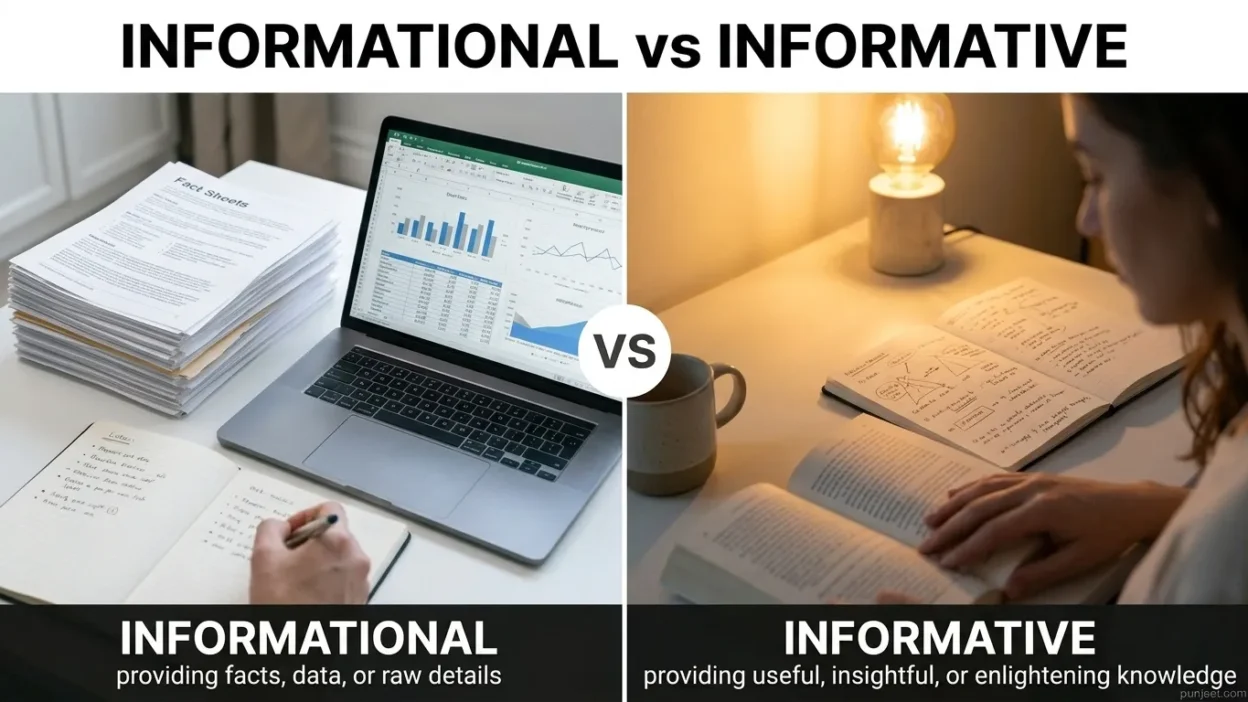
The words informational and informative are closely related, so many English learners use them as if they mean exactly the same thing. Both words connect to information, knowledge, and learning. However, they have slightly different meanings and are more natural in different situations.
Informational usually describes something that provides information or is designed to share facts. Informative describes something that teaches you something useful, gives you knowledge, or helps you understand a topic better. For example, an informational notice may tell you about a school event, while an informative presentation may explain why the event matters. Both words are correct, but the best choice depends on what you want to say. Understanding this small difference can help you write clearer emails, improve your school assignments, and communicate more naturally in everyday English.
Quick Answer
Informational means related to or intended to provide information. Informative means providing useful knowledge or helping someone learn something. An informational sign gives details, while an informative lesson helps students understand a subject. The words often overlap, but their emphasis is slightly different.
Why Do People Confuse Informational and Informative?
People confuse these words because both come from the word information. They also describe things that communicate facts, explain subjects, or help people learn.
For example, an informational article and an informative article can both explain a subject. The difference is mainly in emphasis:
- Informational: Focuses on providing information or facts.
- Informative: Focuses on how much useful knowledge or understanding something provides.
In many situations, either word is acceptable. The choice depends on the meaning you want to emphasize.
What Does Informational Mean?
Informational is an adjective that means related to information or intended to provide information.
It commonly describes materials, signs, pages, documents, and resources that share facts, instructions, or details about a subject.
Examples of Informational
- The school created an informational brochure for new students.
- We attended an informational meeting about the new rules.
- The website has an informational page about its services.
- An informational sign explains the museum’s opening hours.
- The company sent an informational email about the upcoming changes.
In these examples, the main purpose is to provide details or communicate information.
When Is Informational the Best Choice?
Use informational when you want to describe the purpose, type, or function of something that provides information.
Common combinations include:
- Informational brochure
- Informational website
- Informational meeting
- Informational document
- Informational sign
- Informational resources
- Informational email
Easy tip: If something is designed to give people facts or details, informational is often a good choice.
What Does Informative Mean?
Informative is an adjective that means providing useful information, knowledge, or understanding.
It often describes something that teaches you something, explains a topic clearly, or gives you valuable facts.
Examples of Informative
- The teacher gave an informative lesson about climate change.
- I watched an informative video about healthy eating.
- Her presentation was clear and informative.
- The book is short but very informative.
- We had an informative discussion about local history.
In these examples, the focus is on the knowledge or understanding that people gain.
When Is Informative the Best Choice?
Use informative when you want to emphasize that something is useful, educational, enlightening, or full of helpful details.
Common combinations include:
- Informative article
- Informative presentation
- Informative video
- Informative discussion
- Informative lecture
- Informative report
- Informative speech
Easy tip: If something helps people understand or learn about a subject, informative is often the better choice.
Informational vs Informative: Comparison Table
| Feature | Informational | Informative |
|---|---|---|
| Part of speech | Adjective | Adjective |
| Main meaning | Related to or intended to provide information | Providing useful knowledge or understanding |
| Main focus | Sharing facts and details | Helping someone learn or understand |
| Common use | Signs, brochures, pages, documents | Lessons, articles, videos, presentations |
| Example | An informational brochure | An informative lesson |
| Emphasis | The purpose or type of material | The usefulness of the information |
| Can they overlap? | Yes | Yes |
The key difference is emphasis, not a strict division. An informational brochure can also be informative if it teaches readers something useful.
When Should You Use Informational or Informative?
Choosing the correct word becomes easier when you consider what you want to describe.
Use Informational When You Mean “Designed to Provide Information”
Choose informational when the focus is on providing details about a subject, service, event, or process.
Examples:
- The hospital prepared an informational leaflet for visitors.
- Please read the informational document before the meeting.
- The city launched an informational campaign about road safety.
- This page contains informational content about our services.
Use Informative When You Mean “Useful for Learning”
Choose informative when the focus is on the value of the information and what someone learns from it.
Examples:
- The documentary was highly informative.
- Her answer was helpful and informative.
- We listened to an informative talk about personal finance.
- The article provides an informative overview of the subject.
Can You Use Both Words for the Same Thing?
Yes. Sometimes both adjectives describe the same material correctly.
For example:
- The company published an informational guide about its products.
- The company published an informative guide about its products.
The first sentence emphasizes the guide’s purpose: providing product information. The second emphasizes the guide’s value to readers: helping them learn about the products.
Neither sentence is automatically wrong.
12 Examples of Informational vs Informative in Sentences
Here are practical examples to help you understand the difference.
- Informational: The school sent an informational email about the examination schedule.
- Informative: The teacher gave an informative explanation of the examination rules.
- Informational: The museum displayed an informational sign near the entrance.
- Informative: The museum guide gave us an informative tour.
- Informational: I visited an informational website about university admissions.
- Informative: I read an informative article about choosing a university.
- Informational: The company organized an informational session for new employees.
- Informative: The speaker delivered an informative presentation about workplace safety.
- Informational: The brochure contains informational material about the public library.
- Informative: The librarian recommended an informative book about history.
- Informational: The government published an informational notice about the new policy.
- Informative: The news report was informative because it explained the reasons behind the policy.
These examples show that informational often describes the purpose of a resource or communication, while informative highlights the usefulness of its content.
Common Mistakes to Avoid
Even though both words are correct, some uses may sound less natural than others.
Mistake 1: Thinking the Words Always Mean Exactly the Same Thing
The words overlap, but they are not always interchangeable.
- More natural: The sign provides informational details about the building.
- More natural: The teacher gave an informative explanation of the building’s history.
The first emphasizes the sign’s purpose, while the second emphasizes what the explanation teaches.
Mistake 2: Thinking Informational Means Useful
Something can provide information without being especially helpful or interesting.
For example, a notice listing office hours is informational. It may be informative too, but its main purpose is simply to communicate details.
Mistake 3: Thinking Informative Only Describes Educational Materials
An informative conversation, news report, review, or meeting can also help people understand something better.
For example: “Our discussion about the problem was very informative.”
Mistake 4: Using Informative When You Only Mean Related to Information
If you are describing a page category or a type of content, informational may be more precise.
For example: “Visit the informational page for application details.”
However, informative page is also correct when you want to praise the quality or usefulness of the information.
Memory Trick: How to Remember the Difference
Use this simple memory trick:
- Informational = Information provided.
- Informative = Information that teaches.
Imagine two situations.
First, you see a sign showing the location of the nearest hospital. It is an informational sign because it provides directions.
Second, you watch a video explaining how hospitals provide emergency care. It is an informative video because it helps you understand a subject.
Remember that this is a helpful guide rather than a strict grammar rule. A sign can be informative, and a video can be informational, depending on the context.
Informational vs Informative in American and British English
There is no major difference in the meanings of informational and informative between American and British English. Both varieties use the words with broadly the same meanings.
| Context | American English | British English |
|---|---|---|
| A page providing details | Informational page | Informational page |
| A lesson that teaches | Informative lesson | Informative lesson |
| A useful presentation | Informative presentation | Informative presentation |
| A brochure about a service | Informational brochure | Informational brochure |
The choice usually depends on the intended meaning and the context, not on whether you are writing American or British English.
Similar Words to Informational and Informative
Several related words can help you express your meaning more precisely.
- Informative: Gives useful knowledge or improves understanding.
- Informational: Relates to providing information.
- Educational: Designed to teach or develop knowledge and skills.
- Explanatory: Intended to explain how or why something happens.
- Instructive: Provides guidance, lessons, or useful direction.
- Descriptive: Gives details about the features or qualities of something.
- Factual: Based on facts rather than opinions or guesses.
- Explanatory: Helps make a subject, process, or idea easier to understand.
These words have related meanings, but they are not exact synonyms in every sentence. For instance, an educational video is usually designed to teach, while a factual report emphasizes information based on facts.
FAQs:
1. What is the main difference between informational and informative?
Informational emphasizes providing information or being related to information. Informative emphasizes giving useful knowledge or helping someone understand a subject. Their meanings overlap, so context determines which word fits best.
2. Is informational a real word?
Yes. Informational is a standard English adjective. It describes something related to information or intended to communicate facts, details, or instructions.
3. Is informative a real word?
Yes. Informative is a standard English adjective that describes something that provides useful information or increases knowledge and understanding.
4. Is an informational article the same as an informative article?
Not exactly, although both expressions can describe the same article. An informational article is described in terms of its purpose of providing information. An informative article is described in terms of how much useful knowledge it offers readers.
5. Should I write informational content or informative content?
Both phrases are correct. Use informational content when referring to content intended to provide facts or details. Use informative content when emphasizing that the material is helpful, educational, or valuable to readers.
6. Can a presentation be both informational and informative?
Yes. A presentation can provide facts and details while also helping the audience understand a subject. In that case, it can accurately be described as both informational and informative.
7. Which word is better for students to use?
Neither word is always better. Students can use informational to describe materials that provide details and informative to describe lessons, explanations, or resources that help them learn. The best choice depends on the sentence.
Remember This
- Informational focuses on providing information.
- Informative focuses on useful knowledge and understanding.
- Both words are adjectives.
- Both can describe articles, websites, brochures, and presentations.
- The meanings overlap, so context matters more than a rigid rule.
Conclusion
Understanding the difference between informational and informative can make your English clearer and more natural. Although both words relate to information, informational usually emphasizes the purpose of sharing details, while informative emphasizes the knowledge or understanding a person gains.
The easiest way to remember the difference is to think about what you want to highlight. If you are describing something designed to provide facts, choose informational. If you are describing something that teaches or explains a subject well, choose informative. With practice, you will find it easier to select the right word for schoolwork, emails, articles, and everyday conversations.

Joshua Paul is a creative writer and contributor at PunsJet.com who enjoys crafting witty puns and clever wordplay. With a strong sense of humor and a love for language, he creates entertaining content that readers can easily share and enjoy. Joshua’s goal is to spread laughter through fun and memorable jokes.